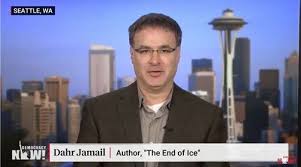
The End of Ice; Bearing Witness and Finding Meaning in the Path of Climate Disruption, Dahr Jamail,2019
Dahr Jamail
We are already facing mass extinction. There is no removing the heat we have introduced into the oceans, nor the 40 billion tons of carbon dioxide we pump into the atmosphere every single year. There may be no changing what is happening, and far worse things are coming. How, then, shall we meet this?
“The question is not are we going to fail. The question is how,” author and storyteller Stephen Jenkinson, who has worked in palliative care for decades, states, “The question is, What shall be the manner of our inability to care for what was entrusted to us? The Question is our manner of failing.” Jenkinson, who now makes his living by teaching about grief and the acceptance of death as an integral part of living, spoke eloquently about grief and climate disruption during a lecture he gave at Simon Fraser University in Vancouver, Canada. When he talks about our failure to care for what is entrusted to us, he is also saying that the time to change our ways is long past. Grief requires us to know the time we’re in,” Jenkinson continues, “The great enemy of grief is hope. Hope is the four-letter word for people who are willing to know things for what they are. Our time requires us to be hope-free. To burn through the false choice of being hopeful and hopeless. They are two side of the same con job. Grief is required to proceed.”
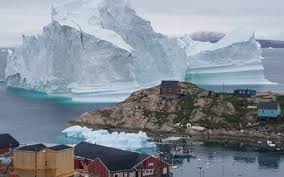
Accelerated Melting of Greenland Ice Cap
This short work is a world wide tour of glaciers, Bering Straight fishing villages, mountain tops, coral reefs, rain and other forests, while interviewing leading experts in the areas he visits.
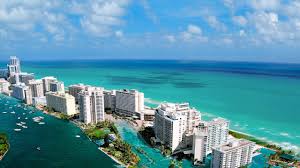
Miami Beach
In his chapter “The Coming Atlantis” he visits Miami and the Everglades. He meets an engineer who is raising roads in Miami Beach 2 feet while leaving all buildings and infrastructure alone. James Hansen points out that Sea level rise is absolutely non-linear. Hansen has a plausible 15 foot rise by 2100 and 10 foot rise by 2050. The entire of South Florida and its aquifer would be totally lost at 10 feet, as would Mumbai and many other large coastal cities and areas. One scientist living in south Florida is planning to retire to Washington D.C. He fully expects his South Florida home to be worthless by the time he retires. It is estimated that by 2100 75% of Florida homes will be underwater. Jamail thinks that only when homeowners fail to find mortgages or insurance for their homes will denial stop. Miami and Miami Beach continue to build high rise condominiums. Current estimates have 2 billion refugees from sea level rise by 2100.
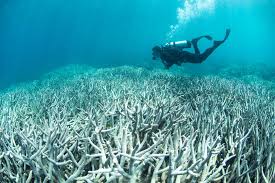
Global Coral Bleaching
In his chapter “Farewell Coral” Jamail points out that if the amount of human generated heat we added to the oceans between 1955 and 2010 were placed in the atmosphere instead, global temperatures would have risen by 97 degrees F. This added heat melts the polar ice and bleaches the coral. Because we know so little about the oceans we can only imagine the impact on sea species and their extinction.
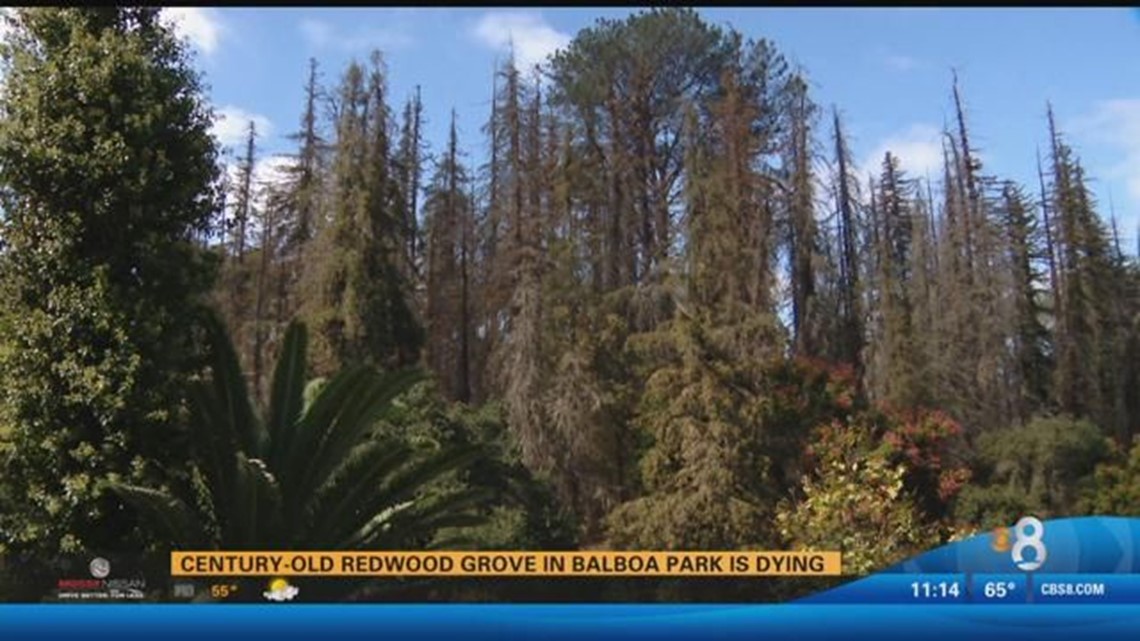
His trips to the forests finds even the redwoods succumbing to the changes as beetles attack them. As forests die they burn releasing their CO2. The Amazon rainforest will soon transit to net positive contribution to CO2 emissions. We can only imagine the mass extinction of species not yet discovered as the rainforests change.
Changing patterns of rain, flooding, and droughts worldwide will severely reduce our ability to grow our food. The inability to grow food locally is estimated to contribute another 2 billion food refugees by 2100.
A willingness to live without hope allows me to accept the heartbreaking truth of our situation, however calamitous it is. Grieving for what is happening to the planet also now brings me gratitude for the smallest, most mundane things. Grief is also a way to honor what we are losing.
Update June 21, 2013. In 2011 allegations of fabrication and misconduct were made against Mortenson and CAI. For a comprehensive summary of his book “Three Cups of Tea”, the 60 minutes expose, and Jon Krakauer’s findings see Wikipedia‘s entry.
.
Here is an update on the activities of Mortenson, the Central Asia Institute (CAI) and his self selecting “Dirty Dozen” following up on his previous Three Cups of Tea. Greg begins with an event from 1999 while he was visiting the Charpurson Valley. He had just met Sarfraz Khan, former mujahedin fighter with a disfigured hand who is making his living trading across the mountains into the Wakhan Corridor of Afghanistan (“no much success”) when they spot a group of 14 Kirghiz (nomadic Afghan) horsemen straight out of the 13th Century riding toward them. Their leader is the young son of the Kirghiz headman and he has heard that Mortenson is in the area and has ridden across the mountains to meet him and see if he would be willing to build a school for their children. Greg is so moved that he impulsively promises their school knowing full well he can’t go into Taliban controlled Afghanistan. It takes him ten years to keep his promise.
Video by Sarfraz Khan
Greg is so impressed with Sarfraz, who speaks seven languages and whose ancestors are Waki from the Corridor, that he hires him as his remote areas project manager. Thus begins what Greg calls the closest friendship of his life.
The promise of the school and the hiring of Sarfraz are the sort of impulsive decision making that make the CAI unique among NGOs. The other unique feature is their “last place first” philosophy, probably owing its origin to the first school Greg built in Korphe Pakistan a village so remote he first had to raise more money so he could build a bridge across a river in order to transport building materials to the village. Korphe was the village that rescued and nursed Greg after his failed attempt to climb nearby K2 and its headman Haji Ali is credited with Greg’s first and best education in the area (“After 3 cups of tea you will be friends forever.”). Haji Ali wanted a school for his grandaughter Jahan Ali, who became CAIs first high school graduate. The emphasis on girl’s education Greg acquired while growing up in Africa (where his father ran a hospital near Mount Kilimanjaro) and where he learned the expression “educate a boy and you educate an individual, educate a girl and you educate a community”. Greg has observed his girl students teaching their mothers to read and write proving to him the truth of this saying.
CAI offers scholarships to the smartest girls to continue their eduction. Once offered, these scholarships can be accepted at any time in the future. One girl was unable to accept a scholarship to become a health worker because of the opposition of the local headman. She married, raised children, and ten years later, the new headman asked her to accept her scholarship. She did, received her education, and returned to her village to help pregnant woman and their babies. Childbirth and infant mortality rates in her village fell to zero. She thinks that her own experiences as a wife and mother have helped her become a better trained health worker and she is grateful for the delay. This type of patience both by CAI and the students is one of the important lessons Greg has learned from his experience.
Wakhan Corridor
After 9/11 and the US displacement of the Taliban, Greg and Safran entered the Wakhan Corridor of Afghanistan and Safran began his education of Greg into Afghan “style“. Safran not only speaks the various languages of the area, but he adapts his accent to the specific region, speaking a fast, clipped Dari in Kabul, and slowing, softening, and rounding the language as he travels further into the Corridor until he morphs seamlessly into the next language of the region. He also adjusts his dress according to region and teaches Greg to follow him. Greg must have felt a little like Sir Richard Burton, the master of disguises. Safran also taught Greg about identifying the real decision makers during a Jirga (meeting of elders) just from their subtle gestures and body language. They develop close friendships with the leaders of the Waki and Tajik groups of the Corridor as well as the border security commander, Wohid Khan, who comes to their aid time after time. They build a series of more than 20 schools in the area. Safran also taught Greg the skills of avoiding kidnapping by never revealing your destination and changing transport frequently. This also assures that the driver is familiar with local conditions. They are constantly moving large sums of money from the Kabul bank to their remote schools to pay teachers, buy supplies and pay for construction. They are never robbed.
In 2005 the report that Americans had put a Koran down the toilet in an Iraqi prison set off riots throughout the Islamic world. NGO workers fled to Kabul and their offices and abandoned vehicles were destroyed. Greg stayed put as a guest in a house where he met for the first time the headman of the Kirghiz, Abdul Rashid Khan the father of horseman Greg and Safran had met in 1999. Abdul Rashid is returning empty handed from several months in Kabul where he had hoped to get help for his isolated people. Hamid Karzi made some half hearted promises which he had no intention of keeping. Abdul Radhid had spent much of his remaining capital to finance the trip. The government eventually sent one rusted out van to the Kirghiz who have no roads. Greg is able to again promise that CAI will build a school in Kirghiz so the old man can return home with some hope. The next day Greg traveled through scenes of destruction (the NGO offices) on his way to determine the fate of his nearby school. The school stood untouched because the village elders had stood in front of it explaining that the school belongs to the village. The rioters departed elsewhere. Greg credits the CAI strategy of making sure the local community takes full pride and ownership of their own schools with saving this school in the riots. The school was not viewed as international by the elders. Again on the NGOs, Greg comments that they insist on dressing in western clothes, drive the latest SUVs complete with nine foot satellite antennas, and generally just scream rich foreigners to the impoverished Afghanis. No wonder they find themselves targets of violence and resentment.
Greg is constantly approached by people wanting schools for their villages. Among those was the desk clerk at the Kabul guest house where Safran and Greg stay when in town. The clerk is a young Pashtun, Wakil Karimi, who grew up in Pakistani refugee camps and speaks several languages including English which is how he got the guest house job. Wakil persists about his school in visit after visit and Safran and Greg get to like him for his intelligence, energy, and persistence. They offer him a job as Afghan project manager and Safran begins Wakil’s boot camp training in Afghan “style“. Wakil’s village is in Taliban country but they visit and decide to let Wakil build his school once they see that the village elders really want it.
Azad Kashmir
Then, in 2005, a massive earthquake devastates much of Pakistani controlled Kashmir. The CAI rushes to the area to see what they can do. Most schools in the area have collapsed and many students have died. The CAI manage to get some tents for temporary schools and start traveling among their tent schools to give aid and pay the teachers. They can’t rebuild schools because people are on the move, farming terraces and drinking water springs have disappeared, the students are afraid to be inside buildings, and their usual stone construction would just collapse in the next earthquake. The CAI scrounged some PVC piping and found itself restoring water supplies so the girls could stop carrying water and return to school. This infuriated some NGOs who had lucrative contracts to restore water but CAI could care less. They just wanted to get their schools functioning again and the NGOs would probably never get the job done.
Greg is always emphasizing the importance of listening. His daughter asked him one day how the earthquake victim children played. Greg thought maybe they didn’t play at all so his young daughter launched a personal effort to round up jump ropes. Mothers joined in and soon he returned to Pakistan carrying hundreds of jump ropes. They were a big success in Kashmir and soon CAI is buying jump ropes locally. Greg starts thinking that while a couple of school have play fields (for soccer), none have a playground with slides, swings, and see-saws. CAI starts adding these to their schools. He relates a story on Bill Moyer’s Journal and in this book about a group of pro Taliban elders who come to see one of CAIs schools. They spend 30 minutes playing on the playground equipment and then started to leave. Greg asked them if they don’t want to see the school. They say no, they already decided they want CAI to build them a school like this one but they insist it must have a playground.
In another instance of listening carefully, Greg finally got one traumatized girl to relate the experience of the earthquake in her tent class. When Greg asked her why so few students had returned to class she said it was because there were no desks and it didn’t seem like a school. The students somehow associated having a desk with the learning and security of school. Greg immediately set villagers to work finding salvageable desks in the school’s rubble and building new ones. The students returned to school, some even without tents sitting under a tree once the desks were available.
Greg returned home to Montana to raise more money but Safran meanwhile uncovered some Chinese engineers in Pakistan who have experience building earthquake resistant structures in Xinjiang Province China. He arranges for the Chinese to design and fabricate three schools in Xinjiang, arranges transport for the materials from Xinjiang, and sets the logistics in place to compete the schools on site in Kashmir in only one month. Lastly, (after already committing CAI to the schools without authorization) he faxes Greg in Montana for the $54k needed for the schools catching Greg by total surprise. Greg takes the schematics for the buildings which are prefabricated from wood and designed to move in a quake to a civil engineering professor in Bozeman. they are to be assembled on a floating concrete pad which can also move in the quake. They are designed to withstand a magnitude 8.2 earthquake. The professor declares the designs sound and Greg gets CAI board approval, as always, to proceed. The schools are ready for occupation in 19 days. Just another typical CAI project.
Greg comments that they encountered very few NGOs in remote Kashmir but the extremists groups including the one that later bombed Mumbai were very effective at reaching the remotest villages and setting up madrasas, extremist Islamic schools often led by illiterate teachers who have memorized a little of the Koran. They feed most effectively on remote and ignorant villagers.
Greg and Safran are terrible at dealing with bureaucracies and are busy building schools throughout the outer regions of Afghanistan without any license or sanction from the central government. They initially tried to register CAI as a NGO with the government but quickly gave up. One official contradictorily claimed 1) there are already hundreds of schools in the Wakhan (there were none); 2) the Corridor is actually a part of China (never); and 3) no one lives in the Wakhan (there are three distinct ethnic groups in the Corridor, each with several thousand members).
Wakil took upon himself the task of getting CAI an NGO license. He spent a full month in the process, finally yelling and shaming the bureaucrats into stamping his final document. Unstated but implied is the refusal of CAI ever to pay a bribe to a government official even when it is clear all other NGOs have paid bribes to get their paperwork approved. CAI stretches their dollars and can construct a typical school and fund it for five years for about $40k. In this context, the cost of even a modest bribe would be intolerable to them.
Greg knows that some of the elders that support his schools make much of their income from poppies and the drug trade. He acknowledges that there are few other opportunities to make money in Afghanistan and praises those that give most of the proceeds back to the people in the form of low cost loans, seed, and other assistance. He regrets the some Afghanis become opium addicts, the cost of which further impoverishes them.
Greg discusses his strange relationship with the US military. He was initially opposed to the US military actions in Afghanistan while welcoming the removal of the Taliban from power, allowing CAI to operate to build schools in the country. As he saw it, a single US missile costing $850k could be used instead to build 20 schools which is a far more productive use of resources.
Then the earthquake struck in Kashmir and the US military loaned a number of Chinook helicopters from Afghanistan to transport supplies in and wounded earthquake victims out and Greg came to see the now popular crews in a new humanitarian light. The crews themselves, after Iraq and Afghanistan also came to see themselves in this new popular humanitarian light and liked it.
The other strange thing that happened was that military wives came across the Parade magazine article about the CAI and started reading “Three Cups of Tea” and discussing the book at their women’s clubs. Their enthusiasm spilled over and soon their husbands, serving or having served in Afghanistan started reading the book, particularly, counter insurgence soldiers. Pretty soon, “Three Cups of Tea” was required reading in counter insurgence academies. Greg discovered all this when forward base commander Christopher Kolenda asked if CAI could build a school near his base in Kunar Province. Kunar Province certainly fits the description of an “end place” but it is also Taliban country. Nevertheless, Wakil and Safran visit Kolenda then sat down with the village elders and decided to build the school.
Soldier Invites CAI to build school in Kunar Province
Thus began a major effort by CAI to build schools across the heart of Taliban country including Kunar Province and Nangarhar Province, the location of several Al Qaeda camps that includes the now famous Tora Bora caves where Bin Laden was thought to have hidden before slipping across the border into Pakistan. For one particularly vulnerable school they convinced a respected local Mullah to be headmaster. When warnings started appearing on the school, the Mullah went directly to Taliban leaders and convinced them to leave the school alone. They did. While CAI has had a little violence and threats at their schools, none have been damaged or closed unlike many other new schools that have been closed, students and teachers killed, and girls attacked with acid. Greg attributes the difference to the strong support the schools have had from the local elders and leaders. Even though CAIs schools are secular, they receive strong support from the local Mullahs.
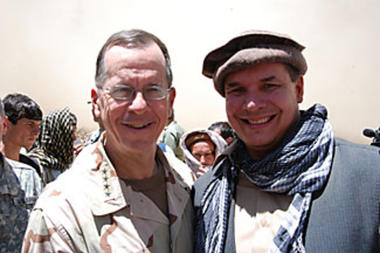
CAI has by now received widespread recognition. Great Britain’s Prince Charles and his wife, Camilla, visited one of the Kashmir earthquake resistant schools; Greg became the recipient of the Star of Pakistan the highest civilian award in Pakistan; Admiral Mike Mullen, chairman of the Joint Chiefs of Staff, opened one of the Panjshir Valley schools; and Gen. David Petraeus and Gen. Stanley McCrystal are both Mortenson fans.
Admiral Mullen with Mortenson
Greg quotes Mike Mullen to show how far the military has come:
The Muslim community is a subtle world we don’t fully – and don’t always – attempt to understand. Only through a shared appreciation of the people’s culture, needs, and hopes for the future can we hope to supplant the extremist narrative. We cannot capture hearts and minds. We must engage them; we must listen to them, one heart, and one mind at a time.
Quite a contrast to the usual nightly news Neanderthal general spouting nonsense about getting the bad guys like he’s playing some kind of video game, which incidentally, is how young military minds are recruited these days – through video games.
Kirghiz porting their school
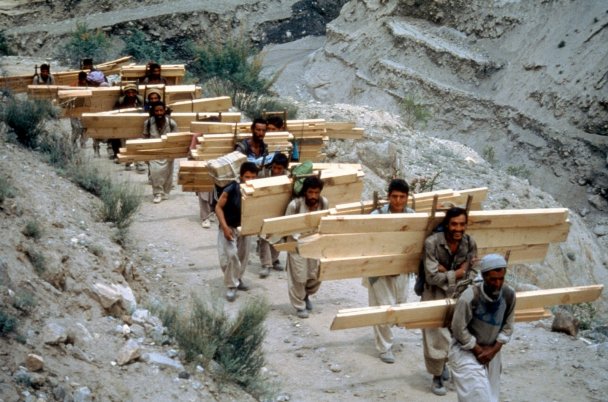
In late 2009 the nomadic Kirghiz finally got their school built on the very roof of the world at 12,500 feet. The logistics of getting materials and workers to the site required some miracle planning and an approach from three sides. Money and lighter materials like the door and window frames traveled across the Wakhan Corridor to the end of road where they were loaded onto Yaks for the three day journey to the site. Trained masons hiked over the mountain passes from the Charpurson Valley in Pakistan. A truck laden with cement, roof beams and other heavy construction material drove across Tajikistan to an old Soviet tank trail leading south toward a lake in Kirghiz. To get permission for the truck to cross Tajikistan, border commander Wohid Khan agreed to personally accompany the truck. From the lake, more Yaks and men transported the heavy materials the final 15 miles to the building site. Greg considers this his last best school even though illness has prevented him from seeing it. In fact fate has twice prevented Greg from entering Kirghiz. But after 10 long years, he has finally kept his promise.
For those wanting a good introduction of this region this book is one of the best. Greg furnishes a series of maps but it is hard to grasp the impact of all those massive mountain ranges. For a while Safran shuttled overland between Kashmir and the Wakhan Corridor to supervise his various building projects. Although the bird flight distance is only 200 miles. Safran needed to cross three different mountain ranges. For two he could drive CAIs 28 year old Land Cruiser across but for the third, into the Wakhan, he used his horse. His first horse died of exhaustion in 2006 and he acquired a new horse which is pictured in the book (They mistakenly identify the horse in the picture as the one who died, probably in the rush to publish. There are a few nonsense sentences in the book as well.). The most startling of the maps shows the ethnic distribution of the area (Pakistan and Afghanistan). There are 18 distinct ethnic groups shown here, one of which is “other” which implies there are even more groups. With the mountains and the ethnic diversity no wonder everyone is confused.
For an account of how the boundaries defining the various countries, including Afghanistan and Pakistan came to be and why Kashmir ended up in India (none of which has very much to do with ethnic boundaries) read the untold story of India’s Partition the tragedy that set off the chain of events leading to our current state. The “Great Game” between Russia and England, which contributed to the partition and boundaries predates the Cold War by a hundred years.
For a recent history of Afghanistan, the Soviet occupation, the CIA (Charlie Wilson’s War) and Pakistani intelligence backing of the Afghan mujahedin, followed by the abandonment of Afghanistan after the Soviet pullout giving rise to the Taliban read Steve Coll’s Ghost Wars.
A 350 page history of the Jewish people from Abraham, Moses, David, through to Zionism and today’s Israel is tough sledding for the reader. Cohen is American, doesn’t speak Hebrew, at one point claims he is Christian to be allowed into the Jerusalem old city, and writes with a strange mixture of empathy and puzzlement at the Jewish story and fate.
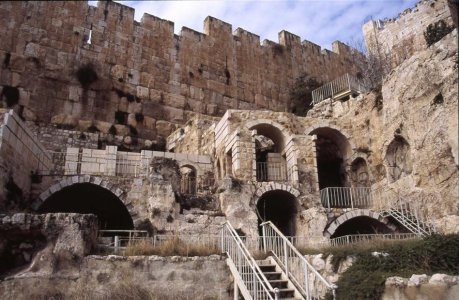
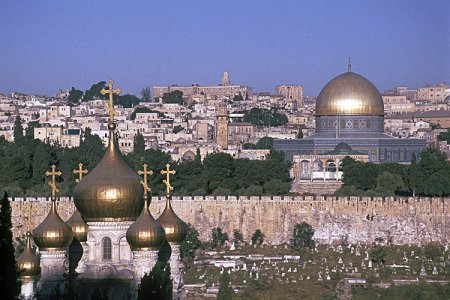
Jerusalem – Layers of History
His history is fleeting with special attention to the life arch of King David, from Shepard, to hero, to king, to wife stealer, (he sends the husband to die as a soldier), to sad old man yearning for his lost son. He credits David with the transition from wandering tribe carrying the Ark of the Covenant everywhere to building a permanent temple on the Temple Mount, thus fixing Jewish fate to a single geographic location. He also gives special attention to the Roman conquest and role of the warrior Jewish Zealots in the death and destruction of Judea including the second temple. The Roman built a temple to Jupiter on Temple Mount but within a few hundred years, the Caesars had converted to Christianity as had many Jews.
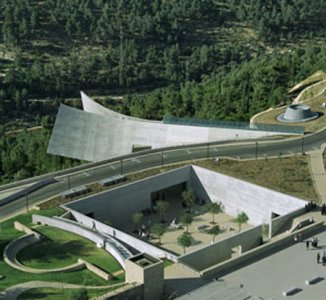
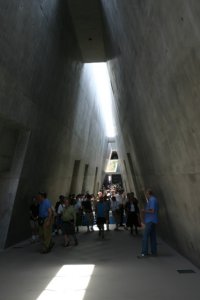
Yad Vashem Holocaust Memorial Museum
He discusses the 2000 year plight of the Jews with alternating pogroms, assimilation, ghettos, leading up to the Holocaust, which he says has been turned into a new religion with its own temples (museums now include Berlin and Washington) throughout the world centered by Jerusalem’s Yad Vashem, leading via Zionism to the formation of Israel.
He says after the Roman conquest, the Jews succeeded in turning the lost temple with its rituals into a book (or really several books) that they could again carry with them everywhere in their wanderings. Unlike the Ark, the book could be multiplied so every Jew could have his own copy wherever he went. He attributes the strength of the Jewish identity to possession of this book.
One interesting section deals with the rise of the notion of race which was intended to doom the prospects for assimilation since the Jews would never be considered Arlan even if they converted to Christianity. So, to counter the race argument, some Jews discovered a lost tribe of red headed Jews who for a short time around 700 AD ruled a small kingdom called Khazaria. But the concept of race somehow got buried deep in the psyche and today Jews are themselves very race conscience with their distinctions between Ashkenazi Diaspora-Caucasian Jews and Sephardic Jews from the Middle East, North Africa, and Spain.
He traces the origins of Zionism, the movement to return and create a Jewish state in Palestine to people like Disraeli, the first and only Jewish British prime minister and American journalist Mordecai Noah, or more interestingly, to German-Polish Jew Moses Hess who knew and shared a coffeehouse with Marx and Engels. Credit is generally given to Theodor Herzl near the end of the nineteenth century.
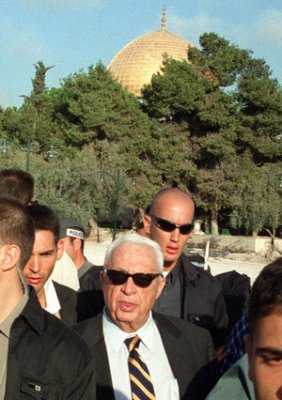
He traces the arch of the State of Israel through its key leaders and heroes, particularly warrior Ariel Sharon, hero of 1948, 1967, and 1973. He draws some parallels between Sharon and David and even Sharon and Moses. Sharon’s bold aggressive style of warfare finally came into disgrace in the 1982 Lebanon invasion following the Christian massacre of Palestinians in several refugee camps in Lebanon. In the final stage of the arch, we follow embittered Sharon as he leads a band of police to the mosque on the Temple Mount during Israel’s withdrawal from Gaza.
Ariel Sharon Visits Temple Mount
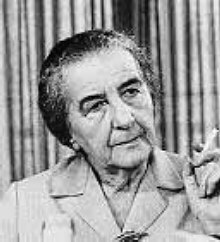
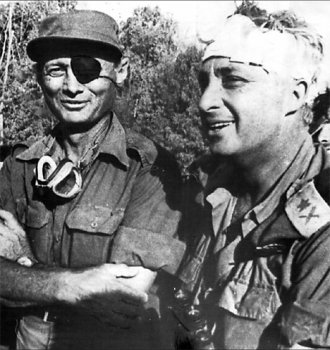
Most memorable are his stories of the 1973 Yom Kippur war which Israel almost lost. We see once heroic one eyed Moshe Dayan losing it when it appears Syria will prevail in Golan, ranting about the loss of the third temple and scaring everyone around him; we see tough Golda Meir taking a cigarette break to collect herself at the height of the crisis then calmly declaring “Let’s go back to work.”
Tough Mother Golda and her cigarette
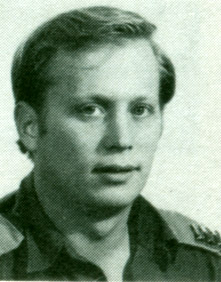
Force Zvika
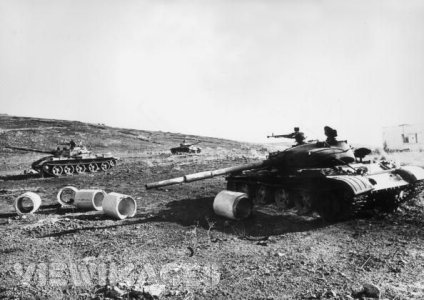
Then there is the amazing story of 21 year old tank commander Zvika Greengold, who commands the only remaining functional Israeli tank and enters the Hula Valley alone at dusk to try to hold off hundreds of assembled Syrian tanks until Israeli reinforcements can arrive. In an all night tank battle, without lights, Greengold maneuvered among and knocked out uncountable tanks and stopped the Syrian advance for 22 hours. He was aided by the fact that his aging tank was a Sherman the same that Syria was using, and that any tank he could find in the dark would be an enemy but the Syrian couldn’t identify him as an enemy. To confuse the Syrians further, he used his radio to command his “Force Zvika” tanks during the action. When reinforcements finally arrive the Israeli commander asks Greengold “Where is Force Zvika?” and he answers “I am Force Zvika”.
Dayan and Sharon during Yom Kippur War
The other Moses-like story concerns Ariel Sharon in the Sinai dessert in 1973. Two divisions of Egyptian soldier have driven the Israelis deep into the dessert where their advance is finally stopped. Some scouts report an incredible discovery; the two Egyptian divisions have left a gap fifteen miles wide between them. Sharon asks his timid commander Gonan for permission to drive through this gap to Suez. Gonan refuses but Sharon, of course, goes anyway. He gets to the Canal by morning and asks Gonan for bridges to cross. Gonan refuses again, so Sharon finds some derelict old landing craft and manages to get several hundred troops and equipment including tanks across the canal. The Egyptians awake to discover their supply lines cut (including water), Israeli troops camped a short drive from Cairo, and two divisions trapped in the dessert. An Egyptian MiG fighter attacks Sharon’s position and Sharon is wounded. Sharon is called back to Sinai for a meeting (shouting match) with Gonan with the result that reinforcements are sent to hold Sharon’s Egyptian position but not under Sharon’s command. Anwar Sadat is forced to negotiate a peace.
Jerusalem Epicenter of Western Religions – and Graveyard
He talks about visiting Israel and of the Jerusalem Syndrome which affects most visitors to the old city, possibly excepting Asian tourists whose culture is outside the Christian, Muslim, and Jewish traditions. Few visitors actually become psychotic but the effects of seeing all the layer upon layer of history built one upon the other and the sites that are central to the three major western religious traditions is somehow overpowering. One wishes that the entire city could be preserved as an international museum, protected from all the struggles and politics but of course Jerusalem is home to a diverse collection of people going about their daily lives, an idea inconsistent with the notion of museum.
The big dynamic today seems to be population, as the Arabs outproduce the Jews changing the political dynamic that would ultimately lead to an Arab controlled democracy. Cohen himself was criticized for being Jewish and for living in the safe US instead of returning to his Jewish homeland. If all American Jews emigrated to Israel (they automatically have Israeli citizenship) the population disparity would be instantly corrected and the Jews would dominate the country. This is the ultimate contradiction buried in the very concept of a religious state. It is something that Ataturk understood when he declared Turkey to be a secular state but that the Zionists and Ayatollahs of Iran have somehow missed.
This account of the rise and fall of Bear Stearns reads like a novel. It is even structured like a novel, opening in Part I on Wednesday March 12 2008 as Bear realizes it can’t borrow enough at the “Repo” daily market to make it through the week, starting a whirlwind of activity resulting in the sale of Bear to JP Morgan Chase (JPM) on Sunday March 16.
As the book opens, a full scale run on Bear has started with massive short selling, other firms refusing to back large trades, and massive investment withdrawals. On Thursday, fearing a systemic meltdown, the Fed, unable to lend directly to Bear, arranges to lend money to JPM who in turn will loan to Bear in an attempt to assure the markets that Bear would be able to borrow sufficiently to stay in business. The attempt fails to stop the run on Friday and unless the Fed and Treasury can negotiate a buyout, Bear will declare bankruptcy Sunday night.
This first part underlines just how shaky and unstable the financial markets are and is a good counterpart to the previously reviewed Connected: 24 Hours in the Global Economy which highlight the demise of Long Term Capital Management in 1998. Bear alone did not join the other 9 wall street firms who purchased LTCM positions to assure that LTCM’s demise didn’t blow up the entire financial system. Bear was widely resented for this refusal at the time.
The entire of wall street has become dependent for the past 30 years on short term borrowing through the so called “repo” market. Much of the borrowing is day to day so the entire of wall street is one day away from insolvency and bankruptcy. Banks have the FDIC to insure deposits, and the Fed discount window to assure access to short term money in hard times. Wall street firms have neither of these backstops. Banks are limited in the degree to which they can leverage deposits and assets; wall street is not and Bear ran itself leveraged to as much as 50 times their holdings. This means that any downturn or decline in asset value will require the borrowing of short term money or the raising of capital, at precisely the time that no one want to loan or invest.
Unknown firms and individuals were also massively shorting the stock then trading in the $60-65 range, betting that it would fall to $20-$30 within 8 trading days. Cohan believes much of the shorting was done by firms holding investments in Bear as a way of “hedging” their bets and limiting their losses if Bear continued to decline. Cohen says many believe Kyle Bass of Hyman Capital, who made a fortune betting against mortgage securities, triggered the run on Bear. To the outsider this betting both sides as a way to “hedge” the gamble of an investment seems strange but this has become a central feature of investing and dramatically increases the volatility of the system. When a firm catches a little cold, everyone jumps on to run the firm out of business by shorting its stock and can do so in a matter of days if the firm is massively leveraged.
When the extension of Federal credit did not stop the run on Bear, the Fed and Treasury went into overdrive to force the Sale of Bear by Sunday night. Only JPM was available and able to move this fast. JPM’s CEO Jamie Dimon had attempted to buy Bear a couple years earlier for Bank One and failed. The big issues were price and the unknown amount of toxic assets at Bear. The government agreed to buy $30 Billion in toxic assets but someone in government (widely believed to be Treasury Secretary Paulson, former CEO of rival Goldman Sachs and no lover of Bear) insisted on a price of $2 using a moral hazard argument that the stockholders should be punished for the problems of the firm. Unfortunately for JPM and Dimon, the negotiators – lawyers screwed up. Any purchase must be approved by a majority of the stockholders of the acquired company and this approval takes time. The agreement gave Bear up to a year to approve the sale and during this year JPM would guarantee all business and finance for Bear. Bear’s executives, reeling from the $2 price (they were led to expect at least $10) quickly realized that if they voted no they could give themselves up to a year for market conditions to approve and for a better offer to arrive, all under the umbrella of JPM protection. Dimon, when he realized his contract drafters mistake threatened to not honor the deal unless the contract was changed. He basically said, sue us, we’re not honoring this contract. It looked like Bear was headed for bankruptcy after all. In the meantime, the market also didn’t believe and $2 price and Bear stock started trading in the $10-$13 range. Dimon started buying as much stock as he could at market prices and Bear stockholders were happy to sell and avoid the $2 price until Dimon accumulated almost 50% of the shares. The vote, of course, approved the sale. The government also came down with a case of buyers remorse and renegotiated with Dimon so that JPM was liable for the the first $1 Billion loss in the $30 billion toxic asset pool.
Part II focuses on the three successive CEO s at Bear who built the company after WWII and set its culture (sharpest elbows on Wall Street). The first, Cy Lewis, was a former football pro with a volatile temper. He based his reputation on cornering railroad bonds during WWII when the government took control of the railroads to move war materials and railroad bonds fell to as low as 5 cents on the dollar. Lewis purchased all he could personally and became instantly wealthy when the bonds returned to par plus interest accrued after the war. The second, Ace Greenburg, was a canny trader who’s basic principle, learned from his father, was to never hold a loser. He also was obsessive about cost controls, at one time outlawing the purchase of paper clips and instructing secretaries to lick only one side of envelopes so they can be reused. He was a renowned philanthropist with a strange sense of humor. He paid for the remodeling of the restrooms at the Jerusalem museum and placed a plaque in each dedicated to his brother. He set up a charitable fund to provide Viagra to homeless vagrant men.
Ace was a pretty good bridge player and seems to have hired the third CEO, Jimmy Cayne, because Cayne was among the top 100 bridge players in the world. Cayne immediately used his bridge contacts, landing Larry Tisch, a huge investor for the firm. Unfortunately Tisch was Cy’s client at the time but Tisch insisted on giving his business to Jimmy. Cayne wanted to buy up NYC bonds as the city teetered on the brink of insolvency in 1976. Ace refused so Cayne went over his head to Cy who recognized the play as similar to his railroad bond purchases in WWII. The bond deal catapulted Cayne into the number two spot in the firm. Cayne eventually becomes CEO and the company went public but continued to be run like a partnership. The CEO at Bear is solely responsible for setting compensation each year and derives his power from this fact.
All three Bear CEO s had limited educations, limited business ethics, unlimited egos, and unlimited greed. They really don’t like one another. At one time Bear offered bucket shops like the one depicted in the movie Boiler Room. in return for handling trade settlement. Much of their sleazy reputation and many legal problems came from this activity though the LTCM decision didn’t help.
All three shared the same strategic goal; make as much money as you can any way you can. They developed a culture that is the antithesis of the MBA cultures at other firms. In Bear’s hiring, having an MBA is almost a viability rather than a virtue. Playing bridge well is a big plus for new hires and bridge seems to be about the only common pattern to the incompatible personalities at the firm.
Rogue Trader Ralph Cioffi
Part III looks at how the once successful Bear came to find itself driven out of business in two days in mid March 2008. Quite simply they gave free reign to their very own internally grown Roque Trader (Book and Movie about how one roque trader brought down Barons). Ralph Cioffi was a much loved smart trader at Bear, but he suffered from advanced attention deficit, meaning that the firm couldn’t count on him remembering much less documenting his trading activities. To compensate, Bear assigned a team of women to follow him around and get approvals and complete the legal paperwork required to record his trading activity. They were bad at this and most trade were done without approval and the paperwork was done after the fact. The legal liabilities of this problem were never explained to the women trying to do the work.
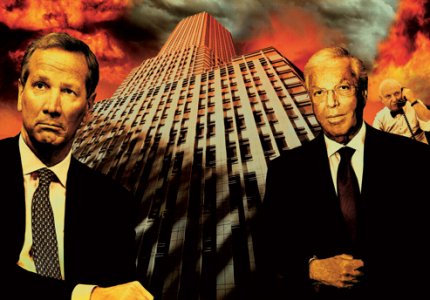
Schwartz, Cayne, Ace as Bear Burns
Almost half of Bear revenues come from the fixed income side of the business and Cayne organized Bear into two divisions each with its own president, Alan Schwartz, a specialist in Mergers and Acquisitions headed the division with all other business and Warren Spector headed the fixed income division. Five levels down, Cioffi is tasked with creating hedge funds to invest in mortgage backed securities. Unfortunately Cioffi runs true to form and by 2006 76% of his trades are made without prior approval but his funds are doing so well everyone covers for him. When it becomes clear that sub prime mortgages are a problem, he assures his investors verbally and in writing that his hedge funds have only 6% sub prime mortgage securities and that he is hedging these. Unfortunately his funds actually have more than 60% sub prime securities plus CDOs CDO squared and even more obscure investments and he is unable to hedge much of anything. After Bear, the parent company, became concerned that Cioffi was not getting approvals they ordered that Bear stop buying into the hedge funds. This resulted in the firm completely dropping any scrutiny the hedge funds might have received from other traders and watchdogs and risk analysts in the parent company. These hedge funds continued to generate massive revenues for Bear until fixed income accounted for 90% of total revenue. Bear stocks peaked in 2005 at $172. Only when the hedge funds turned in early 2007 did Bear come to realize that these funds contained some real problems.
Still, Bear had a year to live and get its house in order or find a buyer before the final run in March 2008. Cayne did nothing to find a serious buyer or to deal seriously with the toxic funds or to reduce leverage and increase capital. He was clearly over his head but would not step aside for a successor. As it turned out neither Schwartz (who finally became CEO weeks before the run) nor Spector would likely have been more successful in turning the firm around had they been given the time to do so. Cayne, in the middle of the crisis over the mortgage hedge funds, left town for a two week bridge tournament during which time he has unreachable. During a phone conference on March 12 dealing with the final run on the firm it was discovered Cayne had left the call to return to his bridge game. This guy was worth $1 billion at Bear’s peak in 2005 and couldn’t be bothered to interrupt his bridge game to try to save the company. Cohen mentions that Cayne reportedly pays world class bridge players $500,000 year to play with him bragging that it is like playing the pro am with Tiger Woods. These guys clearly live in a different world.
The epilogue covers the collapse of Lehman Brothers. This time David Einhorn of Greenlight Capital (another bridge player) was the major player to short the stock and start the run on Lehman. The executives at Lehman credit him with killing them. By this time, September 2008, the government had moved to take over Freddie Mac, Fanny May, and AIG. Like Bear, the Lehman crisis had to be resolved over a single weekend, only this time Merrill Lynch was in the same situation so the government had to deal simultaneously with two potentially disastrous failures, both much larger than Bear. Bank of America indicated an interest in both firms but at the last minute chose to purchase Merill. Barclays was interested in Lehman and negotiated an agreement in principle which had to be approved by British regulators. The British refused because of the unknown financial risks in Lehman’s holdings and Lehman was out of time to seek another buyer. They filed for Chapter 11. Barclays saw bankruptcy as an opportunity to pick up just those pieces of Lehman they actually wanted and did so. This saved perhaps 10,000 wall street jobs but left the toxic Lehman assets for the court to deal with.
Cioffi and Tannin
Ralph Cioffi along with his bosses boss Mathew Tannin, who Cohen says gave performances worthy of an Oscar instead were indicted on June 16, 2008 in New York on charges of conspiracy, securities fraud, and wire fraud.
The big shortcoming in the book is that it was written by a wall street insider who assumes the reader understands wall street terms and nomenclature. A tutorial for dummies should have been included in an appendix so the reader doesn’t constantly have to go to the web to figure out what he is talking about with his wall street shorthand.
The Boys of Everest: Chris Bonnington and the Tragedy of Climbing’s Greatest Generation, Clint Willis, 2006
In the current playgrounds of their sport, mountaineers learn what primitive people know instinctively – that mountains are the abode of the dead, and that to travel in the high country is not simply to risk death but to risk understanding it. Robert Reid Mountains of the Great Blue Dream
Books on climbing normally focus on the adventure, achievement, clashes among climbers, and tragedy. Or more recently, on the commercialization and destruction of the “extreme” sport where, for enough money, practically anyone can have an oxygen mask strapped on and be carried to the top of Everest. Good works exist on the lives of Anatoli Boukreev and Tenzing Norgay Sherpa and his family. But getting to know the climbers and what goes on in their heads in less common. It is precisely this inner dimension that Willis is adept at describing. During Bonnington’s first time on the Eiger Willis narrates:
He (Bonnington) took an hour to climb 60 feet. Ian (Clough) from time to time peered up at him and saw the rope still hanging free. They both knew that a slip here would kill them, but Chris knew this like a piece of news or history he couldn’t manage to believe. He put it well aside and got on with standing just so or tugging cautiously at a hold; his mortality shrank to a concept. And still his knowledge of the risk colored every action he performed, lending his movements and the stillness between them a deliberate and serious quality that awoke his desire for peace, for clarity.
On the direct Eiger route named for John Harlin who fell to his death when a rope broke, Willis writes:
Dougal (Haston) felt himself flotsam on the surface of something vast and deep…John’s death was a part of that dark scenery. Dougal felt a sense of urgent gratitude, almost painful in its intensity; he was alive with this task to perform…Dougal felt his isolation on the face. He liked the Germans; they grieved for Harlin without falling apart or expecting anyone else to do so. But Dougal was not like them…He could ignore the cold as well as his own spasms of grief and fear and the odd and somehow unfinished fact of John’s death. He would finish the climb whatever anyone else might choose to do.
Eiger North Face
Willis’ book includes an inner life account of the remarkable climb of Annapurna’s south face by one of the greatest teams of climbers ever assembled. To understand this feat compare it to the north face of the notorious Eiger which has a summit of 13,000 feet and is about 5900 feet above the valley below. Annapurna’s south face starts at about 17,500 feet and extends to the summit at 26,545 feet. Most of the climb is in the death zone.
Climbing in the Himalayas there is always the altitude, the thin air. Willis writes:
Peter (Boardman) was feeling the altitude without knowing it and he lost himself in games, in the twisted logic of dreams. He named the various knots cows and thought of the pitons as Americans. He gave a girl’s name to each of the carabiners that dangled from his waist.
After Doug Scott, Peter Boardman, and Joe Tasker had summited sacred Kangchenjunga, Willis writes:
They had been afraid to die on the mountain; now they feared a return to a world where such matters were misunderstood, where people thought dying mattered more than it did. They were afraid to leave behind the clarity of intention that had possessed them here. They were afraid not to know what to do. They felt uplifted and unworthy at once — they were drunk with confusion and joy and anxiety. They had come here and retrieved something. They worried that they couldn’t protect it, that they hadn’t changed and that they would forget.
Kangchenjunga
Completing this work featuring climbs from 1958 to 1985, the reader is surprised to realize that almost all of Boning ton’s boys have been killed in the mountains, one or two at a time. For each death, Willis imagines and narrates the last moments; what was the climber thinking as he fell, was buried, or simply quit. The most surprising account is the death of Peter Boardman, perhaps the strongest of all Chris’s boys at high elevation. Peter was climbing the northeast ridge of Everest with Joe Tasker in 1982, who had already suffered two strokes earlier in the climb. Willis posits that Joe slipped, caught himself, and suffered a final massive stroke which killed him. Willis speculates that Peter sat down briefly to grieve and never got up again. Peter’s body was found on the northeast ridge in 1992.
Chris Bonnington finally summited Everest for the first time in 1985 at the age of 50. Willis wryly notes that Chris had any number of Everest ghosts to help him up.
The tragedy of the title seems not so much all the deaths, although they are certainly tragedies for the families left behind, but that these young men cannot imagine life without the challenge of the climb; the new mountain, the new route, the lighter expedition. They keep returning until they die.
Their ever smaller teams of two to four climbers and Alpine style fast ascents without supplemental oxygen predicts the arrival of Anatoli Boukreev in the next generation; the solo climber able to tackle up to four 8000 meter peaks each season with virtually no equipment or support. And like them, Boukreev continues to return till his death. He simply can’t imagine any other life.
Grumble: Book editing is steadily deteriorating today and this book reaches a new low with entire sentences truncated or repeated on the next page (photo insert). The blame probably rests with an increased dependence on computer typesetting and grammar checking unaided by human proofreaders. The human reader doesn’t really need this added challenge.
Annapurna South Face, Chris Bonnington, 1971
Bonnington wrote this account and took most of the remarkable pictures in the book. Perhaps most remarkable is the folded photo in the back of the book of the south face with the climb route, camps, and elevations shown.
The northern boundary of South Asia is and has always been protected by a formidable barrier of mountains and ferocious tribes. This is the story of attempts by the British, primarily in the 19th Century, to learn more about the geography and trade possibilities of this fascinating region.
Knowing that white travelers could never survive in this region, the British Survey Office, located in Dehra Dun recruited and trained native spies in fine arts like learning to walk with a measured stride and counting their steps on prayer beads (modified from the normal 108 beads to 100) for measuring trekking distances; mercury thermometers and barometers for determining altitude, and sextants for measuring location.
These early 007’s were primarily gatherers of information for mapmakers, though each received a secret code name like NA, RN, PA, GK, GM, GNM, etc. They were given the honorary designation of Pundit, meaning scholarly or wise and were the model for Rudyard Kipling’s Kim.
The spies were often native and spoke the languages and were intimate with the cultures of their target territories. To avoid official discovery, they disguised themselves as religious pilgrims or occasionally native doctors. Some were lamas so the religious disguises were authentic.
We follow amazing journeys through Nepal, Sikkim, Bhutan, Kashmir, Afghanistan, Tibet, and even China.
The most effective spies were Pundit Nain Singh, Pundit Kishen Singh, Pundit Sarat Chandra Das, and the illiterate Pundit Kintup
Update June 21, 2013. In 2011 allegations of fabrication and misconduct were made against Mortenson and CAI. For a comprehensive summary of his book “Three Cups of Tea”, the 60 minutes expose, and Jon Krakauer’s findings see Wikipedia‘s entry.
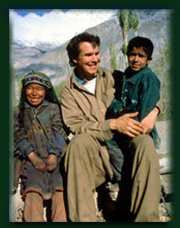
David Oliver Relin’s book “Three Cups of Tea” documents the life and work of Pakistani school builder Greg Mortenson. Mortenson is the son of missionaries who grew up in Tanzania where his parents built a teaching hospital. Mortenson climbed Kilimanjaro when he was eleven and became hooked on climbing. He became a nurse in the San Francisco bay area to support his rock climbing living in his Buick.
After rescuing a French climber during an attempt on K2, Mortenson got lost on his descent out of the mountains and ended up in the Balti village of Korphe not on his map. The village headman Haji Ali and his wife offered the hospitality of their own home while Mortenson recovered and Mortenson promised to build the village a school (emulating his parents and hero Sir Edmund Hillary).
Mortenson wrote an article about his K2 experience for a climbing journal where venture angel Jean Hoerni learned about Mortenson’s wish to build a school. Based on a single phone call (from a pay phone) Hoerni sent Mortenson a check (to a P.O. box) for $12,000. Mortenson bought materials for the school only to realize that the materials couldn’t be delivered to the village without a bridge. Mortenson met Hoerni at the annual Himalayan Association meeting where he was given another $10,000 for the bridge and $20,000 to live on so he could work full time on his school.
Hoerni died of Leukemia shortly after the school was finished leaving Mortenson $1,000,000 to build more schools.
When he had spent the money, Jon Krakauer “Into Thin Air” and “Under the Banner of Heaven” introduced Mortenson to the editor of Parade magazine who ran a cover story on Mortenson’s work. The article resulted in a deluge of letters and contributions, allowing Mortenson to continue building schools. To date Mortenson has built 55 schools in Pakistan and Afghanistan. Along the way, he turned down a U.S. military offer of surreptitious funds. Mother Teresa would probably have accepted the money.
Mortenson seems to have an instinct for surrounding himself with able associates. He has defeated two fatwa’s from fundamental mullahs using the Shia legal system. The first ruling came from Qom in Iran praising Mortenson’s (the infidel) work including the education of girls. The second ruling from Pakistan nullified the Fatwa and ordered the mullah to pay for the material his thugs had destroyed when they attacked a school under construction.
Mortenson provided an important source of information via his extensive contacts in the mountains of Pakistan after the recent earthquake. Greg Mortenson on the Pakistan Earthquake
Climbing peaks above 8000 Meters is a unique sport requiring a combination of luck and a natural ability to survive at these altitudes. Climbing skills are necessary but are secondary to these two characteristics. The recent explosion of interest in extreme sports as an ego enhancer is nowhere more misplaced than the attempts of amateurs with money to try to climb Everest and the other giants. This came home in a big way during the tragic climbing season in 1996 when several “guided” expeditions overstayed their summit efforts and were caught by a storm resulting in eight deaths including two of the expeditions leaders American Scott Fischer and New Zea lander Rob Hall. Accounts of this tragedy include Into Thin Air by Jon Krakauer a writer who was a part of Fischer’s group. Another account of the tragedy is found in High Exposure by David F. Breashears.
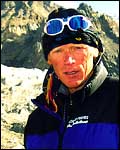
Krakauer criticized two of Fischer’s guides for climbing without supplemental oxygen; Anatoli Boukreev and Lopsang Jangbu Sherpa. Boukreev was deeply hurt by the criticism and wrote his own book of the events The Climb by Anatoli Boukreev and G. Weston Dewalt. In reading these works, I became fascinated by Boukreev. Who was he and why was he such a remarkable climber. Boukreev was a Kazakh born near 8000 meter peaks which always attracted him. He trained hard and became a member of the Soviet climbing team just before the collapse of the Soviet Union. Boukreev needed money and support to continue his climbing which ultimately led to his guiding expeditions. His extreme talent as a climber and his taciturn personality probably made him ill suited as a guide but he had little choice if he wanted to pursue his life’s passion. No one could climb with Boukreev. His specialty was speed climbing without oxygen. He still holds many climbing records including climbing two 8000 meter peaks in one day, and speed records for accents from base camp to summit for a number of peaks. On one legendary climb, he returned to his single tent camp on the descent only to find the tent occupied by another climber. Ever the gentleman, Boukreev, after drinking hot tea with the intruding climber, continued his descent to base camp. Between 1988 and 1997, Anatoli climbed eleven of the fourteen 8000 meter peaks without oxygen; four in a single ninety day period-establishing difficult technical routes as well as speed records. He died in an avalanche on Annapurna on Christmas day in 1997. His diaries were published in 2001 Above the Clouds: The Diaries of a High-Altitude Mountaineer by Anatoli Boukreev.
Also interesting and under appreciated are the many Sherpa mountain climbers starting with the legendary Tenzing Norgay Sherpa who first climbed Everest with Hillary. The ensuing widespread interest in mountain climbing has been a mixed blessing to the Sherpa who have been able to start schools and train generations of mountain climbers and guides. A special account of the Sherpa is found in Tenzing Norgay and the Sherpas of Everest by Tenzing, Tashi (Norgay’s grandson).


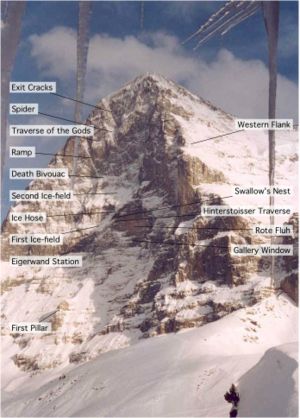 Eiger North Face
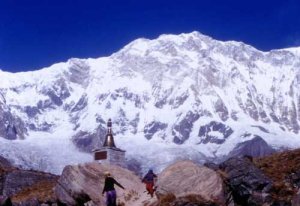 Annapurna’s Anatoli Boukreev Shrine
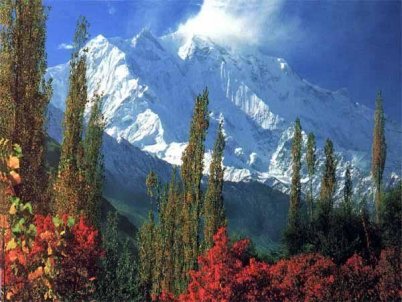
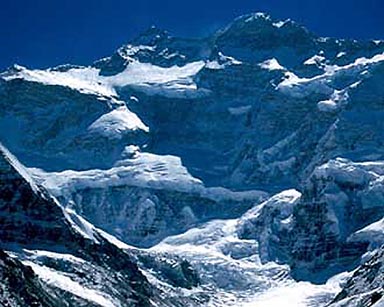 Kangchenjunga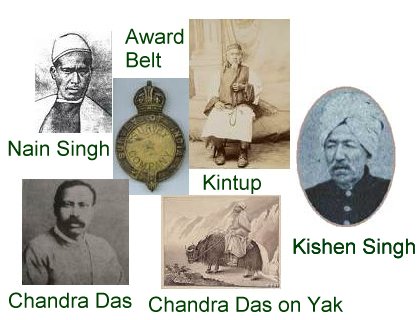
 and kids.
 Climbing peaks above 8000 Meters is a unique sport requiring a combination of luck and a natural ability to survive at these altitudes. Climbing skills are necessary but are secondary to these two characteristics. The recent explosion of interest in extreme sports as an ego enhancer is nowhere more misplaced than the attempts of amateurs with money to try to climb Everest and the other giants. This came home in a big way during the tragic climbing season in 1996 when several “guided” expeditions overstayed their summit efforts and were caught by a storm resulting in eight deaths including two of the expeditions leaders American Scott Fischer and New Zea lander Rob Hall. Accounts of this tragedy include Into Thin Air by Jon Krakauer a writer who was a part of Fischer’s group. Another account of the tragedy is found in High Exposure by David F. Breashears.