Frost in Love

May 26th, 2008

Fall of Frost, Brian Hall, 2008

A work of biological fiction where the author, choosing a few incidents and events of a very long life (89 years), imagines what Frost might have been thinking and how events may have shaped his words. Done with love and humor, but without the cooperation of the Frost estate, this novel brings us to understand and care about Frost as his several biographers have failed to do. Written as a series of vignettes randomly organized from the 1890s to 1963, we slowly are introduced to Frost, his wife Elinor, a high school friend who jilted Rob at one time, and their long suffering children.

Frost at Derry robertfrostderry.jpg

Early Elinor White elinorfrost.JPG

Frost Family frostfamily.jpg

Frost bought several New England farms but was a lazy, untalented farmer and Elinor a very casual housekeeper and mother. Both were spacey in the extreme. Frost quips that New England farmers have been failing for three hundred years so he is in a good tradition. They lost one child at age 3 and another after 3 days. Elinor aborted their final pregnancy over fears for her health. Of their surviving children, Margorie died at age 29, crazy Irma was finally committed by Frost but lived to 78, and suicidal son Carol (Why did you give me a girl’s name?) finally shot himself at age 38 within hearing distance of his own 15 year old son. Tough daughter Leslie, after her divorce, jointed the United States Information Agency (USIA) where she spent a career telling everyone in sight that the agency was doing everything wrong.

Frosts at Plymouth frostcouple.gif

Frost with Kay and Theodore Morrison 1948 kay1948.jpg

After the death of Elinor in 1940, Frost established a close relationship with a married woman that would last until Frost’s death. Frost claimed K was his lover but K never divorced and maintained the relationship was all in Frost’s mind, she was simply his secretary. At JFK’s inauguration, Frost was invited to read a poem. He was stumbling badly and couldn’t read his papers in the bright sun. LBJ tried to use his hat to shade the papers but Frost grabbed the hat and they wrestled for a bit. At the conclusion of the reading he misremembered the President’s name.

In 1962 Frost meets Soviet ambassador Anatoli Drobinin in whom he confides he is a great admirer of self made Khrushchev but is concerned with the tensions over Berlin and has some suggestions. Drobinin arranges a meeting with Khrushchev and 88 year old Frost flies off to Moscow (he hates flying). Frost becomes feverish and Khrushchev goes to Frost’s hotel. Frost tells Khrushchev he is the most powerful man in the world and that Frost really admired the moon shot and orbiting astronaut. Frost tells Khrushchev that the powerful should also be magnanimous and he should give East Berlin back to the West Germans as a sign of that magnanimity. Khrushchev doesn’t take the advise. When word drifts back to Washington JFK is furious. Frost returns home at the height of the Cuban missile crisis. He imagines the nuclear destruction of all mankind and it inspires new poems.

Frost spent year after year, at the end, giving farewell tours. These tours were so popular, that after his death a show with two actors playing the young and old white haired Frost was mounted to continue the farewell tradition. Ever the showman, Frost died on Ground Hog’s day 1963. Daughter Leslie and K secretly interred Frost’s ashes in an unmarked grave in the family plot. Leslie will lord it over Frost’s estate the rest of her life. Few of Frost’s letters show up after he dies, having been destroyed or lost by most of his children and K. Hall suggests, wickedly, that Irma probably ate hers.

Frost universally hated all critics and professors who “interpret” his work for their students. The only one he trusted as a critic was Elinor. He never liked the poetry of Tom (T.S.) Eliot and hated his army of thousands of (Wasteland) interpretive Professors. He was somewhat fonder of Ezra Pound and even assisted in getting Pound released from his asylum.

Hall himself is no slouch when it comes to words. Example of imagined thoughts of Frost:

Freud was a frustrated Novelist. His system is a form of Swedenborgianism, taking good metaphors and petrifying them into dogma.

Self reflections of Frost on his fame:

He’s been given jobs without duties, students without classes. Money has come mysteriously, from a secret fund, an anonymous admirer, a colluding collector. When he has hinted after prizes, committees have gone down on one knee to hand them to him. He, who played sick from school most of his childhood and never finished college, has been awarded so many honorary degrees he had the hoods sewn into a quilt, and at night he sleeps under it like a Celtic Pendragon warmed by the skins of his enemies. Each time he has hinted, connived, covered his tracks, hinted again, he’s got what he wanted, and each time he has felt guilty, and vindicated, and mean, and undeserving, and long overdue.

Frost proves a talented teacher, but a late bloomer in fame with his poetry. When recognition starts to come:

They want to press him while he’s impressive, screw him down in the frame. Principal of some stone institution, state commissioner for pickling souls. They’ll kill him with the best intentions. Run!

On longevity:

..Cannily wicked Dylan Thomas has succeeded in drinking himself to death…His soul and his stock rise, hand in hand. Frost’s own vanity, fiercely held is this, he will survive. The steeple is not for directing eyes heavenward, it’s for climbing, and Frost will remain at the top–partly by kicking, when he has to, other climbers in the face, but mainly, (so simple!), by not leaping off.

On his poem November:

What makes New England rich is its decay, its compost. Waste turned under. The waste of laziness! Which his grandfather deplored. But Rob’s laziness rotted and sprouted his poems. The practical crowd want to ignore the waste leisure and of pleasure, and the pacifist crowd want to ignore the greater waste of human hate, which maybe can be as lordly and creative as hate.

T.S. Eliot ts-eliot.jpg Ezra Pound ezrapound.jpg
On a conversation with the Younger Poet after his death:

This is hell. If you want change, go to purgatory. Tom and Ezra are there, vomiting up their undigested Latin. They’ll be ready for heaven in about a thousand years…I was great wasn’t I? It takes a moment for the Younger Poet to recognize this as a question. “Yes.” You hesitated.

Dog’s Life

May 19th, 2008

Ellington Boulevard, Adam Langer, 2008

Apartment at 523 Ellington Blvd 523-ellington.jpg

A cute tale of life in contemporary New York, particularly in Manhattan Valley, the upper West side between Central Park and Riverside Park at 106 St (now Ellington Boulevard). Deals with the lives of several interrelated people and one dog, named Herbie Mann. Herbie lives with Ike a black jazz clarinetist in an apartment building that he help rehabilitate in the eighties. For his help the landlord lets him stay in a nice apartment in the building for $350 a month for as long as he wants. No written agreement was ever drawn up.

Ike owns a priceless B-flat 19th Century Mueller clarinet. Ike has split from his funk band and is just returning from Chicago where he cared for his now deceased mother in her last months. He hasn’t played or written music for several years. The landlord dies and his lazy son, figuring the market is nearing its peak, starts selling all of daddy’s real estate including Ike’s apartment. Without a written agreement, Ike can’t do much.

George Washington Bridge from Riverside Park riverside.jpg

Enter the other characters, the buyer, whose father’s success as a jingle writer allows him to help his daughter buy the apartment for $650,000, and who has dropped out of graduate school to start her first job as assistant editor as a once prestigious journal, now in sad decline; her husband, for six years a PhD student and teaching assistant at Columbia who can’t get motivated to finish his boring dissertation; the turn around artist hired to save the journal who sets about firing everyone she can find but likes the buyer and promotes her to full editor; the investigative reporter who has been researching the fraudulent methods including phony subscriptions the turn around artist uses to “save” publications only to have them fail totally once she has moved on; the real estate broker who is a failed actor but successful real estate man; the Korean mortgage broker, a girl living in Fort Lee whose parent’s corner fruit stand is going bankrupt and who prays for continuing bad employment numbers so interest rates will stay low; the owner of a run down theater on the upper west side that is losing money and may need to be sold; the heiress who wrote and anonymously published a child’s fantasy novel as a young girl and who is currently studying writing at Columbia. The husband will fall in love with her and the wife will seek revenge by outing her as the author of the fantasy and then trashing it in a review.

Chapters are dedicated to advancing the story from the point of view of each character. Most interesting were the chapters from the point of view of the dog, Herbie, who Ike rescues from the dog pound when he hears Herbie’s perfect A-flat howl. Herbie has been dumped into the pound by one of the other characters in the novel and Herbie has a long memory.

Herbie does not fully sense the passage of time - to him, it seems to be almost all one moment of running and standing still, of swimming and dreaming, of happiness and despair. He is a puppy and he is growing old. Ike is here and he is not. Part of Herbie is still swimming toward Canada, part of him never escaped the shelter, part of him is still in Chicago, part of him is digging in front of a house in Croix-de-Mer, part of him has only just been born. He smells the present and the past - he smells the meadow and his mother’s breath, smells Chloe Linton’s perfume and Ike’s shirt, smells Lake Michigan, the grass in Central Park, and the steps at Stranger’s Gate the once led down to West 106th Street and now lead to Duke Ellington Boulevard.

St. Croix Island st-croix.jpg

Destiny’s Canal

May 12th, 2008

Path Between the Seas, The Creation of the Panama Canal, David McCullough, 1977

French Excavator french-shovel.jpg

Epic tale of the efforts of the French and Americans to create the long desired passage between the Atlantic and Pacific oceans. President Grant sent survey teams to find the best route in 1870 but nothing further was done by the U.S. to attempt to build a canal. Instead, the French, following their engineering and financial success at Suez, raised private money under the leadership of Ferdinand de Lessep, hero of Suez, who insisted a sea level canal be built in Panama. The French effort was under-funded and plagued with problems, not least of which was disease. Further efforts to raise money failed and the company was thrown into bankruptcy. Scandals at the highest level were uncovered with newspaper payoffs and political bribes but only Charles Lessep, son of Ferdinand, and one other minor player were ever sent to jail. The effort ended in 1889.

Teddy Roosevelt became President in 1902 and immediately set out to build the canal. He left it to Congress to decide the best route, although Nicaragua was assumed to be favored. Enter Philip Bunau Varilla, a French engineer of the earlier French effort and influence peddler William Cromwell who set out to convince Congress that Panama was the better route and that the U.S. should buy the French assets including rail and digging excavators at $109 Million. When it appeared they would lose, the French lowered the price to $40 Million and TR became interested, thinking this purchase would speed the completion of a canal. Two volcanic eruptions, one on Martinique and one in Nicaragua convinced Congress to vote for Panama.

Secretary of State John Hay (former private secretary to Lincoln (star with Henry Adams of Gore Vidal’s Empire ) immediately negotiated a new canal treaty with Columbia but after months of delay, the Colombian Legislature rejected the treaty in spite of the offered $10 Million immediate payment. Bunau Varilla, with Hay and TR working behind the scenes engineered a coupe in Panama with American naval support (gun boat diplomacy) so that Columbia could not land troops to regain control. TR asked his Attorney General to construct a legal defense for his actions, but Attorney General Knox replied:

Oh, Mr. President, do not let so great an achievement suffer from any taint of legality.

When TR trying out a defense during a cabinet meeting demanded “Have I defended myself?” Elihu Root responded:

You certainly have, Mr. President. You have shown that you were accused of seduction, and you have conclusively proved that you were guilty of rape.

TR at the Controls roosevelt-shovel.jpg

Bunau Varilla was named special envoy to negotiate a canal treaty and Bunau Varilla wrote a draft totally favorable to the U.S. Hay recognized Panama as an independent country, signed the canal treaty and Congress ratified the treaty immediately. Panama hesitated to sign until Hay threatened to pull the navy back. The $10 Million went to JP Morgan to hold for Panama who invested most of it in New York real estate. The French got their $40 Million. McCollough reminds us that American Imperialism was largely the result of purchases (Louisiana, Alaska, Philippines) and was never considered to be imperialist as a consequence.

Heroes of Panama were William Gorgas who understood the role of mosquitoes as carriers of Yellow Fever and Malaria and who headed the health and sanitation efforts that came close to eradication these two killers. He had previously done the same in Cuba. John Stevens had built the Great Northern railway, discovering the Marias pass and the Stevens pass, giving the Great Northern the lowest elevation trans continental route. Stevens immediately saw that the keys to Panama were eradication of disease and building railroads capable of hauling the excavation debris away from the cuts. He spent a couple years building housing, hospitals, harbors, and railroads before any major excavation could start. He resigned at this point.

Colonel George Goethels of West Point was then appointed as the virtual dictator of Panama. TR knew that the military man would complete his mission and not resign.

Digging the Culebra Cut
culebra_cut.jpg 1913culebracut.jpg

The choice between a sea level and lock and lake canal was not made until 1907. The canal was designed then to accommodate the Titanic, the largest ship of the time. The locks were 1000 feet by 102 feet. The size of the canal was to dictate the maximum size of ships for decades including aircraft carriers of the navy. Only the Queen Mary and Queen Elizabeth were too large for the canal. Modern oil tankers are far too large. The lock and lake design meant damming two rivers on the Atlantic and Pacific sides.

The dams had the side effect that electric power could be made available for everything in the canal zone and in the entire country. The canal pioneered electrical trains, locks, and much else. The Culebra Cut, a nine mile stretch at the highest elevation, was the biggest challenge given the massiveness of the cut and the continuous land slides. Even after the canal opened, slides would close the canal for months at a time.

gatun-construction.jpg gatun-lock_construction.jpg

The canal became a major tourist attraction while it was being built with hundreds of thousands of visitors. The canal opened simultaneously with the outbreak of WWI in 1914 and ceremonies were canceled. The first crossing was by one of canal’s own freight ships and was hardly noticed.

Club House panama-club-house.jpg

The physical and social structure of the canal zone comes in for detailed scrutiny with some suggesting the canal was actually a socialist system. It is probably more correct to look at the canal zone as a very large military base before the days of outsourcing with its rigid hierarchical structure and completely self contained infrastructure, even though most residents and workers were civilian and not military. In any event the canal zone was a model of efficiency virtually without corruption, nepotism, or fraud, a remarkable achievement. In this way, the canal zone stands as a shining beacon of American know how in sharp contrast to today’s Baghdad Green Zone where waste, nepotism, cronyism, fraud, and incompetence are the only way of life.

Osama Where art Thou

May 5th, 2008

The Bin Ladens, Steve Coll. 2008

This book seems to be almost a companion volume to the author’s previous Ghost Wars. That book was the account of the struggle over Afghanistan by the Soviet Union, United States, Pakistan, and Saudi Arabia without any consideration to the possible interests of Afghanis. Now we have a partial history of the Yemeni Bin Laden family whose patriarch Mohamed Bin Laden learned his way into construction at the same time that Abdulaziz Ibn Saud was consolidating his control and unifying what would become the kingdom of Saudi Arabia. The Bin Laden family kept relationships with the royal house of Saud by being useful to them. Mohamed established relationships with Addulaziz and his two sons and successors King Saud and King Faisal.

Salem Bin Laden 1975 salem.jpg

When Faisal and Saud asked Mohamed to mediate a dispute between them, Mohamed fained illness, explaining to his associates that the brothers Saud and Faisal would never hurt one another but anyone getting in the middle might well die. The Bin Ladens understood their place in order of things in a genealogically determined society. Mohamed’s sons and successors Salem and Bakr stayed close to king Fahd and were described by Coll as Concierges to the royal family. This is a polite way to put their role. Royal procurer is more apt. Still, the roles have paid off giving the Bin Ladens a steady stream of increasingly large construction contracts and they are among the wealthiest non royal families in Saudi Arabia.

This book gives a useful look at the tight family relationships of Arabs and the dictates of Islam as to multiple marriages (4 wives allowed - divorce is easy) inheritance (all sons get a share with daughters receiving a half share). For the Bedouin living on the edge of existence these rules allowed strong patriarchs to survive. In oil rich Saudi Arabia, it leads to an explosion of descendants (Mohamed had more than 50) and a population explosion.

The book is largely devoted to Mohamed’s oldest son Salem who became head of the Bin Laden family in 1967 when Mohamed died in a plane crash. Salem was educated in and comfortable with the west, a lover of aviation and of western women, and a popular party giver to the royal family. Extremely audacious, Salem is seen by the royal family as a kind of lovable, loyal court jester. In one instance, Salem bets King Fahd that he can propose to and marry his four western girl friends in one big get together in London. Salem loses the bet but later marries his British girl friend. He also dies in a plane crash in 1988. After Salem’s death, his British widow married a half brother of Salem to remain part of the Bin Laden family.

Mosque at Mecca and Prophet’s Mosque at Medina
mecca1.jpg medina2.jpeg

The Bin Ladens, both Mohamed and his sons, got contracts for restoration work on the holy shrines in Mecca, Medina, and the Dome of the Rock Mosque in Jerusalem. From the beginning, revenue from the Hajj, the pilgrimage to the holy sites which is the lifelong dream of every Muslim, provided a significant source of revenue to the Kingdom. As the number of pilgrims exploded to more than 2 million annually, facilities had to be greatly enlarged and expanded. The Bin Ladens even installed the worlds largest York air conditioning in the mosques for the comfort of the pilgrims. Because infidels are not allowed near the holy sites, the machinery was located several miles away so maintenance workers could access the equipment. Of the Hajj Coll writes:

The pilgrims all arrived at the same time of year and all went to the same places, Medina and Mecca, and more or less simultaneously. They arrived, too, in a heightened state of spiritual awareness, if not longing or near-rapture. On this heavily preconceived yet richly emotional journey, millions of Muslims discovered and judged modern Saudi Arabia. It was a process about as reliable as the one by which Saudis discovered America through vacations in Disney World and west Los Angeles. But it was no less true of powerful, in either case, for being incomplete.
Well-educated, globally conscious Hajj pilgrims from poorer Muslim countries such as Egypt or India sometimes resented Saudi Arabia for two reasons; its garish, wasteful nouveau wealth, and its intolerant religious orthodoxy.

So where is Osama in this tale? It seems not much is known - knowable about him. Most of the information we have which finds its origins in American “Intelligence” is wrong. Osama is a younger son of Mohamed and a poor 15 year old Syrian girl Mohamed married probably to land a construction contract. He divorced her again within 3 years. Unlike his educated (both in Europe and America and the best schools in the middle east) brothers, Osama is a mediocre student with a Jeddah (Saudi Arabia) high school education. While in high school, he is targeted by the Muslim Brotherhood, probably because he is a member of the wealthy Bin Laden family. He never studies engineering but becomes a radicalized Muslim. When the brothers try to involve him in construction contracts in the holy cities, Osama proves to be a bad manager, and while quiet and polite, when he does talk, he seems to create friction and problems with his extreme religious views.

The family sends him off to Peshawar Pakistan to funnel charity donations to the Afghan cause during the Soviet occupation. Salem often acts as currier carrying bags of money for Osama to distribute. Osama wants to join the action and asks Salem for arms. Salem looks but is unclear what he finds for Osama. In Osama’s only significant military engagement on the Afghan border, 100 of his fighters are killed. While a military disaster, Osama films the whole thing and turns the result into a propaganda film with himself as star.

After the Soviet withdrawal, Osama returns to Saudi Arabia offending everyone in sight. He suggests to the royal family that they should allow Osama to raise an army to chase Sadam Hussain out of Kuwait rather than allow infidel Americans onto Saudi soil. The royal family tells the Bin Laden family to shut Osama up but they cannot so the Sauds pulled Osama’s passport and deport him. He chooses Sudan, one of the few countries willing to accept him. Bakr, now head of the Bin Laden family, sorts out inheritance issues in the family and Osama chooses $15 million in cash and small continued holdings in Bin Laden businesses.

Osama invests and loses most of this money in bad business deals in Sudan. Osama takes credit for blowing up two American embassies in Africa and the US pressures Sudan to exile Osama yet again. They do, and Osama returns to Afghanistan where he promises $10-20 million annually to the Taliban to give him asylum. It is unclear if he ever gave the Taliban financial support but he did build Mullah Omar a new family compound.

The idea for the plane bombing in the US probably originated with Khalid Sheikh Mohammed uncle of Ramzi Yousef, the man who bombed the World Trade Center in 1993. Osama revised the plan to scale it back from 10 planes and to cast himself as the star.

Strangely, there is no mention of Osama’s health issues in this book. After 9/11, the American public was media fed the image of this tall guy running from cave to cave with a dialysis machine strapped to his back. Could Coll find no verifiable evidence of a health problem or did he simply think it wasn’t worth mentioning? Is this more evidence of invented intelligence like Osama’s wealth? Coll should have said something.

Both Mohamed and Salem Bin Laden died in plane crashes. Osama is unlikely to follow suit. American intelligence, after greatly exaggerating Osama’s Wealth ($300 million reported in the press up to $500 million) now set out to find the new sources of his money. This is a bit silly since the African embassy bombings are estimated to have cost only $10,000 and the 9/11 airline bombing to have cost only $100,000. Rich Saudis including Kings are known to drop several millions in a single night of gambling. The focus of this effort fell, of course, on the rest of the Bin Laden family. No connections or money flows have been discovered. The Bin Ladens continue to thrive in the construction business, being awarded a $1.6 billion contract for prisons in 2006. Osama has apparently not damaged the family reputation with the house of Saud.

This book, like Ghost Wars was hastily edited and is full of nonsense sentences and misspellings. Still, it gives a glimpse of Saudi Arabia, the house of Saud, and the role of the Bin Laden family within the kingdom. It is disappointing when it comes to Osama. Beyond debunking some of the false information about Osama, it sheds little light on this enigmatic, fanatical figure. We don’t understand him any better now than before.

Bush Monarchy

April 28th, 2008

Nemesis, The Last Days of the American Republic, Chalmers Johnson 2006

Asking whether the U.S. will go the way of Rome or of Britain who “voluntarily” divested itself of its empire, Johnson completes his doomsday trilogy (The Sorrows of Empire and Blowback). This volume, while published earlier, makes an excellent companion piece to Naomi Klein’s Shock Doctrine. Where Klein explicates the Chicago school-Adam Smith-Neocon creed explaining the intellectual basis and beliefs behind our bewildering current mess, Johnson provides the indisputable facts and figures of our current situation in condensed 280 very, very depressing pages.

Fort Baghdad Embassy iraqembassy.jpg

On Iraq, Johnson explains that the covert (i.e. real) reasons for the war were to secure permanent military bases in the Middle East and to secure a reliable source of oil. He says that the U.S. military will try to hold four military bases permanently in Iraq no matter what (perhaps in defiance of a new President?) including the green zone and airports where the U.S. has built hardened, permanent facilities and the world’s largest embassy on 104 acres built at a cost approaching $1 Billion. The green zone has its own power, water, and all utilities. Ironically the headquarters for the elected government of supposedly sovereign Iraq is located inside a U.S. fort! The other critical bases the U.S. military will hold onto are located next to the oil fields of course. He concurs with Klein that allowing the looting and destruction of priceless cultural artifacts and archaeological sites in Iraq was a deliberate act by the neocon Bush administration.

To tamp down violence in Iraq, at least until Bush is out of office, the military has resorted to bribing the different factions. FrontLine recently reported that Muqtada al-Sadr was given $300 million for assurances of a cease fire from his Shia Mahdi Army. That would have built a few schools and houses in New Orleans.

He notes that while Bush made the CIA the fall guys for the failure of intelligence leading to war with Iraq and largely dismantled the CIA intelligence gathering function, covert operations at the CIA are stronger than ever. He says that the intelligence role of the CIA has always been to tell the President what he wanted to hear, not to provide independent actual intelligence. He also points out that every President since Truman (i.e. since the founding of the CIA) has used the agency for covert operations. Add to the CIA covert operations, the black ops portion of the Defense Department budget and you have a huge well funded establishment beyond the scrutiny of the public or of Congress.

In Blowback, Johnson explained why various terrorist acts such as the African Embassy bombings, the Cole attack, and even 9/11 were in retaliation for U.S. activities the American people know nothing about because the U.S. acts are kept secret. The Freedom of Information Act (FOIA) was passed in 1966. In 1974, in response of Nixon’s use of the CIA and FBI to spy on Americans, the FOIA was strengthened. Much of the information we have today about the secret activities of our government comes from the courts upholding FOIA requests. Even with extensive redacting (blacking out portions of the documents) much information can be gained from secret documents. The Bush administration first had a policy of complying as slowly as possible to FOIA requests and then instituted a prohibitive price of $372,999 for each search.

Until Bush, Presidential records were released to the public 12 years after the President leaves office. Bush changed this in 2001, just as key Reagan era documents were set to be released, perhaps to protect his father who escaped the Iran Contra mess largely unscathed. Now Presidential records will only be released when authorized by both the current sitting President and the former President, if still living.

Johnson gives a laundry list of countries (very long) where the CIA has interfered with, assassinated, or propped up authoritarian governments believed to be anti-Soviet. He details the CIA role in the 1973 overthrow of the democratically elected Allende of Chile and military takeover by the torturing dictator Pinochet. He also details the role of the CIA in funneling money and advanced weapons via Pakistan to the Muhajadin fighting the Soviets in Afghanistan.

CIA 737 leaves Majorca Spain - Protestors in Shannon Ireland
cia-majorca.jpg <> shannon-cia.jpg

The most entertaining (if this is the right word) portion of the book was his discussion of the activities of amateur plane spotters, whose hobby since WWII has been spotting and recording the activities of military and private aircraft around the world. The internet now provides an almost complete and accurate record of the landings of all private planes anywhere. When Sweden broke the story of a special rendition (arresting two Egyptian refugees and handing them over the CIA at a private airport to be flown to Egypt), this database was used to identify the plane used in the rendition and to trace the travels of this same plane throughout the world over time. The plane was owned by a fictitious company with fictitious owners but with a P.O. box near Langley. Once outed, the plane’s ownership and identification numbers were changed, but the plane could be instantly identified from its manufacturers identification number and the tracking continued. The entire fleet of CIA planes was identified in this way and with them a complete picture of renditions; which countries cooperated in the arrests; where the prisons were located; the magnitude of the effort. The CIA seems to have been totally oblivious to this amateur network and its worldwide resources. The network estimates the number of people grabbed as more than 3,000. The victims simply disappeared either to be killed or tortured for information. The outstanding work of this amateur network at outing CIA’s fleet and tracking renditions sounds like the material for a movie. The administration and CIA strongly believes they have stopped terrorist attacks in Europe and the U.S. with this program. That this activity violates the rights of many innocent individuals and violates the laws of virtually every nation involved doesn’t matter in the least. Hearing the term for the first time one wag said special rendition sounds like something Pavarotti would do before a small audience.

collateral_iraqgirl1.jpgcollateraldamage2.jpg

Johnson decries the growing insensitivity of Americans and its media to innocent civilians being slaughtered by our military in bombings and ground assaults. No one counts the number. They are seldom reported and incidents are known by the Administration, the military, and our own media as collateral damage. Its as if we are to believe these death are unavoidable accidents instead of the direct result of U.S. military action. In the unlikely event the military ever accidentally destroyed a nuclear armed missile launched from the middle east, the weapons could fall anywhere in the region including Europe. The military still refers to the catastrophic potential results of such an incident as collateral damage.

Johnson really hits his stride when discussing the ever growing number of military bases occupied by U.S. forces throughout the world. The new trend is for smaller bases located closer to potential hot spots such as two islands off the coast of Venezuela where we are positioned to instantly take out democratically elected Chavez. He uses Japan with which he is most familiar to discuss the effects on the occupied country of these bases; the raping, the pollution, the damage, the noise of an insensitive military. He says the public and the military have no understanding of the ill feelings caused by all these bases (800 plus the actual count is unknown even by the military) and the damage to our reputation in the world. Japan is spending $7 Billion of its own money to help the U.S. build a new base on Guam to remove at least some occupiers from Japan.

He then turns to star wars, the ultimate military spending boondoggle. He explains that even a small military incident in space could pollute the orbits with so much junk that all satellites would be forever unusable with crippling impact to the economies of the world. The Air Force is currently running a “recruiting” ad on television showing just such an incident in space. He talks about the air force monopoly over GPS which is now indispensable both for military and civilian use. The air force currently reserves the right to shut down a region of GPS at their own discretion. The Europeans are so concerned about the air force monopoly on this critical resource, that they have funded Galileo a competing higher tech system which was to have gone online this year. When Bush threatened the Europeans to stop this deployment, the threat backfired and funds and new countries rushed to join the Galileo network. Recent setbacks may delay the start of Galileo until 2014 however. We only hope Galileo doesn’t go the way of Motorola’s Iridium satellite telephone system that was delayed so often it was obsolete by the time it was introduced.

The Imagined North Korean Threat
north_korea_missiles.jpg
And the American Response (Why is Putin worried?)
ABL abl_one.jpg GMD Test gmd-test.jpg

After WWII the military and military industrial complex greatly exaggerated the cold war Soviet threat so they could continue to expand defense budgets. After the collapse of the Soviet Union, the government toyed with the idea of making China the new evil empire. Neocon interests in trade and investment with China defeated this idea and instead they invented a new threat using poor North Korea. Much of the justification for the anti ballistic missile program lies with the idea that North Korea or another rogue state could acquire and use nuclear armed ICBMs. The military is fully aware that all their proposed programs are useless against the latest Russian build ICBM but might have a chance at a Korean ICBM (actually two antique Russian scud missiles strapped together. The last one the Koreans tested barely cleared Japan.) So the military is cynically spending billions to build weapons systems they know won’t work to address threats that don’t exist. The most ridiculous of these weapons and the most costly is the megawatt laser to be mounted in a 747. Even if the laser worked (it doesn’t) The 747 has to fly so close to its intended target that it can easily be shot down by simple existing ground to air missiles costing next to nothing. What matters is not the practicality of the weapon but the money required to build it.

The reason this all works is that the military and military industrial complex is spread throughout the entire country. In each congressional district with facilities and plants, the industry simply buys a congressman who, in return for election support and a guaranteed lifetime job when they leave Congress, will vote for any appropriation proposed. A quid pro quo agreement means that I vote for your district’s appropriations if you vote for mine. To suppress public outrage, Congress hides more and more appropriations in special earmarks and outright black ops budget items. The public is kept in line through fear (terrorism, nuclear armed rogue states, etc.) and Johnson refers to Bush as “Fear-Monger-in-Chief“. The system is thoroughly ingrained and, under Bush, totally out of control. We are guaranteed to bankrupt our system if the trend continues. As it is, the deficit limits must continually be raised. China and Japan are the two biggest holders of this massive budget debt. The system is totally corrupt and will lead to the downfall of the entire government if it continues. In summary:

The iron triangle of the Air Force, Congress, and the military industrial complex, sanctified by high tech jobs it offers to American workers, is driving our country toward bankruptcy. For some it is tempting to continue the lucrative practice of buying arcane space technologies that do not work - missile defenses, for example, simply because it keeps people employed. Meanwhile our democracy is undercut by members of Congress who use the lavish “campaign contributions” they receive - bribes by any other name - to buy elections. The only public service these bought-and-paid-for Congressmen attend to is providing a legal veneer for munition makers’ unquestioned access to the tax revenues of the government.

Johnson talks briefly about Keynesianism, where a government is justified in instituting spending and employment programs to level the business cycle. His theories were put to large scale successful tests by FDR in the great depression with works programs in the parks and the building of roads and dams. Keynes believed that military spending and employment could also be justified in times of recession and depression. The problem with a Keynesian justification of our current boondoggle military spending is that the military spending is totally insensitive to the business cycle - it only ever goes up through boom and bust.

The King Makers
bush-v-gore.jpeg supreme-court-bush.jpg

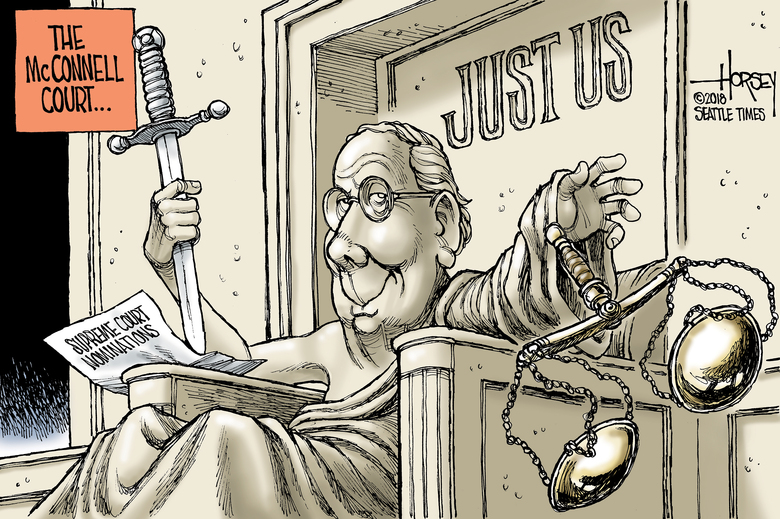
The President’s constitutional job is to carry out the laws passed by Congress. When Clinton tried to veto single line items in a legislative bill, the Supreme Court ruled this was unconstitutional. The President must either sign or veto a bill in its entirety. Bush instituted a new approach called a signing statement wherein the President reserves the right not to enforce provisions of a bill with which he disagrees. In a Bush stacked Supreme Court, who after all appointed his majesty in the first place, the signing statements have not been challenged. Bush used a signing statement to gut John McCain’s 2005 anti torture provision. Bush disagrees with it and refused to enforce it, end of discussion. With this simple devise, Bush has totally undermined the separation of powers and has rendered Congress virtually powerless.

Another terrible precedent of the Bush era is the extensive use of the low level fall guy. Torture at Abu Ghraib came to light with the leaking of photographs to the press. The ACLU was able to get ahold of key documents establishing responsibility for torture at the prison through FOIA lawsuits. Today we have a picture of the all the leading White House officials sitting around a conference table in the White House discussing torture. Who was prosecuted? The top official held accountable was Brigadier General Janis Karpinski, a woman and reserve officer who was briefly in charge of all U.S. prisons in Iraq. She received a reprimand and was demoted to colonel even though she clearly was not an instigator of the torture program. Johnson asks what does this do to a military command structure? As a soldier do you blindly carry out the commands of your superior officers even if you think they are illegal? Why weren’t officers and officials at the highest level held accountable if the commands were illegal? Does a soldier need to consult a lawyer before obeying orders in the future?

To be fair, Bush has used higher level fall guys as well; Scooter Libby, John Ashcroft, Donald Rumsfeld, and Alberto Gonzales are prominent examples.

What a depressing picture. A Congress bought and paid for by the weapons makers. A President with a total disregard for the American Constitution. A Supreme Court who appoints a monarch and stands ready to do his bidding. The only bright spot Johnson can see is that there is unlikely to be a military coup for two reasons; The generals have very good lives with absolute security and luxury as it is and second, the soldiers may now refuse to follow orders if those orders are seen to be illegal such as overthrowing the government. OK, I know, but this will have to stand for optimism in an otherwise totally depressing account.

Numbers Man

April 21st, 2008

Collapse, How Societies Choose to Fail or Succeed, Jared Diamond, 2005

Three Gorges Dam China threegorges.jpg

Diamond is a Professor at UCLA specializing in evolutionary biology and bio-geography. This book looks at man’s effects on the environment today and in the past. He is interested in decisions that cause some societies to collapse and others to sustain themselves successfully for thousands of years. The book’s blurbs and Diamond himself try to give reason to hope, but the facts and figures of the situation in the modern world are pretty depressing reading, particularly the discussion of modern China. But Australia is pretty depressing reading as well. And I skipped altogether reading the chapters on Rwanda and Haiti.

Haze over China hazechina.jpg

His central thesis seems to be that some people in the past have made enlightened decisions, some by highly centralized governments like Japan, and some by highly decentralized systems like New Guinea. He also finds optimism in some corporations who find economic reasons to act responsibly in the environment to avoid the massive cleanup costs of destructive mistakes. He sites a Chevron subsidiary (since spun off) that is such a model of environmental stewardship in New Guinea that their project is, in effect, the countries largest and most successful wildlife preserve. Of Chevron’s and Shell’s project in Nigeria, Diamond says merely that the project is older and the government of Nigeria is corrupt.

Shell Nigeria Oil Spill shell-nigeria.jpg

His discussion of the Bitterroot Valley south of Missoula in Montana was extensive. It seems that Montana, which has fallen to one of the lowest income states in America is now best suited for fat cat vacation homes such as those of Charles Schwab’s 2600 acre Bitterroot Stock Farm, 125 home sites with 6,000 sq ft million dollar homes of in a gated community. The only contact with the local population is when the fat cats show up at a local bar to enjoy the Montana Western fauna. Ted Turner’s buffaloes are elsewhere in the state. Is this a success or a failure? Preserve the environment for the wealthy?

bitterrootvalley.jpg stmary.jpg
Bitterroot Shack bitterrootshack.JPG

Gated Mansion in Bitterroot Valley dalymansion.jpg

His reasons for optimism at the end are a little strange; e.g. we could have been hit by a huge meteor over which we have absolutely no control, instead of the current man made disaster. If man did it, surely man can undo it. Really? It seems that man’s impact and control over the environment is why we are in this mess to begin with.

Okie Song

April 14th, 2008

Harpsong, Rilla Askew, 2007

Hohner Harmonica hohner.JPG

Harlan Singer is a part Cherokee musical hobo who unlike Woodie Guthrie, cannot seem to get very far away from Oklahoma. Harlan, taught by a black shoe shine boy, he plays the harmonica and can imitate almost any sound in nature from birds to wind, is always creating new songs with new lyrics to describe what he sees. He wins the heart of a fourteen year old Oklahoma farm girl, Sharon, and together they jump freight trains to Hoovervilles throughout the Midwest. Unlike Steinbeck’s Okies, they never get to California.

Riding the Rods rail_rods.jpg
rail_tramp.jpg

Hooverville hooverville.jpg

Harlan is looking for Profit, a bible spouting old man Harlan is indebted to in some unknown way. They return to Oklahoma time and again to look for Sharon’s family who have moved on when their farm is foreclosed, and to visit Calm Bledsoe, the Cherokee trapper (the Cherokee were relocated to Oklahoma from the Great Smokies Mountains of Tennessee - North Carolina see) who is Harlan’s only friend and confidant. Set in the depth of the great depression we revisit the farm foreclosures and bank failures, the useless miner’s strikes, and the dust bowl.

Dust Bowl dust-storm.jpg dust_car.jpg

Written alternately from Sharon’s and Harlan’s points of view, with occasional visits to the folk legends they become, we get a real sense of time and place.

Fog of War

March 31st, 2008

day, A.L Kennedy, 2008

Legendary Avro Lancaster Bomber lancaster11m.jpg

Wonderful writing from Glasgow’s master novelist. The main character, Alfred Day, has grown up in the home of an abusive father and abused mother. To escape, he joins the RAF in WWII. Because of his diminutive size , Alfred becomes a tail gunner on a Lancaster bomber, where he can fit in the tiny tail gun turret. His bomber crew becomes his family as they set out to survive the war (30 missions required).

Typical Lancaster Bomber Crew bomber-crew.jpg

1941 Lancaster Showing Tail Gun Turret lancaster.jpg

The novel is written from the fog that is Alfred’s mind and in the modern manner we alternately find ourselves waiting for or in a mission bombing run, in a German prison camp (or is this a movie set after the war where Alfred is playing a British prisoner of war). The crew and their relationships are strong but vague. The missions are unforgettable but hazy. Characters in the prison camp (or is this the movie set in Germany?) are dangerous and ominous. Then there is the London married woman, whose barely remembered husband has disappeared as Japan overran Singapore at the beginning of the war. Does Alfred have a future with this lonely woman? Will they make it? Will the husband return? The crew is as curious as we are. Will Alfred survive the war with mind intact? One of the best ever writings that takes us into the mind of the common soldier/airman, caught up in world changing events with only his own internal moral compass for guidance. A.L. is a woman of exceptional writing skill.

Cold Mountains

March 24th, 2008

Thirteen Moons, Charles Frazier, 2006

smokymountains.jpeg mingusmill.jpg

cades-cove.jpg

This second novel by the author of Cold Mountain again is set in the mountains of North Carolina. The main character this time is Will Cooper, an orphan whose aunt and uncle took him out of school at age 12 and sold him into indentured servitude for seven years to an old man who needed a clerk for his Indian trading post. With a young horse, a knife, and a few dollars he heads off to his new life. Once in the Cherokee nation, his horse is stolen and other Indians direct him to the house of Featherstone, leader of the horse thieves. The thieves refuse to return his horse but when they see he has a few dollars they invite him to join them at a card game. Unfortunately he is a very good card player and soon not only wins his horse and some money, but the pretty young girl, Claire, he assumes is Featherstone’s daughter. The thieves have no intention of letting him leave with his winnings and he runs away with nothing. When he finally arrives at his trading post, Featherstone is waiting with his horse, saying they are now even.

Cherokee Trading Post cherokee-trading-post.jpg

Will makes a go of the trading post occasionally ordering a book to continue his education, particularly in the law. One of his regular customers is Bear, a small time chief who trades primarily for whiskey which he drinks immediately in the store. When Bear learns that Will is an orphan he offers to adopt him and teach him Cherokee ways and the language. Thus, all white Will becomes an Indian. After a few years Will falls in love with Claire and they become lovers. The old owner of the trading post dies and the owner’s son sells the business to Will releasing from his bond. Will hires a smart young clerk for the second trading post and expands his operation. He starts operating as a courtroom lawyer for the Indians mostly dealing in land disputes. When the President decides to relocate the Cherokee out West, Will starts traveling to Washington to lobby for letting the Indians stay. He fails but is allowed to keep some land for himself and Bear’s small clan when the rest of the Indians, including Featherstone are moved. Will learns that Claire is Featherstone’s wife not his daughter. Bear and Will start buying land at auction, accumulating large tracks of steep mountainous land not wanted by white settlers. He converts his trading posts into general mercantiles for the white settlers and grows prosperous. He travels West looking for Claire, love of his life, but fails to find her.

Will becomes a senator, then a Colonel in the Confederate army during the Civil War. Frazier jokes that with the number men claiming to be Colonels after the war, the Confederate army must have had only two ranks; General and Colonel. Will earned the rank by arriving with his own troops provided for from his own pocket. Will gains notoriety when his Indian troops scalp some Union soldiers. After the war, the creditors descend to take away most of the land and the army arrives to relocate the last of the Indians to the West. Will keeps a small piece of land for himself and remains of Bear’s clan in exchange for acting as army interpreter and locating some runaway killers. He had invested in railroad stock before the war, and when the railroad is built through the area (across his place) he amasses a second fortune. Claire returns a wealthy middle aged widow and they briefly renew their affair, but Claire isn’t interested in marriage and she moves on. Will never marries.

Smoky Mountain Railroad smokyrr.jpg

A delightful, deeply felt, return to a time and a place. Particularly interesting was the prevailing attitude of the time that to be white, you must be 100% white. If you were 1/32 or even 1/64 Indian, you were considered Indian by white society. For the Indians, to be Indian was to be accepted or adopted as an Indian and had nothing to do with blood or birth. Thus many Cherokee, particularly the wealthier Indians, were mostly white, usually Scottish like Featherstone. Bear was more pure blooded Cherokee. The prevailing attitude allowed Will, uniquely, to be fully accepted by both white society where he acts as lobbyist, Senator, Colonel, lawyer, businessman and landowner; and, because of Bear’s adoption, by Indian society.

Streams of Consciousness

March 17th, 2008

Diary of a Bad Year, J.M. Coetzee, 2007

diaryofabadyear.jpg

The latest from Nobel Laureate Coetzee is uniquely written as three distinct streams of consciousness, one of which is presumably intended to meet the vague contract obligations of a German publisher but consists primarily of ranting about the history of governance, Bush and the complicity of Australian former Prime Minister John Howard in Bush foreign policy, the criminality of the Bush administration, avian flu and viruses, terrorism and the cold war, child pornography, children learning numbers and number theory, Australia’s treatment of Aborigines contrasted to Apartheid in South Africa; you get the idea. The other two streams represent the thoughts of the writer and his typist-hospitality worker alternating with dialog between them and between the girl and her boyfriend discussing the writer. Each of the three streams occupies the top, middle, and bottom of each page respectively, separated by lines. Since the three are unrelated and all have the undisciplined nature of streams of consciousness, reading this book presents a real challenge: Do you read an entire chapter of each stream and then go back and read the next? Or do you read all three streams a page at a time (but sometimes paragraphs and even sentence go on to the next page) until you get a natural break? And how do you keep track of the each matter under discussion? Does it even matter?

The aging writer, who was born in South Africa in 1934, meets the pretty girl with the short skirt and beautiful behind in the apartment’s laundry room. So he can meet her again he asks her to type his latest manuscript as he dictates it to tape. She calls herself his Filipina and is intrigued by this presumed dirty old man, constantly speculating about his sexual inclinations especially as she types the section on child pornography. She grew up in a diplomatic family, living in many countries, but remains surprisingly naive. Her boyfriend thinks the old man, a successful writer, must have money stashed somewhere, and wants the girl to snoop around since, when the old man dies, the money will go somewhere as the vultures descend. She interprets the boyfriend’s curiosity as male competitiveness. When she threatens to quit, the writer tones down his writing to treat more gentle subjects with literary figures and use of language. The boyfriend gets stuck in reflections on the dinner party given by the writer to celebrate the completion of the book where the boyfriends has acted badly and loses his girlfriend.

An interesting experiment in writing.