
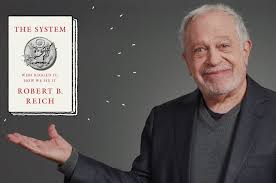
The System; Who rigged it, how we fix it; Robert B Reich, 2022
The typical American, as I have shown, has little wealth and has “near-zero, statistically non-significant” political power. Almost all wealth and power now reside in the oligarchy. Yet the oligarchy is not committed to the public good. It does not want to raise the wages of working Americans, reduce inequalities, guarantee all Americans access to good health care and a world class education, or stop climate change. The oligarchy’s allegiance is to corporate shareholders, and its major interest is enlarging their and its own wealth. The easiest way to lift share values and enlarge the oligarchy’s wealth are to hold down wages, roll back regulations, find ever cheaper places to produce products and services, fight unions, and secure giant tax cuts that result in less money for education, health care, and everything else most Americans need.
In the 1980s and 1990s almost a quarter of all public corporations in the United States were at one time the target of an attempted hostile takeover, opposed by a firm’s management. Another quarter received takeover bids supported by management.
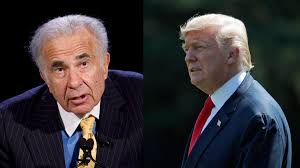
Corporate Raider Carl Icahn and Donald Trump
Few conditions change minds more profoundly than the imminent possibility of being sacked. Hence across America, CEOs who were now threatened by being replaced by CEOs who would maximize shareholder value began to view their responsibilities differently: they would maximize shareholder value even more. The corporate statesmen of previous decades became the corporate butchers of the 1980s and 1990s, whose nearly exclusive focus was — in the meat ax parlance that became fashionable — “to cut the fat,” “cut to the bone,” and make their companies “lean and mean.” By 1997, the Business Roundtable reversed the position it had taken in 1981. Now it declared the “job of business is in fact only to maximize shareholder wealth.”

Between 1981, when Jack Welch took the helm at GE, and 2001 when he retired, GE’s stock catapulted from $13 billion to $500 billion. Welch accomplished this largely by slashing American jobs and abandoning the communities GE had been rooted in. Before he became CEO, most GE employees had spent their entire careers with the company, usually at one of its facilities in upstate New York. But between 1981 and 1985, a quarter of them — 100,000 in all — were laid off, earning Welch the moniker of “neutron Jack,” along with the growing admiration of the business community. Between the mid-1980s and the late 1990s, GE slashed its American workforce by half again (to about 160,000) while nearly doubling its foreign workforce (to 130,000)…As GE opened facilities abroad, staffed by foreign workers costing a small fraction of what GE had paid its American employees, the corporation had all but abandoned upstate New York.
Giant corporations that dominate an industry also gain political power. They provide significant campaign contributions, have platoons of lobbyists and lawyers, and directly employ many voters. As a result, their CEO’s phone calls to members of congress are promptly returned. Items they want included in legislation are dutifully inserted; those they don’t want are scrapped. They get tax loopholes, subsidies, bailouts, regulatory exemptions, and loan guarantees they seek. They can stop laws in their tracks. Never underestimate the monetary value of such largess. The financial returns on political investments are among the highest in the whole system.
The three systemic changes I have outlined — from stakeholder to shareholder capitalism, from unionized workers to corporate monopolies, and from regulation of Wall Street to letting the street run wild — profoundly altered the American system. It created a jaw-dropping wealthy and powerful oligarchy. It shafted just about everyone else.
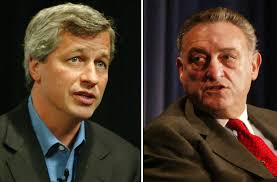


Jamie Dimon and Sandy Weill <> <> <> <> <> Koch Brothers
Dig under the surface of the system and you see individuals making deals that generate billions for themselves — such as Carl Icahn’s corporate raids, Jack Welch’s attacks on GE’s workers and unions, Warren Buffet’s investments in corporations with moats, and Sandy Weill’s and Jamie Dimon’s unfettered financial supermarkets and betting parlors.
Dig deeper and you see how these deals depended on seemingly small changes in laws and regulations, such as preventing companies defending themselves from raiders, neutering antitrust enforcement, imposing small fines for firing union organizers, refusing to regulate derivatives, and dismantling Glass-Steagall.
Bore still deeper and you see a vicious cycle in which, starting around 1980, wealth and power began concentrating around a relative small group at the top, giving them increasingly political clout to get changes in laws and regulations that concentrated their wealth and power even more.
The first three decades after WWII featured a growing middle class. a steadily more inclusive democracy, and a nation beginning to grapple with problems like poverty, inequality of opportunity, and environmental decay. African American and women slowly gained footholds in the system. Mass production begat mass consumption demanded steady jobs with good wages. This balance relied on strong unions, a government willing to regulate corporations, and large corporations rooted in their communities and responsible for the well being of their employees and neighbors as well are shareholders.
The last forty years, the opposite has occurred. The middle class has shrunk, democracy is too often malfunctioning, and the nation has turned its back on climate change, poverty, widening inequality, and the evils of racism and xenophobia. As I’ve said, the economy doesn’t have to be a zero-sum game in which the winners do better only to the extent losers do worse. But power is necessarily a zero-sum game. Certain people possess it only to the extent other people don’t. Some people gain it only when others lose it. The connection between the economy and power is critical. As power has concentrated in the hands of a few, those few have grabbed nearly all the economic gains for themselves.