Investment Bubbles always Burst (Life after AI)

The Reverse Centaur’s Guide to Life After AI; How to Think About Artificial Intelligence — Before it’s Too Late, Cory Doctorow, 2026

A reverse centaur is a machine that uses a human conscripted to serve as a biological appendage for a machine working at an inhuman pace.

The fact that there’s a low probability that an AI will be able to do your job doesn’t change the fact that there’s a high probability that an AI salesman will convince your boss to fire you and replace you with an AI that can’t do your job.

Never forget that you aren’t the target for AI hype — investors are…If you drive 101 of 280 past (SFO) or San Jose (Airport) , you’ll pass gigantic electronic billboards, pumping out ten of thousands of ANSI lumens that glow even at high noon, seen by thousands of commuters but there to pitch only a couple dozen VCs and executives at major firms.

If you want to puncture the AI bubble, you should train your fire on the applications that are used to justify the massive investment in data centers and training.

The workers who are dead center in the crosshairs of AI bosses are programmers. Google, Amazon, Microsoft, Apple — over and over,  we hear announcements from tech bosses about how many of their coders they plan to fire once the AI works, or (even more ominously) how many coders they’ve already fired because AI works so well.

The reason tech workers are able to command all these on-the-job goodies is down to an accident of history: when computers were absorbed into every kind of industrial and personal activity, the supply of trained coders was nowhere near high enough to meet the demand for their obscure, hard-to-master skills.

This meant that coders could demand all kinds of concessions from their bosses because there were always high-paying jobs with gobs of perks going for anyone who knows how to turn out reliable code on deadline, and bosses could afford to meet those demands and still turn gigantic profits.

In 2018, Google workers by the tens of thousands, walked off the job, kicking off a series of confrontations that forced the company to abandon a censored search engine for the Chinese market, a $10 Billion  military project…The exec in charge of the military contract resigned…In the space of just a few months Google declared its first dividend, fired twelve thousand workers (including many of its most senior–and thus most mouthy–technical staff), and declared a $70 billion stock buyback, which would have paid those workers wages for the next twenty-seven years.

One Google engineer relates his experience with AI in the workplace: “I have been a software engineer at Google for several years. With the introduction of generative AI-based coding assistance tools, we are already seeing a decline in open-source  code quality (defined as ‘code churn’ how often a piece of code is written only to be deleted or fixed within a short time). I am also starting to see a downward trend of (a) new engineer’s readiness in doing this work, (b) engineers willingness to learn new things, and (c) engineers effort to put in serious thoughts in the work.”

For AI companies to make back the hundreds of billions, their investors have entrusted them with, they will have to displace a hell of a lot of high-waged labor. That’s displace, not augment. AI companies are selling the replacement of workers with chatbots, but chatbots just can’t do workers’ jobs. To sell hundreds of billions of dollars worth of AI, you need a killer demo.

During the drafting of this book (2026), an MIT study found that 95 percent of commercial AI deployments fail, with “no measurable impact on profit.” The news sparked a panicked sell-off of AI related stocks, though whether this is the pin that pricks the bubble remains to be seen.

Its essential that we never stop reminding people that the current, actually existing lucrative uses for AI are terrible and should be banned.

In 2025 builder.ai (once valued at more than $1 billion) collapsed…In reality, builder.ai was a secret employment agency, farming out the work of building its customer apps to eight hundred to one thousand low waged Indian programmers. Wags said the “GPT” in ChatGPT stands for “Gujarati People Typing”.

Tech bubbles are surprisingly easy to generate, thanks to something economists call “the Byzantine premium.” That’s the extra value that investors place on an asset that they don’t understand.

Every bubble is a transfer of wealth from savers to crooks. Every bubble is bad. We shouldn’t have bubbles…Regulators should intervene to prevent bubbles in the first place. ..Some bubbles pop and leave nothing behind. These are the pure fraud bubbles.

The crypto bubble keeps getting reinflated, not least because the literal president of the United States issued his own shitcoin…But eventually the crypto bubble will burst (again) (and permanently) and when it does what will be left?

The environmental costs of the “compute” is off the charts. Even if you stipulate that the world will benefit from having some giant “advanced” AI tools, there’s no rational case for endangering the planet and the lives of millions of people to make several redundant AI tools that are functionally indistinguishable, with each consuming so much energy that they wipe a substantial share of the gains made from solarization and the broader switch to renewables.

Remember: seven giant AI companies account for 35% of the U.S. stock market. Amputating 35% of the market is going to destroy a ton of innocent bystanders, including people whose retirement savings are invested in index funds, considered the safest of all safe bets. We’re talking about a crash that will put 2008 in the shade and meet or exceed the pandemic selloff.

What’s more, that AI center is literally incinerating million dollar GPUs all the time and these have be be constantly replaced.

You can’t give a third of the S&P 500’s value over to seven money losing AI companies that energetically pass the same $100 Billion IOU around and around without creating the conditions for a prolonged, brutal global crash.

Hangzhou DeepSeek Artificial Intelligence Basic Technology Research Co., Ltd., doing business as DeepSeek, is a Chinese artificial intelligence company that develops large language models. Based in Hangzhou, Zhejiang, DeepSeek is owned and funded by High-Flyer, a Chinese hedge fund.

The release of Deepseek in 2025 sent shock waves through AI investors. Deepseek laid bare the incredible laziness of the giant U.S. AI companies, who solved all their scaling issues by throwing money at their problems rather than by applying their ingenuity to them. Deepseek’s debut sent a cold chill up the spine of every investor in a big U.S. AI company. If their $100 billion models can be bested by a model that cost a reported $6 million to create and can run on commodity hardware, what future do these top-heavy AIs have?

But they (AI companies) haven’t invented an intelligent being. They haven’t set in motion the tools to conjure up a new god or demon. They haven’t even invented a tool that can do your job for you.


Is Big Tech a Bubble?

Muskism; A Guide for the Perplexed, Quinn Slobodian & Ben Tarnoff, 2026

His (Musk’s) communication style had always been proleptic (refers to something that is anticipatory, happens before its expected time, or treats a future event as if it has already occurred. ) The logic of financial fabulism (a contemporary literary genre that weaves fantastical, mythic, or surreal elements into otherwise realistic everyday settings. It blurs the line between reality and the impossible, treating magical occurrences as mundane to explore profound human themes) treated imagined futures as already underway, allowing speculative claims to generate market effects before the underlying technology had matured. “Musk’s success is sustained by predictions of a technological sublime that’s only ever another decade away.”

On twitter, however, such predictions could produce financial effects instantaneously. In 2018, Must tweeted, “Am considering taking Tesla private at $420. Funding secured.” The number was a weed joke, but investors took him seriously: Tesla stock jumped 11 percent…In 2020, he posted “stock price too high imo” and Tesla dropped as much as 12 percent. In January 2021, he added “#bitcoin” to his Twitter bio and the cryptocurrency jumped 20 percent within an hour. This was attention alchemy at work. As journalist Marco D’Eramo observed, Musk’s followers were his “real capital”.

The most important site of cyborg symbiosis (concept heralds a future where biological intelligence and artificial intelligence converge, potentially mirroring the cooperative success stories found in nature.)  was social media. “Facebook and Twitter and Instagram and all these social networks — they’re giant cybernetic collectives,” Musk told the podcaster Joe Rogan ins 2018. They didn’t just let people collectivize their thoughts but, more importantly, their feelings. The “success of these online systems,” Musk argued, is a function of how much limbic resonance (a neurobiological concept describing the capacity for deep emotional and physiological attunement between two or more people) they’re able to achieve with people.” Virality was driven by emotion. “The more limbic resonance, the more engagement.”

What made these collectives cybernetic was the fact they included computers as well as humans. And these computers were, in fact, learning from the humans. AI systems based on neural networks are trained to perform a particular task by finding patterns in large quantities of data. On the platforms, users supplied this data through their activity. “We’re all collectively programming the AI,” Musk explained.

Gradually, this process would result in smarter and smarter AI. “The percentage of intelligence that is not human is increasing, and eventually we will represent a very small percentage of intelligence,” said Musk. The ultimate legacy of the cybernetic collectives of social media would be humanity training its replacement. In a computer, a bootloader is a special program that helps initialize the system. Humanity, Musk told Rogan, was becoming “the biological bootloader of AI.”

But there was an interesting wrinkle to this theory. If our online interactions were fueled more by emotion than reason, then the AI systems that we were collectively programming would reflect that. The AI that learned from observing our behavior in the cybernetic collective would become “our id writ large,” Musk said. This was a view of advanced AI not merely as “superintelligence” but as an algorithmic embodiment of combined impulses and instincts.

One implication was that social media had immense importance for the future of the human race. If social media were the primary site of cyborg symbiosis, then a platform like Twitter was more than a place to crack jokes, troll rivals, or pump crypto and stocks. It was a place where the perils of superintelligence could be neutralized by dissolving ourselves into data. If we didn’t become AI, AI would eliminate us.

SpaceX, OpenAI and Anthropic are all expected to make their stock market debut with hefty valuations, as investors are eager to get in on the companies at the heart of the AI boom that have previously been locked up in private markets
.
Wired; Public backlash against AI is escalating rapidly, driven by widespread anxiety over job displacement, surging utility costs from massive data centers, and ethical concerns regarding copyright and disinformation. This growing distrust has sparked grassroots protests, lawsuits, and an alarming spike in targeted, anti-tech extremism across the United States.

Is Big Tech a Bubble? Goldman Sachs;

  • The AI Capex Loophole: Critics argue that Big Tech is funding their own “circular revenue”. Giant tech firms invest billions into AI startups, which then use that exact funding to rent cloud infrastructure from those same tech giants.
  • Unsustainable Spending: Companies are heavily sacrificing cash flows and taking on massive debt to fund data centers and AI hardware. Some analysts from major banks warn that this mirrors the telecom overspending of the dot-com era.
  • Historical Concentration: A handful of mega-cap tech stocks now make up an unprecedented share of indices like the S&P 500, leaving the broader market vulnerable to any industry pullback.

A just Transition from neoliberal capitalism to progressive capitalism

The Road to Freedom; Economics and the Good Society, Joseph E Stiglitz, 2024

From FDR’s “Four Freedoms Speech” 1941

The first is freedom of speech, and expression — everywhere in the world. The second is freedom of every person to worship God in his own way — everywhere in the world…freedom from want — which, translated into world terms, means economic understandings, which will secure to every nation a healthy peacetime life for its inhabitants — everywhere in the world…freedom from fear — which translated into world terms, means a world-wide reduction of armaments to such a point and in such a thorough fashion that no nation will be in a position to commit and act of physical aggression against any neighbor — anywhere in the world.

From Reagan to Clinton, presidential administrations expanded the freedom of the banks. Financial deregulation and liberalization meant freeing the banks to do as they pleased…The very word “liberalization” connoted “freeing”. When the 2008 financial crisis hit, we discovered the cost. Many Americans lost their freedom from fear and want as the very real prospect grew that millions of workers and retirees would lose their jobs and homes. We as a society lost our freedom — we had no choice but to spend taxpayers’ money to bail out the banks.

John Maynard Keynes and FDR saw an alternative way forward from classical economics. Updated for the marked changes in the economy and our understanding of the past three-quarters of a century, their vision still stands as an alternative to the neoclassical and neoliberal economics that followed and to the new Right that is emerging. The Keynes and FDR approach was a tempered capitalism with government playing a key but limited role, ensuring stability, efficiency, and equity — or at least more than is provided by unfettered capitalism. They laid the groundwork for a twenty-first-century progressive capitalism that supports meaningful human freedom.

Adam Smith 1776 The Wealth of Nations :

The interest of [businessmen] is always in some respects different from, and even opposite to, that of the public…The proposal of any new law or regulation of commerce which comes from this order…ought never to be adopted, till having having been long and carefully examined. with the most suspicious attention. It comes from an order of men…who have generally an interest to deceive and even oppress the public.

If you are born into the wrong environment, those assets mean nothing. They yield the returns they do only because of the socioeconomic environment as to our own skills and effort. There is full justification, then, for imposing high taxes on high income even in a perfectly competitive economy in which wealth is garnered in ways that have full moral legitimacy.

Likewise, the moral claim against progressive taxes is slim if high incomes arise out of luck or inheritance–and even more so if they are made possible through exploitation or because the rules that generate or allow such income have been shaped by access to political power.

Donald Trump illustrates what happens when parents and teachers fail, and an individual does not become socialized. When norms, peer pressure, and tradition worked normally, we didn’t need strong laws to define what a president could ethically do. Almost every president acted within the constraints. But Trump, with his brazenness, may force us to define the presidential limits more precisely by putting them within laws and regulations.

In the centuries since the Enlightenment, we’ve developed institutions that do a remarkable job of assessing the truth–independent courts, research and educational institutions, and professional associations. There was a widespread consensus behind these institutions until the naysayers in the modern Republican Party and their counterparts around the world arrived on the scene. Unless we restore trust in our truth-ascertaining and verification institutions, it will be hard to have a sustained, well-functioning society or a productive economy.

Financial Times article in 2020 on Facebook;

In short, without full transparency, with a mechanism for holding participants to account, without equal ability to transmit and receive information, and with unrelenting intimidation, there is no free marketplace of ideas. One of the major insights of modern economics is that private and social incentives are often not well-aligned. If those who want to spread misinformation are willing to pay more than those who want to counter it, and if lack of transparency is more profitable than transparency [if we simply say] “so be it,” we won’t get a well-functioning marketplace of ideas.

Online platforms have not only exacerbated societal fragmentation; they have also increased the problem of the rapid, viral spread of mis- and disinformation. Virality means that information can spread quickly, more quickly than “antidotes” to the misinformation can be designed. The lack of transparency in who gets what messages have meant that the antidotes cannot be effectively developed and delivered in the relevant time span, if at all.

Social media companies have enabled the incitement of violence and the spread of hate speech and induced antisocial behavior. Their claim that they are neutral is obviously false.

Should we allow greenhouse gas emission to go unfettered? How should we manage a public health crisis like a pandemic? In that case, the transmission of scientifically false information — especially targeted mis- and disinformation that goes viral — can have dangerous and destructive consequences.

Feudalism was marked by a high concentration of power and wealth, low economic growth and slow social progress. Communism succeeded in generating greater security and more equality in material goods but failed on other counts, including low economic growth, an absence of freedom in all dimensions; a concentration of power, and a greater inequality of standards of living than Communist rulers would admit.

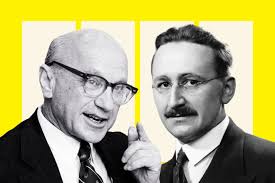
Milton Friedman Friedrich Hayek

Neoliberalism, the dominant economic system in the West over the past forty years, is increasingly viewed as an economic failure because it brought slower growth and more inequality than in earlier decades…It increased societal polarization; created selfish, materialistic, and often dishonest citizens, and contributed to a growing lack of trust.

It is intuitively clear to me that a society marked by greater equality (other things being equal) is better than one marked by huge disparities; that cooperation and tolerance is fundamentally better than greed, selfishness, and intolerance. The extreme versions of the latter that have appeared on the American scene in recent decades are truly loathsome.

Similarly, we now recognize the dangers of climate change, but if governments take action to restrict fossil fuels, under existing investment agreements, they might have to pay out as much as $340 billion to compensate the companies for not destroying the planet.

Our economic system has to be decentralized, with a multiplicity of economic units–many enterprises and other entities (of different kinds) making decisions about what to do and how to do it. The world is too complex to be centrally planned…Any well functioning economy or society requires a mix of types of institutions, not only public and private for profit, but also cooperatives, private not for profit, and so on. And the governmental institutions need to operate at multiple levels, including local, state or provincial, national and global. These institutions need to exert checks and balances on each other and the overall governance structure must limit power and its abuse. I want to emphasize that there must be large parts of the economy that are not and cannot be driven by profits. These include much of the health, education, and care sectors, in which the the narrow pursuit of profits often leads to perverse results. The private prison system has failed its core mission of rehabilitating prisoners.

…we are not born fully formed; we are shaped by our parents, our schools, and the environment surrounding us–including the economic, political, and social system in which we are embedded…cooperative institutions may spur more cooperative behavior. The neoliberal system that we’ve had for the past half century has failed on its own terms by not producing the shared prosperity it promised, but more disturbingly, it also bred more selfish and materialistic people who are less honest and trustworthy. What kind of a world is it in which individuals routinely make money by taking advantage of others and don’t even feel guilty?

Progressive capitalism’s deep aspiration is to construct a society in which there is more empathy, more caring, more creativity, and healthy striving, with individuals who are less selfish and more honest–and these attributes will lead to a better-functioning economy and society.

I believe a large part of the answer is related to two problems of neoliberalism that I’ve called attention to: the growing income and wealth divide that marks twentieth and twenty-first century neoliberal capitalism and the polarization caused by the media. Making matters worse is that current rules allow the rich and elites to have a disproportionate voice in shaping both the policies and societal narratives. All of which leads to an enhanced sense by those who are not wealthy that the system is rigged and unfair, which makes it all the more difficult to heal divisions.

As income inequalities grow, people wind up living in different worlds and don’t interact. There is a large body of evidence showing that economic segregation is growing and has consequences, for instance, on how each side thinks and feels about the other. The poorest members of society see the world as stacked against them and give up on their aspirations; the wealthiest develop a sense of entitlement, and their wealth helps to ensure that the system is rigged. But these individual opinions about the economic divide only increase the societal divide.

Not only are neoliberal economies inefficient, but neoliberalism as an economic system is not sustainable. There are many reasons to believe that a neoliberal market economy is prone to devour itself. A market economy runs on trust. Adam Smith emphasized the importance of trust, recognizing that society couldn’t survive if people brazenly followed their own self interest rather than good codes of conduct.

The regard to those general rules of conduct, is what is properly called a sense of duty, a principle of the greatest consequence to human life, and the only principle by which the bulk of mankind are capable of directing their actions… Upon the tolerable observance of these duties, depends the very existence of human society, which would crumble into nothing if mankind were not generally impressed with a reverence for those important rules of conduct.

A “businessman” like Donald Trump can flourish for years, even decades, taking advantage of others. If Trump were the norm rather than the exception, commerce and industry would grind to a halt.


Time is running out to limit climate change from greenhouse gases

Here Comes the Sun; Bill McKibben, 2025

At 210 pages this short book is intended to paint an optimistic picture of our chances to limit global temperature rise to a livable maximum. The book is packed with decades long activist experience and remarkable solar power technical development. The reader can reach their own conclusions whether this picture warrants optimism. But the book is well worth reading.

Solar power generation technology that required breakthroughs in solar panels, storage batteries, and power generating wind turbines have, in only the past 15 years, succeeded in joining Moore’s law of  growth in digital computing power as the second exponentially advancing technology in human history.

Thanks to Chinese and other nation’s investments, the world is now in position to replace the burning of fossil fuels with greenhouse gas free energy to meet the total needs of the planet. Now the question becomes – will solar based infrastructure be deployed in time to limit temperature rise to livable levels. In McKibben’s view we may only have five  years to do so.

Solar power is now far and away the cheapest power source in human history and it continues to drop in price. On the positive side, China has made the most progress, reducing its dependence on coal burning generation more than any other country. China is also the leader in the development and production of EV cars, trucks, and buses.  Even the petrol-states of the middle east are converting to solar power generation. In America, California and Texas (surprise?) are leading the way in adopting solar power. Rolling blackouts in California are (almost) a thing of the past. Arizona’s SRP (home to valley of the sun) is slowing down deployment by charging $50 a month just to connect your home solar to their grid. They should be paying homeowners and businesses to connect.

The global south, most close to the equator stand most to gain and adoption is happening at the grass roots first with self installed Chinese panels being placed everywhere. Cheap power is central to reducing inequality and improving lives throughout the globe.

The cost of converting the globe as fast as possible could be expedited with surprisingly little investment but the returns on such investment would be much lower than other alternate investments for billionaires and wealthy retirement funds. In the investment world, saving the planet does not enter the calculations.

The risks (of coups or outright corruption) are greater as well. McKibben suggests that the World Bank and IMF should shoulder these risks but that seems unlikely.

So we have an unstoppable exponential growth source of clean energy that may not get deployed in time to save the planet.

McKibben ends talking about grass roots efforts in the U.S. where key decisions regarding building wind and solar farms are usually local decisions that may come down to the whims of one or two key participants.

He notes that the Covid pandemic demonstrated a widespread and fast public and political response but the threat of immediate personal risk was at the heart of this pandemic. Within a five year period only those directly affected by weather and fire events are likely to be motivated to take action.

And the billionaire class are busy investing in survival pods and space travel! Like Trump, only they matter – no empathy for anyone else.

How Dupont (Chemours) Saint-Gobain and 3M Poisoned the World

They Poisoned The World: Life and Death in the Age of Forever Chemicals; Mariah Blake 2025

Manhattan Project: “The goal was to isolate a rare class of uranium atoms that were capable of producing nuclear chain reactions — the only process that could yield enough energy for an atom bomb…The most promising — gaseous diffusion — involved converting uranium into a gas called uranium hexafloride, or hex, and pumping it through a maze of porous barriers. Since the desired isotope, uranium-235, passed through the tiny pores, the rest of the atoms would gradually be filtered out, leaving only the prized nuclear fuel….If the project stood any chance of succeeding, the physicists needed materials that could stand up to both flourine and hex in some of the harshest conditions imaginable…As luck would have it, Dupont had already developed one that seemed to fit the bill: Teflon. The company hadn’t figured out how to make more than a few ounces at time, but it had a history of ramping up production fast…In the last two months of 1942 alone, the government contracted with Dupont to build two  factories to produce flourocarbon lubricants and sealants based on research from university scientists, and a third facility to manufacture a chemical critical to the production of both flourocarbons and hex — which were now a matter of national security….To avoid being seen as a war profiteer, the firm agreed  to limits its fee for the project to one dollar above costs and to turn all patents over to the US government. But it held on to its patent for Teflon, expecting the material would be key to the Columbia method for enriching uranium.”

Post War Products: “The push by companies like 3M to turn wartime innovations into peacetime profits would transform American Life. After the conflict, manufactures began marketing these materials for every imaginable purpose. Poison gases found new life as pesticides. Explosives like ammonium nitrate were repackaged as chemical fertilizer, revolutionizing entire food systems. And plastics once reserved for military use were transformed into a cornucopia of goods. Polyethylene, which had been used to coat radar cables, were turned into Tupperware, Hula Hoops, and grocery bags. Vinyl, or PVC, became shower curtains, flooring, medical equipment, and a popular new household item call Saran wrap. Nylon, which had been used to make parachutes, flak jackets, and aircraft fuel tanks, returned to store shelves in the form of previously scarce run proof stockings.”

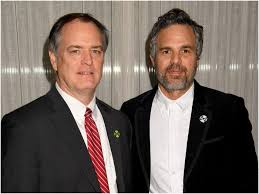
Rob Bilott and Mark Ruffalo

The book first focuses on PFOA (Perfluorooctanoic Acid C8HF15O2) which has a chain of 8 carbon atoms and were the first identified forever chemicals that do not break down. The book gives detailed histories of the long legal battles around the Dupont plant near Parkersburg, West Virginia, and the Dupont plant near Hoosick Falls NY surrounding Dupont’s production of PFOA chemicals. Cincinnati attorney Robert Bilott was involved in both battles. The 2019 Todd Haynes movie Dark Waters dramatizes the Parkersburg legal battle with Mark Ruffalo playing Robert Bilott.

Bilott first filed a Federal case in West Virginia in 1999 on behalf the Tennants, farmers whose cattle were dying as a result of Dupont hazardous substances being dumped into Dry Run near his farm. The case evolved into a class action suit with 3500 plaintiffs. Dupont reneged on their medical agreement forcing Bilott to file cases one by one. When the first few cases awarded millions in damages, Dupont settled with all plaintiffs for $671 million in 2017.

The Hoosick Falls case was settled for $27 million in 2025.

Dupont spun off its forever chemical division to Chemours Company in 2015.

Chemical companies continued development of forever chemicals in a new class of PFOS (Perfluorooctanesulfonic acid C8F17SO3H or C8HF17O3S ). Other new inventions were chemicals with carbon chains from 1 to 7 atoms and are identified as PFAS and include PFOA and PFOS.  They all share the characteristic that they don’t break down so are forever chemicals. It has become next to impossible for governments or the EPA to regulate (like setting parts per billion limits in drinking water).

“It all began in the early 2020s, when a group of European researchers developed a technique to detect an elusive subset of forever chemicals that evaded other methods — specifically, those with three or fewer carbon atoms. After applying this technique for drinking water across Germany, they made a breakthrough discovery: All but 2 percent of PFAS detected were ultashort-chain substances, which up until that point had hardly registered on scientists’ radar.”

“One molecule turned out to be particularly abundant — triflouroacetic acid, or TFA, which is used to make pesticides, pharmaceuticals, and working fluids for heating and cooling systems. It is also a common breakdown product of other PFAS. The researchers found that this chemical alone accounted for 90 percent of forever chemicals detected in German tap water. Since then, TFA has been detected in alarming levels in beer, bottled water, tea, and baby food in a variety of countries. One survey found the TFA made up virtually all PFAS found in rivers and groundwater across Europe.”

“Similarly, when researches from Emory University measured the levels of various PFAS in tap water from homes in Indiana, they found that TFA accounted for 85 percent of the total. And the average concentration was orders of magnitude above the EPA’s safety limits for PFOA. Industry has long insisted that shorter chain chemicals are safer because they don’t build up in people’s bodies. But the Emory team found that the TFA levels in homeowner’s blood were even higher than the national average for PFOA at its peak. This wasn’t because the chemical had built up over time but because people were being exposed to such large qualities.”

“They (TFA) build up faster in crops, leading to enormous concentrations in the few foods that have been tested. And they’re virtually impossible to get out of drinking water. Not only do they pass right through the type of carbon filters used to remove legacy chemicals but they also foil newer treatment technologies that are meant to remove a broad range of PFAS.”

“So far, manufacturers like Dupont, Chemours, and 3M have been hit with roughly fifteen thousand legal claims, the lion’s share from municipalities, water districts, and residents of polluted communities, though more than thirty U.S.states have also brought cases. And the numbers are expected to rise sharply in the coming months and years.”

“While these (EPA) standards are a potentially important step, they do nothing to protect people from the thousands of other forever chemicals that are inundating their bodies. And there’s no telling whether they (EPA standards) will survive Donald Trump’s second presidency.”

“In the end, any federal action may prove less consequential than the aggressive measures cropping up in other places. In 2023, the European Commission introduced a wholesale ban on the production and sale of PFAS and products containing them, the most sweeping chemical regulation in the bloc’s history. Thanks to the tireless efforts of grassroots activists, many U.S. states are embracing similar measures.”

“Rob Bilott, the lawyer who brought these chemicals to the world’s attention, sees these developments as a testament to the power of ordinary citizens. “It shows just how much individual people and communities standing up and speaking out can do and the dramatic change they put in motion” he said. “It took us way too long get here, but its happening.”


Techno Feudalism – OpenAI

Empire of AI; Dreams and Nightmares in Sam Altman’s OpenAI, Karen Hao 2025

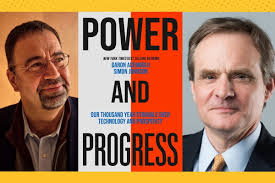
In their book Power and Progress, MIT economists and Nobel laureates Daron Acemoglu and Simon Johnson argue that every technology revolution must begin with a rallying ambition. It is the promoted of a technology benefiting everyone that puts in motion the long journey of amassing enough talent and resources to turn it into a reality. After analyzing one thousand years of technology history, the authors conclude that technologies are not inevitable. The ability to advance them is driven by a collective belief that they are worth advancing. The irony is that for this very reason, new technologies rarely default to bringing widespread prosperity, the authors continue. Those who successfully rally for a technology’s creation are those who have the power and resources to do the rallying. As they turn their ideas into reality, the vision they impose–of what the technology is and whom it can benefit–is thus the vision of a narrow elite, imbued with all their blind spots and self-serving philosophies. Only through cataclysmic shifts in society or powerful organized resistance can a technology transform from enriching the few to lifting the many.

The two features of technology revolutions–their promise to deliver progress and their tendency instead to reverse it for the most vulnerable–are perhaps truer than ever for the moment we now find ourselves in with artificial intelligence. Since its conception, the development and use of AI has been propelled by tantalizing dreams of modernity and shaped by a narrow elite with money and influence to bring forth their conception of the technology. That conception is what has led to the exploding social, labor, and environmental cost that are playing out around the world today, particularly, as we’ll see, in many Global South countries, for which the consequences of their dispossession by historical empires still linger in delayed economic development and weaker political institutions.

“In February 2020, I (Hao) published a profile for MIT Technology Review, drawing on my observations from my time in the (OpenAI) office, nearly three dozen interviews, and a handful of internal documents.

“There is a misalignment between what the company publicly espouses and how it operates behind closed doors .. Over time it has allowed a fierce competitiveness and mounting pressure for ever more funding to erode its founding ideals of transparency, openness, and collaboration.”

“…OpenAI would ‘t speak to me again for three years.”

Alan Turing published in 1950 the article “Can machines think?”  proposing the Turing Test, also known as the imitation game. He argued that if a machine could engage in conversation indistinguishable from a human, it could be considered to be thinking. The term “artificial intelligence” was first coined by John McCarthy, an American computer scientist, in 1956. The field immediately divided into two camps promoting alternate research approaches:

1. Symbolic AI (or GOFAI – Good Old-Fashioned AI)
  • Relies on representing knowledge using human-readable symbols and logical rules,.
  • Aims to explicitly program knowledge and rules into the system, enabling logical reasoning and deduction.
  • Strengths: Transparency and interpretability, logical reasoning, and handling structured problems where rules are well-defined.
  • Weaknesses: Inflexibility in handling complex and ambiguous real-world scenarios, difficulty with large and unstructured datasets, and a labor-intensive process of knowledge acquisition.
  • IBM’s Deep Blue computer that first defeated chess grand masters used symbolic AI in its development.
2. Connectionist AI
  • Models AI processes based on the structure and functioning of the human brain, utilizing artificial neural networks.
  • Learns from data through training, identifying patterns and relationships, rather than relying on explicit programming.
  • Strengths: Excels at pattern recognition, handles large and complex datasets effectively, and demonstrates adaptability.
  • Weaknesses: Often considered “black boxes” due to their lack of transparency, making it difficult to understand how they arrive at decisions, Also requires significant computational resources and extensive training data. 
  • AlphaGo which first beat the Go champion was developed with Connectionist AI
Bridging the gap: Neuro-symbolic AI
Recognizing the limitations of each approach, a new field called neuro-symbolic AI is emerging. This approach aims to combine the strengths of both symbolic AI and connectionist AI, creating systems that are both adaptable and explainable. 
  • This integration allows AI systems to leverage neural networks’ ability to learn from data while utilizing symbolic reasoning to understand and explain their decisions.
  • This approach is especially promising for complex tasks requiring both pattern recognition and logical reasoning, such as medical diagnostics, autonomous driving, and financial modeling. 
The evolution of AI continues to explore ways to effectively combine these approaches to create more robust and trustworthy intelligent systems. 

Effective altruism (EA) is a philosophical and social movement that advocates using evidence and reason to determine the most effective ways to benefit others.

Ilya Sutskever, Sam Altman, Mira Murati, and Greg Brockman, of OpenAI

Following Sutskever’s philosophy of scaling simple neural networks, the question in the early days of OpenAI became: Scale which one?..none of the neural networks that had gained widespread traction seemed to fit the bill. In August 2017, that changed with Google’s invention of a new type of Neural network know as the Transformer. Transformers excel at picking up on long-range patterns. In 2018 OpenAI released the first version of that model, called Generative Pre-Trained Transformer, later nicknamed GPT-1. The second word in the name pre-trained — is a technical term with AI research that refers to training a model on a generic pool of data as a prerequisite for it to learn more specific tasks later. IGPT-1 in other words, had been trained on a generic pool of English to create a rough approximation of how the language worked. The model could then be “fine-tuned” or specialized, later by training on a much more tailored dataset–say Shakespeare plays to teach it how to generate Shakespeare-esque prose.

The cluster of models that OpenAI trained leading up to the final 1.5-billion-parameter version illustrated this relationship (between data, compute, and parameters). Each one (model) fell neatly on a curve of increasing capability. So it was little surprise when the largest one, which they named GPT-2 markedly improved over the juvenile text generation of GPT-1 to produce lengthy and coherent enough prose to be confused with a human’s.

What the darker surprise to the team was the content that GPT-2 was producing with its new coherence. Fed a few words like Hilary Clinton or George Soros, the chattier language model could quickly veer into conspiracy theories.. Small amounts of Nazi propaganda swept up in its training data could surface in horrible ways.

Everything OpenAI did was the opposite of inevitable; the explosive global costs of its massive deep learning models, and the perilous race it sparked across the industry to scale such models to planetary limits, could only have ever arisen from the place it actually did.

GPT-4’s new level of performance convinced OpenAI leadership that it was time to start working toward one of Altman’s long-coveted ambitions: an AI assistant that would look like and feel like the character Samantha (Scarlett Johansson) in the 2013 Spike Jonze movie Her.

But for the OpenAI executives, the rumors (that Anthropic was about to introduce a chatbot) were enough to trigger a decision; the company wouldn’t wait to ready GPT-4 into a chatbot; would release Schulman’s chat-enabled GPT-3.5 model with the Super-assistant team’s brand new chat interface in two weeks, right after thanksgiving (ChatGPT launched Nov 29, 2022 “No, all the GPU’s are melting. Everything is crashing.”).

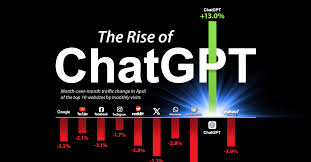
Within two months ChatGPT had reached one hundred million, at the time the fastest-growing consumer app in history.

ChatGPT catapulted OpenAI from a hot startup well-known within the tech industry into a household name overnight.

The model’s (ChatGPT) high rate of hallucinations, for example, had continued to prove particularly difficult to get under control … an internal document noted that OpenAI’s model had hallucinated during an internal test on roughly 30 percent of so-called closed-domain questions.

AI hallucinations occur when large language models (LLMs) generate false, misleading, or nonsensical information, presenting it as factual. These errors can range from simple inaccuracies to completely fabricated details.

On the Dangers of Stochastic Parrots: Can Language Models Be Too Big?

This paper originate within Google. The four big warnings:

First, large language models were growing so vast that they were generating an enormous environmental footprint, as found in Strubell’s paper. This could exacerbate climate change, which ultimately affected everyone but had a disproportionate burden on Global South communities already suffering from broader political, social, and economic precarity.

Second, the demand for data was growing so vast that companies were scraping whatever they could find on the internet, inadvertently capturing more toxic and abusive language as well as subtler racist and sexist references. This, once again, risked harming vulnerable populations the most in ways like the wrongful arrest of the Palestinian man or as documented in Noble’s work.

Third, because such vast databases were difficult to audit and scrutinize, it was extremely challenging to verify what was actually in them, making it harder to eradicate toxicity or more broadly ensure that they reflected evolving social norms and values.

Finally, the model outputs were getting so good that people could easily mistake its statistically calculated outputs as language with will meaning and intent. This would make people prone not only to believing the text to be factual information, but also to consider the model a competent advisor, a trustworthy confidant, and perhaps even something sentient.


The kinds of chips that OpenAI needed were expensive. Known as graphic processing units, or GPUs, that had originally been designed to quickly render graphics on computers, such as for giving video games a low-latency, glossy finish. But the same form factor excelled at training the AI models OpenAI wanted to develop, since they shared with graphics-rendering a common requirement: the need for crunching massive amounts of numbers in parallel.

Nvidia was the only chip maker making suitable GPUs and A100s, B100s, H100s, and V100s were are used in OpenAI ‘s modeling.

A15 Bionic Chip

Apple does not figure significantly in this discussion of the development of AGI. Their first Iphone introduced in 2007 incorporated an ARM (Advanced reduced instruction set computer) and a Power IV GPU. In 2017 Apple added an NPU (Neuroprocessing unit to its Bionic chip.

Yanis Varoufakis take on the tech giants damage to capitalism TechnoFeudalism Killed Capitalism


Anarchism, Libertarianism, Neoliberalism, the origins of market Radicals

Crack-Up Capitalism; Market Radicals and the Dream of a World Without Democracy, Quinn Slobodian, 2023

Slobodian starts with a brief history of Hong Kong and of Singapore post independence from Britain. These have been the model for special economic zones (SEZ) and greatly influenced Chinese Chairman Deng Xiaoping’s  establishment of Shenzhen, Zhuhai, Shantou and Xiamen in the 1980s.  (see Deng and the Transformation of China)

He later spends time on the development of SEZs in Dubai. “If there is any place in the world that has contributed to global zone fever as much as the Asian juggernauts of Hong Kong and Singapore, it is Dubai…In the first decade of the 2000s, Dubai’s economic growth grew by 13 percent a year on average, outpacing even China. Skyscrapers were built (by low cost foreign labor) at the rate of a floor every three days. In six years, the city’s population doubled and its footprint quadrupled.” All three also created additional land from massive land reclamation projects.

How could such historical accidents be made to happen again? The shortcut to Hong Kong that (Paul) Romer offered was called the charter city. The formula: persuade poor nations to surrender patches of uninhabited territory to be managed by richer ones. Pollinate the empty land with rules known to make capitalism work and watch it grow. This would be colonialism by consent, occupation by invitation…Why not go all the way and give over your country to external management.

While earlier settlers once sought wealth in gold, crops, or railroads, the treasure of (special economic) zones like Prospera in the twenty-first-century was their status as a jurisdiction — their potential as a new place to pick and choose among regulations and licensing requirements. Such zones offered vivid examples of what had become standard practice in the conduct of global capitalism. When people form a business contract anywhere in the world, they already had the choice of which law they elect to use;  most commercial contracts are written either in New York State or English law. For what one scholar calls “roving capital”, laws were selected and combined a la carte…These jurisdictions (SEZs) were portals to what Oliver Bullough calls Moneyland, where people can select whichever laws “are most suited to those wealthy enough to afford them at any moment in time.”

The result, they said, would be the emergence of a hypermobile superclass of high-IQ individuals, who could remotely coordinate placid low-IQ workforces while stashing their wealth far from the grasping hands of governments.

Davidson and Rees-Mogg called this tiny, rarefied fraction of the world’s population “sovereign individuals” and estimated their combined number at a hundred million worldwide. The nation-state form was dysgenic. It worked against the dictates of evolutionary advance and survival. In an era of hypermobility, it served evolutionary interests to escape national constraints…The elites would cease to see national identity as anything meaningful, and the conceit that they owed anything to their so-called fellow citizens would be laughable. They would understand that one’s countrymen were actually “the main parasite and preditor”, their brains contaminated by the idea that they were owed a share of someone else’s hard-earned income. Sovereign individuals knew they had no obligations to anyone but themselves.

(Balaji) Srinivasan’s tweak to the start-up city model was to suggest that the online and offline worlds might not be alternatives to each other but complementary: you build online first, then you come down to earth. His replacement of the sovereign individual with “the sovereign collective” seemed like a break from Davidson and Rees-Mogg, but the difference was really only semantic. All three say the same things: the possibility of exit created by new technology, the creation of a new global caste of meritocratic adepts, and the abandonment of the taxing, regulatory state in favor of new affiliations and even new territories organized along the lines of private corporations.

Srinivasan preferred blue-sky (or, better blank-whiteboard) speculation to real-world examples. Yet one of the successful examples he offered was telling: the state of Israel. This was indeed a reverse diaspora, organized through newspapers and texts that produced a kind of cloud country of a Jewish homeland through the media of the time. Kicked off by the the publication of Theodor Herzl’s Jewish State in 1896, the Zionist plan translated only slowly into facts of the ground through small-scale acts of colonization, which were eventually accepted and given legitimacy by the dominant imperial powers of the the day. But consider the consequences of this example. The land in Palestine was no more bare than anywhere else in the world, and it remains rent by competing historical claims over territory. Israel’s solution to the problem of demographic and political geography has been to create a two-tier system separating primarily Jewish citizens of country from Muslim inhabitants of the regions. It fenced boundary — policed by cameras, drones, armed soldiers, and heat-sensing technology at the limit of theological frontier — puts the Berlin Wall’s death strip to shame.

Perhaps there was an honesty in this example. Srinivasan and his fellow tech investors expressed frustration with the problems of San Francisco —  a place rife with visible inequality and untreated mental illness, the legacy of centuries of racialized poverty, violence, and discriminatory immigration policy stretching back to the original expropriation of the land on which the city was built. It is clear that Srinivasan, with his resources, could find somewhere better. But as he seemed to admit to himself, it would probably look like the state of Israel: militarized, paranoid, defiant — and also very invested in technology. It was not for nothing that a bestselling book on Israel praised by Srinivasan called it the “start-up-nation”. Here was a template: a cloud country with a twenty-six-foot-tall border wall.

Those seeking an exit in the metaverse would also find nothing of the sort. The platforms that we log on to are owned by private actors. Our every keystroke (and when we are strapped into a VR rig, out every twitch bend and nod) is minutely tracked, traced, sorted, calibrated, and sold onward to advertisers and other developers. It says a lot that one of Silicon Valley’s most successful companies — Uber — did not offer an empty prairie on which to roam and build. Rather, if you were a driver, it pulled you along like a dog on a leash, punishing you for any deviation while preserving the fiction that you were a free contractor. The metaverse, as one critic has astutely observed, is probably best thought of as a cubicle.  The private government of corporations has little space for the alternative visions of collectives, other than those that reproduce its own dominance.

As one of the foundational texts of tech criticism notes, Silicon Valley often forgets its Hegel at its own risk. The German philosopher taught that the master is always dependent on the slave. Neither island nor cloud can exist without its underclass. Beyond the Masses of app-mediated gig workers, (see techno feudalism Yanis Varoufakis) even the vaunted artificial intelligence programs work only because of the often repetitive routines and efforts of labor both skilled and unskilled. From Honduras to Dubai, the waged service class is the easiest for the visionaries to forget and the hardest for them to live without.

Patrik Schumacher, Parametricism

In the twenty-first century, however, the situation changed again, (anarcho-capitalist Patrik) Schumacher said. As manufacturing grew more automated, and advances in artificial intelligence promised a “man-machine symbiosis” on the horizon, democracy no longer made sense. It was an antique ideology, an artifact of an earlier, superseded moment in the history of capitalism — a dumbly literal reading of the world map, as if everything were penned inside its colored containers. What made sense in the twenty-first century were dots on the map like Liberland: blank-slate enclaves that could be anchor points for virtual enterprises, getaways for the global elite, or new citadels of financial services, marketing, design, software engineering, and other lines of work that needed little more than an electrical outlet and a robust internet connection. “The revolution comes when the political system becomes a barrier to the forces of production” Schumacher said. “And that’s what we’ve reached.”

Reimagined Industrial City NEOM

(SEZ) Zones are everywhere, but contrary to the rhetoric of boosters, they do not seem to be creating islands of liberation from the state. Rather, states are using them as tools to advance their own purposes. NEOM is a telling example. Saudi Arabia, an economy owned and operated by a royal family, is contracting with the Chinese company Huawei to wire its agglomeration in the desert as a “smart city”. As one consultant conceded, zones have proceeded through government-enabled confiscation, running roughshod over basic libertarian principles of property rights. Creating a land market in rural China, was projected to leave 110 million villagers without land land by 2030. Zones are not turning the world into a patchwork of a thousand private polities in dynamic competition. They are strengthening the position of a handful of state-capitalist superpowers.

Good capitalists know the real game is capturing the existing state, not going through the hassle of creating a new one.

Besides, the United States itself looks more like a (SEZ) zone all the time.  In 2022, it edged out Switzerland, Singapore, and the Cayman Islands to take top spot in an index of financial secrecy, crowned as the best place in the world to illegally hide or launder assets. Its own status as a democracy has been called into question. It was briefly downgraded by a well-respected index to a so-called anocracy, a system mixing features of democratic and autocratic rule. Soon, Americans may no longer need to go elsewhere to realize the perfect zone.

No matter the rhetoric, zones are tools of the state, not liberation from it. No matter the exit fantasies, zones cannot escape the earth. The third truth about them is perhaps the most banal but most consequential; zones have inhabitants. There is no such thing as a blank slate.

We can see this clearly back in the ur-zone of Hong Kong. I began this book with Milton Friedman gazing out affectionately at the city’s skyline, which he imagined as a perfect container for the conduct of capitalism, with decision-making insulated from disruptions by the absence of democratic elections. In 2017, when I presented and early version of that chapter at the University of Hong Kong, a professor from the law school laughed. Milton’s description of a quiescent city-state was borderline ridiculous in the middle of one the most convulsive periods in Hong Kong history, with the population taking to the streets time and time again to demand political self-determination.

TechnoFeudalism Killed Capitalism

Techno Feudalism; What Killed Capitalism, Yanis Varoufakis, 2023

Self proclaimed libertarian Marxist.

The Rise of Big Finance and Big Business

To produce the rivers of credit necessary to fund the Edisons, the Westinghouses, and the Fords of early twentieth-century capitalism, small banks merged to form large ones and lent either to the industrialists directly or to speculators eager to buy shares in the new corporations…And it led to emergence of Big Finance, which grew up alongside Big Business in order to lend it monies borrowed effectively from the future: from profits not yet realized but which Business promised to delivery.

The Creation of the American technostructure in WWII (Eisenhower’s military industrial complex)

(after Pearl Harbor brought the US Into WWII) the US government began to emulate…the Soviet one.
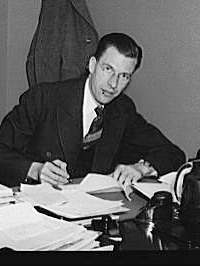

Galbraith at work in 1940
It told factory owners how much to produce and to what specifications, from aircraft carriers to processed food. It even employed a price czar – the economist John Kenneth Galbraith – whose job, literally, was to decide the price of everything, to fend off inflation, and to ensure a smooth economic transition from wartime to peacetime is no exaggeration to say that American capitalism was run according to Soviet planning principles, with the exception that the networked factories remained under private ownership of Big Business.

Under President Roosevelt, the US government’s deal with Big Business was simple: they would produce what was necessary to win the war and, in exchange, the state would reward them with four incredible gifts. First, state guaranteed sales translated into state guaranteed profits. Second, freedom from competition, since prices were fixed by government. Third, huge government funded scientific research (e.g. the Manhattan Project, jet propulsion) that provide Big Business with wonderful new innovations and a pool of highly skilled scientific personnel to recruit from during and after the war. And forth, a patriotic aura to help rinse off the stench of corporate greed that clung to them after the crash of 1929 and make them over as heroic enterprises that helped America win the war.

Galbraith called this nexus (at the end of the war) the technostructure.

With the war behind them, one thing kept the good folks of the technostructure up at night: if the government would no longer guarantee sales and prices, where would they find the customers ready and willing to pay for all the chocolate bars, cars, and washing machines that they were planning to manufacture…(hence the rise of Madison Avenue and consumer behavior modification)

In the 1960s, a decade marked by an ideological and nuclear clash between America and the Soviet Union that almost blew up the world, Soviet planning principle were implemented with remarkable success in …the United States. Irony has seldom taken a more effective revenge over earnest ideology.

The American Golden Age of Bretton Woods 1944-1971

This dazzling design, America’s Global Plan to remake Europe and Japan in the image of its technostructure, led to capitalism’s Golden Age. From the wars end until 1971, America, Europe and Japan enjoyed low unemployment, low inflation, high growth and massively diminished inequality.

As long as America was the major surplus nation, Bretton Woods was safe as houses. And that’s why, by the late 1960s, the Bretton Woods system was dead in the water. The reasons? Three developments which caused America to lose its surplus and become a chronically deficit economy. The first was the escalating Vietnam War which forced the US government to spend billions in South East Asia on supplies and services for its military. The second was President Lyndon Johnson’s attempt to make amends for the ill effects of conscription on working-class America, its black communities in particular. His valiant but expensive Great Society program substantially reduced poverty but, at once, sucked lots of imported goods from Japan and Europe into the United States. Lastly, Japan’s and Germany’s factories surpassed America’s in terms of quality and efficiency, partly due to the support successive US governments had extended to Japan’s and Germany’s manufacturing sectors – the car industry being an obvious example.

Nixon Shock the death of Bretton Woods 1971

..on 15 August 1971 President Nixon announced the eviction of Europe and Japan from the dollar zone. Bretton Woods was dead. The door had been opened on a new and truly dismal phase in capitalism’s evolution.

Fed Dismal Chairmen Volcker, Greenspan, Bernanke

In 2002, thirty years after the Nixon Shock, humanity’s total income approximated $50 trillion. In the same year, financiers around the world had wagered $70 trillion on a variety of bets…. By 2007 humanity’s total income had risen from $50 to $75 trillion – a decent 33 percent increase over five years. But the sum of bets in the global money market had gone up from $70 to $750 trillion – a rise in excess of 1000 percent…Bretton Woods was designed to prevent such greed-fueled recklessness from bringing humanity to the brink of another Great Depression, indeed another world war, ever again.

Once they lost their fixed exchange with the dollar, the dollar value of European and Japanese money began fluctuating wildly…The dollar became the only safe harbor, courtesy of its exorbitant privilege, namely, that if any French, Japanese, or Indonesian company, indeed anyone wanted to import oil, copper, steel, or even just space on a freight ship, they had to pay in dollars…The Nixon Shock produced a magic trick for the ages; the country going deeper and deeper into the red was the country whose currency was becoming more and more hegemonic…But there was another reason why the dollar’s hegemony grew: the intentional impoverishment of America’s working class.,,It is also no coincidence that union busting became a thing in the 1970s.

Crash of 2008

With investment first knocked out by the crash of 2008 and finished off soon after by austerity, throwing new money at the financiers was never going to resurrect it. Put yourself in the position of a capitalist at a time when austerity is eliminating your customer’s income. Suppose I give you a billion dollars to play with for free, i.e. at a zero interest rate. Naturally you will take the free billion but as we’ve established you would be mad to invest it in new production lines. So what are you going to do with the free cash? You could buy real estate or art or better still, shares in your own company. That way, the shares in your company appreciate in value, and if you are the CEO running it, your stature and share-linked bonuses rise too. No new investment, in other words, but a lot more power in the hands of the powerful.

For while the American deficit returned with a vengeance a year after the crash of 2008 and the subsequent bankers bailouts, it never restored the beast’s capacity to recycle the world’s profits. True, the rest of the world continued to send most of its profits to Wall Street. But the recycling mechanism was broken: only a small fraction of the monies rushing to Wall Street returned in the form of tangible investments in factories, technologies, agriculture. Most of the world’s money rushed to Wall Street to stay in Wall Street. There, it sloshed around doing nothing useful. As it piled up, it bid up share prices, thus giving the Jills and the Jacks of of finance yet another opportunity to do stupid things at a mammoth scale.

When an activist states makes fabulously wealthier, the same banks whose quasi-criminal activities brought misery to the majority, while they are punished with self-defeating austerity, two new calamities beckon: poisoned politics and permanent stagnation. The poisoned politics we need not elaborate on – from Greece’s neo-Nazis to America’s Donald Trump we have all lived through the nightmare. But permanent stagnation? Why would more wealth for the ultra-rich stagnate capitalism? And how did it lead to the funding of cloud capital?

Cloud proles and cloud serfs

…capital has hitherto been reproduced within some labor market – within the factory, the office, the warehouse. Aided by machines, it was waged workers who produced the stuff that was sold to generate profits, which in turn financed their wages and the production of more machines– that’s how capital accumulated and reproduced. Cloud capital, in contrast, can reproduce itself in ways that involve no waged labor. How? By commanding almost the whole of humanity to chip in to its reproduction – for free…By doing so, we shall see that while workers have become ‘cloud proles’ we all have become ‘cloud serfs’…Cloud proles – my term for waged workers driven to their physical limits by cloud based algorithms—suffer at work in ways that would be instantly recognized by whole generations of earlier proletarians. (As in Chaplin’s 1936 movie Modern Times)
Workers employed by General Electric, Exxon-Mobil, General Motors or any other major conglomerate pay in salaries and wages approximately 80 percent of the company’s income. This proportion grows larger in smaller firms. Big Tech’s workers, in contrast, collect less than 1 percent of their firm’s revenues. The reason is that paid labor performs only a fraction of the work that Big Tech relies on. Most of the work is performed by billions of people for free…The fact that we do so voluntarily, happily even, does not detract from the fact that we are unpaid manufacturers – cloud serfs whose daily self-directed toil enriches a tiny band of multibillionaires residing mostly in California and Shanghai.

Amazon and Jeff Bezos the end of capitalism
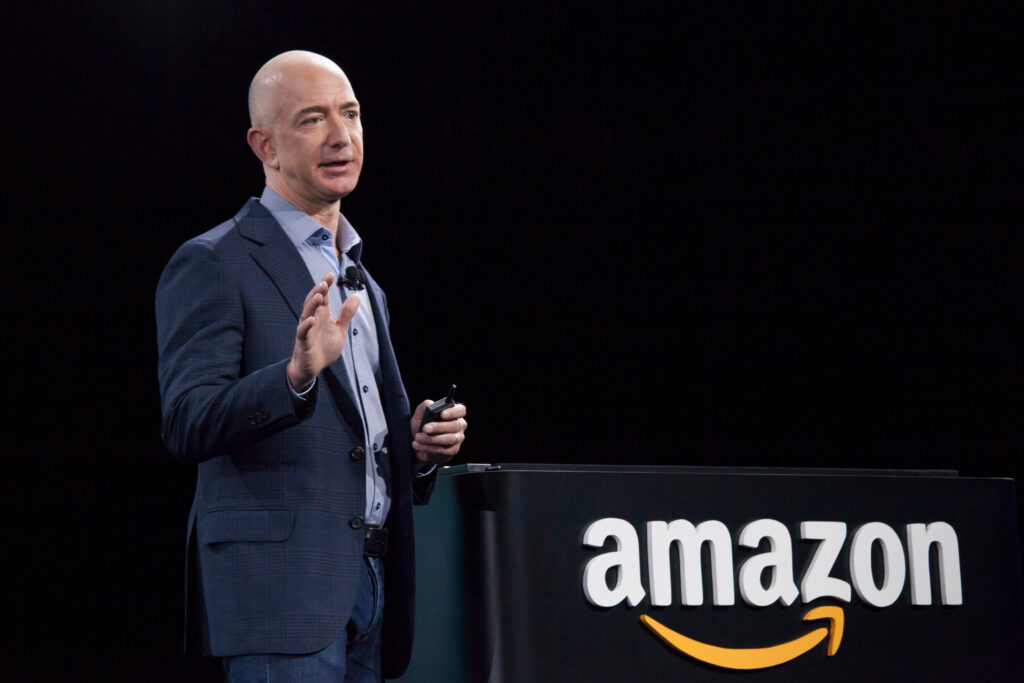
Enter Amazon.com and you have exited capitalism. Despite all the buying and selling that goes on there, you have entered a realm which can’t be thought of as a market, not even a digital one…Even the ugliest of markets are meeting places where people can interact and exchange information reasonably freely. In fact, it’s even worse than a totally monopolized market – there at least, the buyer can talk to each other, form associations, perhaps organize a consumer boycott to force the monopolist to reduce a price or to improve a quality. Not so in Jeff’s realm, where everything and everyone is intermediated not by the disinterested invisible hand of the market but by an algorithm that works for Jeff’s bottom line and dances exclusively to his tune.
(Amazon is) a type of digital fief…A post-capitalist one, whose historical roots remain in feudal Europe but whose integrity is maintained today by a futuristic, dystopian type of cloud-based capital.

Tesla and Elon Musk Amazon copycat

Copycat ecommerce platforms, offering variations on the Amazon theme, are springing up everywhere, in the Global South as well as the Global North. More significantly,other industrial sectors are turning into cloud fiefs too. Take for example Tesla,,, Elon Musk’s successful electric car company. One reason financiers value it so much higher then Ford or Toyota is that its cars’ every circuit is wired into cloud capital. Besides giving Tesla the power to switch off its cars remotely, if not, for instance, the driver fails to service it as the company wishes, merely driving around Tesla owners are uploading in real time information (including what music they are listening to!) that enriches the company’s cloud capital.

A.I. Algorithms produce Cloud Proles and Cloud Serfs

It took mind-bending scientific breakthroughs, fantastical sounding neural networks and imagination-defying A.I. Programs to accomplish what? To turn workers tolling in warehouses, driving cabs and delivering food into cloud proles. To create a world where markets are increasingly replaced by cloud fiefs. To force businesses into the role of vassals. And to turn all of us into cloud serfs, blued to our smartphones and tablets, eagerly producing the cloud capital that keeps our new overlords on cloud nine.

Privatization of the Internet Commons

Capitalism surfaced when owners of capital goods (steam engines, machine tools, spinning jennies, telegraph poles, etc.) acquired the power to command people and nations– powers that far exceeded, for the first time, those of landowners. It was a Great Transformation made possible by the prior privatization of common lands. Same with cloud capital. To acquire its eve greater powers to command, it too required the prior privatization of another crucial commons: Internet One.
Previously, to exercise capital’s power to command and make other humans work faster and consume more, capitalists required two types of professionals; managers and marketeers. Especially under the auspices of the post-war technostructure, these two service professions achieved greater prominence even than bankers and insurance brokers…Then cloud capital arrived. At one fell swoop it automated both roles. The exercise of capital’s power to command workers and consumers alike was handed over to the algorithms. This was a far more revolutionary step than replacing autoworkers with industrial robots. After all, industrial robots simply do what automation has been doing since before the Luddites: making proletarians redundant, or more miserable or both. No, the truly historic disruption was to automate capital’s power to command people outside the factory, the shop or office – to turn all of us, cloud proles (blue collar working-class) and everyone else, into cloud serfs in the direct (unrenumerated) service of cloud capital, unmediated by any market.
Meanwhile, conventional capitalist manufacturers increasingly have no option but to sell their goods at the discretion of the cloudalists, paying them a fee for the privilege, developing a relationship with them no different to that of vassals vis-a-vis their feudal overlords.

The Apple iPhone and the Apple Store


The stroke of genius that unlocked cloud rent for Steve Jobs was his radical idea to invite ‘third party developers’ to use free Apple software with which to produce applications for sale via the Apple Store. In one fell swoop Apple had created an array of unwaged laborers and vassal capitalists whose hard work yielded a host of capabilities available exclusively of iPhone owners in forms of thousands of desirable apps that Apple engineers could never have produce themselves in such variety or volume.

Google’s Android Operating System and Google Play

Only one other conglomerate managed to persuade a significant proportion of those developers to create apps for its own store: Google. Long before the iPhone arrived, Google’s search engine had become the centerpiece of a cloud empire which included Gmail and YouTube, and which would later include Google Drive, Google Maps and a host of other online services…Google followed a different strategy to Apple’s. Instead of manufacturing a handset in competition with the iPhone, it developed Android, an operating system that could be installed for free on the smartphones of any manufacturer, including Sony, Blackberry and Nokia, who chose to use it. The idea was that if enough of Apple’s competitors installed it (Android) on their phones, the pool of smartphones operating on the Android software would be large enough to lure third-party developers to produce apps not only only for the Apple Store but for a new store running on Android software. That’s how Google created Google Play, the only serious alternative to the Apple Store.

Creation of Vassal Capitalists and the Precariat

But large or small, powerful or otherwise, all vassal capitalists are by definition dependent to a greater or lesser extent on selling their wares via an ecommerce site, whether Amazon or Ebay or Alibaba, with a sizable portion of their net earnings being skimmed off by the cloudalists they depend on.
Meanwhile, as Amazon was snaring makers of physical products within its cloud fief, other cloudalists were focusing their attention on the precariat (people whose employment and income are insecure). Companies like Uber, Lyft, Grubhub, DoorDash and Instacart in the Global North, along with their imitators in Asia and Africa, wired into their cloud fiefs a vast array if drivers, delivery people, cleaners, restauraneurs – even dog walkers – collecting from these unwaged, piece-rate workers a fixed cut of their earnings too. A cloud rent.
The Great Transformation from feudalism to capitalism, was predicated on the usurpation of rent by profits as the driving force of our socio-economic system. That was why the word capitalism proved so much more useful and insightful than a term like market feudalism. It is this fundamental fact – that we have entered a socio-economic system powered not by profit but by rent – that demands we use a new term to describe it. To think of it as hyper capitalism or rentier capitalism would be to miss this essential defining principle. And to reflect the return of rent to its central role, I can think of no better name than technofeudalism.

Technofeudalism Underlies the Great Inflation

…the Great Inflation and cost-of-living crisis that have followed the recent pandemic cannot be properly understood outside the context of Technofeudalism…I recounted how for twelve long years after the crash of 2008, central banks printed trillions to replace the bankers’ losses. We saw how socialism for bankers and austerity for the rest of us dampened investment, blunted Western capitalism’s dynamic and pushed it into a state of gilded stagnation. The only serious investment of the central banks’ poisoned money during this time went into the accumulation of cloud capital. By 2020, cloud rents accruing to cloud capital accounted for much of the developed world’s aggregate new income.
…rents stunning comeback could only mean deeper and more toxic stagnation. Wages get spent by the many struggling to make ends meet. Profits get invested in capital goods to maintain the capitalists’ capacity to profit. But rent is stashed away in property (mansions, yachts, art, cryptocurrencies, etc.) and stubbornly refuses to enter circulation, stimulate investment into useful things, and revive flaccid capitalist societies. And so the vicious cycle begins: deeper stagnation.
The pandemic (2020) exacerbated the same trend. The only significant difference from the pre-pandemic period was that, this time, and for the first time since 2008, some of the fresh trillions printed by the central banks were spent by governments on the population, to keep their citizens alive while locked down. Nevertheless, most of the new monies ended up bolstering the share price of Big Tech corporations. This explains the report of the Swiss Bank UBS, published in October 2020, which found that billionaires had increased their wealth by more than a quarter (27.5 per cent) between April and July of that year, just as millions of people around the world lost their jobs or were struggling to get by on government schemes. What happens when supply suddenly dies? Especially during times when the locked-down masses get some income support from the central banks’ money tree. The price of groceries, exercise bikes, bread makers, natural gas, petrol, housing and host other goods goes through the roof and, following a dozen years of subdued prices, a Great Inflation sets in.
When, for whatever reason, prices surge across the board, a social power game is afoot in which everyone attempts to suss out their bargaining power. Business managers try to work out how far they can raise prices – if not to profit then, at least, to recoup their own rising costs. Rentiers, both traditional and cloudalists, test the water with rent hikes. Workers assess the extent to which they can push for a pay rise – at least to compensate for the higher bills they must meet. Governments play the game too: do they intervene by using the greater income and VAT tax receipts flowing from the rising prices to assist weaker citizens being crushed by inflation? Or do they subsidize Big Business as it is squeezed by high energy prices? Or do they do nothing much? Until these questions get answered inflation continues to roll.

Delayed Green Energy Adoption

The need to switch from fossil fuels to green energy could not be more urgent. The rise in energy costs that is an integral part of the Great Inflation would seem to have taken us away from that goal, offering a windfall to the fossil fuel industry. But this will not last long. Advances in green energy are pushing down fast the costs of green electricity generation. Even though the life cycle of fossil fuels has been extended, ruinously for the planet, cloud based green energy is growing – and, with it, so is the relative power of cloudalists.

China’s Dark Deal Post 1971 Global Capitalism

From the 1970s onward, global capitalism was founded on this fascinating recycling of, mainly, Asian manufacturing profits into American rents, which in turn sustained the American imports that provided Asian factories with sufficient demand.
Why call it a Dark Deal? Because in the small print of this pact between America’s and East Asia’s ruling classes was written misery for workers on both sides of the Pacific. American workers faced the exploitation and immiseration that resulted from under investment and its industrial heartland being hollowed out by manufacturing in Asia and the underdeveloped Global South. Meanwhile, in China’s fast-industrializing coastal cities, workers suffered the frenzied exploitation associated with over investment…
The came the crash of 2008. This had two main effects that, together, underpin today’s New Cold War: it strengthened China’s position in the global recycling mechanism, ant it turbocharged the build-up of cloud capital both in the United States and China.
…when the bottom fell out of Wall Street, China stabilized global capitalism by cranking up domestic investment to more than half of China’s national income. It worked in that Chinese investment took up much of the global slack caused by Western commitment to austerity. China’s international stature rose, and its accumulating dollar surpluses allowed Beijing, in addition to feeding Wall Street, to become a major investor in Africa, Asia, even in Europe through its famed Belt and Road Initiative.

Chinese cloudalist agglomeration

…to grasp the enormity and nature of China’s big five cloudalist conglomerates – Alibaba, Tencent, Baidu, Ping An and JD.com – consider the following thought experiment. Imagine if, in the West, we were to roll into one Google, Facebook, Twitter, Instagram and the version of Chinese owned Tik Tok still available to American users. Then include the applications that play the role that telephone companies used to: Skype, WhatsApp, Viber, Snapchat. Add to the mix ecommerce cloudalists like Amazon, Spotify, Netflix, Disney Plus, Airbnd, Uber and Orbitz. Lastly, throw in PalPal, Charles Schwab and every other Wall Street bank’s own app.
Unlike Silicon Valley’s Big Tech, China’s is directly bound into government agencies that make all-pervading use of this cloudalist agglomeration: to regulate urban life, to promote financial services to unbanked citizens, to link its people with state health care facilities, to conduct surveillance of them using facial recognition, to guide autonomous vehicles through the streets – and, outside its borders, to connect Africans and Asians participating in China’s Belt and Road Initiative to its super cloud fief.
With this great leap into financial services, China’s cloudalists acquire a 360-degree view of their users’ social and financial life. If cloud capital is a produced means of behavior modification, Chinese cloudalists have accumulated cloud capital beyond the wildest dreams of their Silicon Valley competitors, who, by comparison, enjoy far less power per capita to accumulate cloud rent.

American Dollar Reign

It (dollar’s reign) has allowed countries with large trade surpluses, like China and Germany, to convert their excess production – their net exports – into property and rents in the United States: real estate, US government bonds, and any companies that Washington allowed them to own. Without the dollar’s global role, Chinese, Japanese, Korean, or German capitalists would never have been able to extract such colossal surplus value from their workers and then stash it away somewhere safe. Michael Pettis: “While the US dollar may create an exorbitant privilege for certain American constituencies, this status creates an exorbitant burden for US the economy overall, especially for the vast majority of Americans who must pay for the corresponding trade deficits either with higher unemployment, more household debt, or greater fiscal deficits.”

Cloud Capital Affect on the Liberal Individual

It (cloud capital) has produced individuals who are not so much possessive as possessed, or rather persons incapable of being self-possessed. It has diminished our capacity to focus by co-opting our attention. We have not become weak-willed. No, our focus has been stolen. And because technofeudalism’s algorithms are known to reinforce patriarchy, stereotypes and pre-existing oppressions, those that are most vulnerable – girls, the mentally ill, the marginalized and yes, the poor – suffer the outcomes most…Bigotry is technofeudalism’s emotional compensation for the frustrations and anxieties we experience in relation to identity and focus…it is intrinsic to cloud capital, whose algorithms optimize for cloud rents, which flow more copiously from hatred and discontent.
And therein lies the greatest contradiction: to rescue that foundational liberal idea – the liberty of self-ownership—will therefore require a comprehensive reconfiguration of property rights, over the increasingly cloud-based instruments of production, distribution, collaboration, and communication. To resuscitate the liberal individual, we need to do something that liberals detest: plan a new revolution.
To stand a chance of overthrowing technofeudalism and putting the demos back into democracy, we need to gather together not just the traditional proletariat and the cloud proles but also the cloud serfs and, indeed, at least some of the vassal capitalists. Nothing less than such a grand coalition that includes them all can undermine technofeudalism sufficiently.

Cloud mobilization

The beauty of cloud mobilization is that it stands on its head the conventional calculus of collective action. Instead of maximal personal sacrifice for minimal collective gain, we now have the opposite: minimal personal sacrifice delivering large collective and personal gains. This reversal has the potential to pave the way toward a coalition of cloud serfs and cloud proles that is large enough to disrupt cloudalists control over billions of people.
Under technofeudalism, we no longer own our minds. Every proletarian is turning into a cloud prole during working hours and into a cloud serf the rest of the time. Every self employed striver mutates into a cloud vassal, while every self employed struggler becomes a cloud serf. While privatization and private equity asset-strip all physical wealth around us, cloud capital goes about the business of asset stripping our brains. To own our minds individually, we must own cloud capital collectively. It’s the only way we can turn our cloud-based artifacts from a produced means of behavior modification to a produced means of human collaboration and emancipation.
For a more thorough discussion of the required mobilization see Yanis Varoufakis’novel, Another Now, 2021.


Pentagon Militarizes Climate Change

The Pentagon, Climate Change, and War; Charting the Rise and Fall of U.S. Military Emissions, Neta C. Crawford, 2023

For most of the last 250 years humans have carried on with making “progress”–industrialization in the service of the good life—assuming that fossil fuels were an essential ingredient in shaping the world we were certain would be better than the one we were leaving behind. Our grand strategy for security took for granted that we would need fossil fuel for industry and fossil fuel for war. Only in the last fify years or so has it become clear that burning all that fuel and at the same time destroying the forests and the wetlands that take up the carbon released by the fire, is not just leaving the past behind, but destroying the possibility of preserving what is increasingly– in essential life giving respects—understood as a better world.

In sum, the economy, foreign policy beliefs, and military doctrine institutionalized greater demand for fossil fuels. The deep cycle of oil demand, consumption, militarization, and conflict begins with demand for oil and increasing consumption. Then, when U.S. policy makers feel anxious about guaranteeing oil supplies in the face of dependency, or are concerned about the price of oil, they back allies in the Persian Gulf and greater Middle East, as occurred in 1946 and 1949, in 1957. in 1973, in 1980 and 1990. The United States played favorites within the states that had large oil reserves, even if some of those government leaders were autocratic, such as the Shah of Iran, Saddam Hussein, and the leaders of Saudi Arabia.
Yet, the risk of supporting authoritarian regimes is that those regimes are increasingly unstable as the citizens who demand more say in their government push back against authoritarian kings, emirs, and shahs. When challenges to the undemocratic, autocratic or kleptocratic rulers within states with large oil supplies occurred, or there were external challenges, the United States sometimes backed the leaders or system that is thought could bring stability. Thus with the Eisenhower Doctrine, the United States backed Saudi Arabia’s King Saud and Crown prince Faisal as a way to balance against Egyptian leader Gamal Abdel Nasser. At times, as in the case of backing the Shah of Iran in the 1970s and Saddam Hussein in Iraq in the 1980s, these alliances backfired…This in turn increases the sense among U.S. Elites that the Middle East is a volatile region that needs U.S. Intervention to remain stable.

The military has understood the science and the consequences of global warming quite well for decades. They paid for much of that research. National security strategists have sounded muted alarms, the Pentagon has adapted some of their equipment and operations, and experts have imagined scenarios of increasingly dire complex emergencies and catastrophes and climate-caused wars.
Pentagon leaders have been farsighted and tactically flexible. Some of the smartest, best-trained and most determined people on the planet, given the resources of the richest nation on earth, the people at the Pentagon are trying to make things better…They have developed better batteries, put up solar arrays at bases, and even thought about moving some bases.


Camp Lejeune Hurricane Destruction 2018

Camp Lejeune (North Carolina) was hit by Hurricane Florence in September 2018 and suffered $3.6 billion worth of damages. In October 2018 , Michael, a category 5 hurricane devastated much of Tyndall Air Force Base in Florida, including F-22 aircraft, damaged beyond repair or destroying hundreds of buildings…Estimated to cost $4.9 billion to repair and reconstruct the base, the rebuilding was expected to last as long as five to seven years.

TYNDALL AIR FORCE BASE, Florida — Hangers once used to keep aircraft out of the elements now lie scattered across the flight line following Hurricane Michael on October 10, 2018. Hurricane Michael is the third largest hurricane to make landfall in the United States, reaching peak winds of 155 miles per hour.

Tyndall Hurricane 2018

And yet at the same time, the Pentagon has been strategically inflexible and blind…For the most part, the armed forces, and our political leaders, have not put away the tools and habits of mind that got us here in the first place. Our grand strategy for national security has not fundamentally changed. In some ways it can’t, because it is premised on the anticipation and fear of war—the idea that for us to be safe, we have to be prepared to meet every threat anywhere at any time with overwhelming force. The national security strategy is also premised on the idea that force works, that the threat of coercion and the actuality of destruction can get us what we want. So once we believe those things—that war is possible and may be imminent, that we must have a capacity to make war that far exceeds our enemy’s abilities, and that coercion and destruction are effective—it seems that the only way to deal with the threat of climate change-caused war is to prepare for more war. Of course, in preparing for more war, governments give the armed forces everything they need: money, weapons, people, bases, and fossil fuels. We defend and protect the oil we think we need to defend ourselves…At the same time that we are making our weapons more energy efficient and the installations more resilient, we scarcely question whether war is inevitable or in fact made more likely by our bases and our burning fuel to be the most powerful nation on earth…The military is inadvertently or perhaps deliberately militarizing climate change.

Ode to (Gordon) Moore’s Law

Chip War, The Fight For the World’s Most Critical Technology, 2022, Christopher Miller

This reader is a retired software engineer whose 40 year career began with punch card mainframes and ended with microcontrollers with embedded graphic displays, WiFi, and flash memory on a single chip. My introduction to computing was as a graduate research assistant on an ARPA funded project to study the dimensionality of nations. Since that time I followed the development of the ARPANET. I have lived the profound impact of Moore’s Law, needing to constantly anticipate where technology would be when project development required several years before introduction. Moore’s Law has still not been broken after all these years.
To get some sense of what exponental increase in transistors looks like consider the 1980s Cray 2 supercomputer which was export restricted for national security reasons. The CRAY-2 stood nearly 4 feet tall with a 5.5-foot diameter and weighed 5,500 pounds. The iPhone 12 is 5,000 times faster than the Cray-2!
Exponential growth of a technology is unique in human history.

  • If the computing power on each chip continued to grow exponentially, Moore realized, the integrated circuit would revolutionize society far beyond rockets and radars…At Fairchild, Noyce and Moore were already dreaming of personal computers and mobile phones.

    Alongside the rise of these new industrial titans (Intel and Micron), a new set of scientists were preparing a leap forward in chipmaking and devising revolutionary new ways to use processing power. Many of these developments occurred in coordination with government efforts, usually not the heavy hand of Congress or the White House, but the work of small, nimble organizations like DARPA (originally ARPA, Larry Robert director 1966-1973) that were empowered to take big bets on futuristic technologies — and to build the educational and R&D infrastructure that such gambles required.


    Morris Chang Founder of TSMC

    (Dutch) ASML‘s history of being spun out of Philips helped in a surprising way, too facilitating a deep relationship with Taiwan’s TSMC (founder Morris Chang). Philips had been the cornerstone investor in TSMC, transferring its manufacturing process technology and intellectual property to the young foundry. This gave ASML a built-in market, because TSMC’s fabs were designed around Philip’s manufacturing processes. An accidental fire in TSMC’s fab in 1989 helped too, causing TSMC to buy additional nineteen new lithography machines, paid for by the fire insurance. Both ASML and TSMC started as small firms on the periphery of the chip industry, but they grew together, forming a partnership without which advances in computing today would have ground to a halt.

    The next generation EUV (Extreme ultraviolet) lithography would therefore be mostly assembled abroad, though some components continued to be built in facility in Connecticut. Anyone who raised the question of how the U.S. would guarantee access to EUV tools was accused of retaining a Cold War mindset in a globalizing world. Yet the business gurus who spoke about technology spreading globally misrepresented the dynamic at play. The scientific networks that produced EUV spanned the world, bringing together scientists from countries as diverse as America, Japan, Slovenia, ad Greece. However, the manufacturing of EUV wasn’t globalized, it was monopolized. A single supply chain managed by a single company would control the future of lithography.

    By the mid 2000’s, just as cloud computing was emerging, Intel had won a near monopoly over data center chips, competing only with AMD. Today nearly every major data center uses X86 chips from either Intel or AMD. The cloud can’t function without their processors… Some companies tried challenging z86’s position as the industry standard in PCs. In 1990 Apple and two partners established a joint venture called Arm, based in Cambridge England. The aim was to design processor chips using a new instruction set architecture based on the simpler RISC (reduced instruction set computer) principles that Intel had considered but rejected. As a startup Arm faced no costs of shifting away from x86, because it had no business and no customers. Instead, it wanted to replace X86 at the center of the computing ecosystem. Arm’s first CEO, Robin Saxby, had vast ambitions for the twelve-person startup…However Aim failed to win market share in PC’s in the 1990s and 2000’s, because Intel’s partnership with Microsoft’s Windows operating system was simply too strong to challenge. However Arm’s simplified, energy-efficient architecture quickly became popular in small, portable devices that had to economize on battery use. Nintendo chose Arm based chips for its handheld video games…

    The problem wasn’t that no one realized Intel ought to consider new products, but that the status quo was simply too profitable. If Intel did nothing at all it would still own two of the world’s most valuable castles–PC and server chips–surrounded by a deep x86 moat.

    Intel turned down the iPhone contract…Apple looked elsewhere for its phone chips. Jobs turn to Arm’s architecture, which, unlike the x86 was optimized for mobile devices that had to economize on power consumption. The early iPhone processors were produced by Samsung (founder Lee Byung-chul), which had followed TSMC into the foundry business… By the time Otellini (Intel) realized his mistake, however it was too late.

    By the 2000’s, it was common to split the semiconductor industry into three categories. “Logic” refers to the processors that run smartphones, computers, and servers. “Memory” refers to DRAM which provides the short-term memory computers need to operate, and flash, also called NAND, which remembers data over time. The third category of chips is more diffuse, including analog chips like sensors that convert visual or audio signals into digital data, radio frequency chips that communicate with cell phone networks, and semiconductors that manage how devices use electricity.

    It (America’s second class status) dates to the late 1980s when Japan first overtook the U.S. DRAM output. The big shift in recent years is the collapse in the share of logic chips produced in the United States. Today, building an advanced logic fab costs $20 billion, an enormous capital investment that few firms can afford…Given the benefits of scale, the number of firms fabrication advanced logic chips has shrunk relentlessly.


    Jensen Huang CEO Nvidia

    Nvidia (which became dominant in graphics) not only designed chips called graphic processors units (GPUs) capable of handling 3D graphics, it also devised a software ecosystem around them. Making realistic graphics requires use of programs called shaders, which tell all the pixels in a image how they should be portrayed in, say a given shade of light. The shader is applied to each of the pixels in a image, a relatively straightforward calculation conducted over many thousands of pixels. Nvidia’s GPUs can render images quickly because, unlike Intel’s microprocessors or other general-purpose CPUs, they’re structured to conduct lots of simple calculations–like shading pixels–simultaneously.
    In 2006, realizing that high-speed parallel computations could be used for purposes besides computer graphic, Nvidia released CUDA, software that lets GPUs be programmed in a standard programming language, without any reference to graphic at all. Even as Nvidia was churning out top-notch graphic chips, Huang (CEO) spent lavishly on this software effort, at least $10 billion,…to let any programmer–not just graphic experts–work with Nvidias chips…Nvidia discovered a vast new market for parallel processing, from computational chemistry to weather forecasting. At the time, Huang could only dimly perceive the potential growth in what would become the biggest use case for parallel processing, artificial intelligence.
    Today Nvidia’s chips, largely manufactured by TSMC, are found in most advanced data centers.


    Dr. Irwin Jacobs co founder Qualcom

    For each generation of cell phone technology after 2G, Qualcomm contributed key ideas about how to transmit more data in the radio spectrum and sold specialized chips with the computing power capable of deciphering this cacophony of signals. The companies patents are so fundamental it’s impossible to make a cell phone without them. Qualcomm soon diversified into a new business line, designing not only the modem chips in a phone that communicate with a cell network, but also the application processors that run a smartphone’s core systems. These chip designs are monumental engineering accomplishments, each built on tens of millions of lines of code.

    For many years, each generation of manufacturing technology was named after the length of the transistor’s gate, the part of the silicon chip whose conductivity would be turned on and off, creating and interrupting the circuit. The 180nm node was pioneered in 1999, followed by 130nm, 90nm, 65nm, and 45nm, with each generation shrinking transistors enough to make it possible to cram roughly twice as many in the same area. This reduced power consumption per transistor, because smaller transistors needed fewer electrons to flow through them.
    Around the early 2010s, it became unfeasible to pack transistors more densely by shrinking them two dimensionally. One challenge was that, as transistors were shrunk according to Moore’s Law, the narrow length of the conductor channel occasionally caused power to “leak” through the circuit even when the switch was off. On top of this, the layer of silicon dioxide atop each transistor became so thin that quantum effects like “tunneling”–jumping through barriers that classical physics said should be insurmountable–began seriously impacting transistor performance. By the mid 2000s. the layer of silicon dioxide on top of each transistor was only a couple of atoms thick, too small to keep a lid on all the electrons sitting in the silicon.
    To better control the movement of electrons, new materials and transistor designs were needed. Unlike the 2D design used sine the 1960s, the 22nm node introduced a new 3D transistor, called a FinFET (pronounced finfet), that sets the two ends of the circuit and the channel of semiconductor material that connects them on top of a block, looking like a fin protruding from a whale’s back. The channel that connects the two ends of the circuit can therefore have an electric field applied not only from the top but also from the sides of the fin, enhancing control over the electrons and overcoming the electricity leakage that was threatening the performance of new generations of tiny transistors…These nanometer-scale 3D structures were crucial for the survival of Moore’s Law, but they were staggeringly difficult to make, requiring even more precision in deposition, etching, and lithography. This added uncertainty about whether the major chip-makers would all flawlessly execute the switch to FinFET architectures or whether one might fall behind…Moreover, the 2008-2009 financial crisis was threatening to reorder the chip industry. Consumers stopped buying electronics, so tech firms stopped ordering chips.

    Smartphones and PCs are both assembled largely in China with high-value components mostly designed in the U.S., Europe, Japan, or Korea. For PCs, most processors come from Intel and are produced at one of the company’s fabs in the U.S., Ireland, or Israel. Smartphones are different. They are stuffed full of chips, not only the main processor (which Apple designs itself), but modem and radio frequency chips for connecting with cellular networks, chips for WiFi and Bluetooth connections, an image sensor for the camera, at least two memory chips, chips that sense motion (so your phone knows when you turn it horizontal), as well as semiconductors that manage the battery, the audio, the wireless charging. These chips make up most of the bill of materials needed to build a smartphone.
    As semiconductor fabrication capacity migrated to Taiwan and South Korea, so too did the ability to produce many of these chips. Application processors, the electronic brain inside each smartphone, are mostly produced in Taiwan and South Korea before being sent to China for final assembly inside a phones plastic case and glass screen. Apple’s iPhone processors are fabricated exclusively in Taiwan.

    These tricks kept Moore’s Law alive, as the chip industry shrank transistors from the 180nm node in the late 1990s, through the early stages of 3D FinFET chips, which were ready for high-volume manufacturing by the mid-2010s.
    However, there were only so many optical tricks that could help 193nm light carve smaller features. Each new workaround added time and cost money. By the mid-2010s, it might have been possible to eke out a couple of additional improvement, but Moore’s Law needed better lithography tools to carve smaller shapes. The only hope was that the hugely delayed EUV lithography tools, which had been in development since the early 1990s, could finally be made to work at a commercial scale.

    Even the deep pockets of the Persian Gulf royals who owned GlobalFoundries weren’t deep enough. The number of companies capable of fabricating leading-edge (7nm) chips fell from four to three. (TSMC, Intel, and Samsung).

    As investors bet that data centers will require ever more GPUs, Nvidia has become America’s most valuable semiconductor company. Its assent isn’t assured however, because in addition to buying Nvidia chips the big cloud companies — Google, Amazon, Microsoft, Facebook, Tencent, Alibaba, and others — have also begun designing their own chips, specialized to their processing needs, with a focus on artificial intelligence and machine learning.


    Master Chip Designer Jim Keller

    Gordon Moore’s famous law is only a prediction, not a fact of physics…At some point, the laws of physics will make it impossible to shrink transistors further. Even before then, it could become too costly to manufacture them. The rate of cost declines has already significantly slowed. The tools needed to make ever-smaller chips are staggeringly expensive, none more so than the EUV lithography machines that cost more than $100 million each.
    The end of Moore’s Law would be devastating for the semiconductor industry — and for the world. We produce more transistors each year only because it’s economically viable to do so.
    The durability of Moore’s Law, in other words has surpassed even the person who it’s named after and the person who coined it. It may well surprise today’s pessimists too. Jim Keller, the star semiconductor designer who is widely credited for transformative work on chips at Apple, Tesla, AMD, and Intel has said he sees a clear path toward a fifty times increase in the density with which transistors can be packed on chips.”we’re not running out of atoms”, Keller has said. “We know how to print single layers of atoms.”