
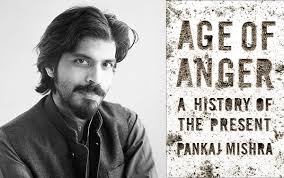
Age of Anger; A History of the Present, Pankaj Mishra, 2016

Friedrich Nietzsche and Marx

Voltaire

Jean-Jacques Rousseau
Nietzsche Appeared to be building on this contrast when he claimed to identify in the battle between Voltaire and Rousseau the ‘unfinished problem of civilization’. On one side stood the ‘representative of the victorious, ruling classes and their valuations’; on the other, a vulgar plebeian, overcome by his primordial resentment of a superior civilization.
One doesn’t have to subscribe to Nietzsche’s dichotomies to see that the disagreements between Voltaire and Rousseau illuminate some of the perennial questions: how human beings define themselves, what holds societies together, and divides them, why the underprivileged majority erupts in revolt against the privileged few, and what roles intellectuals play in these conflicts.
Alexis de Tocqueville
But as Tocqueville shrewdly pointed out, determined to ‘rebuilt society according to a entirely new plan, which each of them elaborated by the light of reason alone’, these men of letters (Voltaire and Rousseau) developed
“a taste for abstract, general theories of government, theories in which they trusted blindly. Living as they did almost totally removed from practical life, they had no experience that might have tempered their natural passions. Nothing warned them of the obstacles that existing realities might pose to even the most desirable reforms. They had no idea of the perils that invariably accompany even the most necessary revolutions. Indeed, they had no premonition of them because the complete absence of political liberty ensured that they not only failed to grasp the world of affairs, but actually failed to see it. They had nothing to do with that world and were incapable of recognizing what others did within it.”
V.S. Naipaul Salman Rushdie
Many of them also became members, like Naipaul and Rushdie, of what the philosopher Kwame Anthony Appiah calls a ‘comprador intelligentsia’: ‘a relatively small, Western-style, Western-trained group of writers and thinkers who mediate the trade in cultural commodities of world capitalism at the periphery’. Some other began to think, after close observation of European and American politics and history, that Voltaire and Kant, after all, might not hold the key to redemption, which may lie closer to home, in indigenous religious and cultural traditions.
John Maynard Keynes
The triumphs of capitalist imperialism in the nineteenth century had fulfilled on a grand scale Voltaire’s dream of a worldwide materialist civilization knit together by rational self-interest…A typical later example was the inhabitant of London, who in 1914, as John Maynard Keynes wrote, could ‘order by telephone, sipping his morning tea in bed, the various products of the whole earth…he could at the same moment and by the same means adventure his wealth in the natural resources and new enterprises of any quarter of the world’. This blessed citizen of an empire, who was best positioned to make money in globalized markets, regarded this state of affairs as normal, certain, and permanent, except in the direction of further improvement’. To him, ‘the projects and politics of militarism and imperialism, of racial and cultural rivalries’ seemed to have no influence on social and economic life. The extensive conflagrations of the early twentieth century, during which racial and national identity was repeatedly valued more than economic rationality, shattered this illusion. As Keynes wrote, with devastating understatement, “The age of economic internationalism was not particularly successful in avoiding war”.
But Nietzsche seemed to answer most thrillingly, as the (nineteenth) century ended, a general feeling of malaise: he seemed best able to discern, as Lu Xun, China’s iconic modern writer, claimed, ‘the falsity and the imbalances’ of nineteenth-century civilization. He confirmed the sense that old practices and institutions were failing to respond to the imperatives of development and progress, but he also seemed to amplify a widely felt need for a New Man and New Order.
To his youthful followers across the world he (Nietzsche) provided the intellectual framework for several quintessentially modern and pressing projects: the radical trans-valuation of inherited values, the revolt against authority and its shibboleths, the creation of new forms of superabundant life, and politics in the grand mode.
However, men like (Timothy) McVeigh, (Ramzi Ahmed) Yousef and (Omar) Mateen challenge the assumption that a freely willing human subject is motivated by certain desires, beliefs and perceived benefits, and has an omelette in mind — a New Man or a New Middle East — when he breaks eggs. For them the act of violence is all; they have no vision of an alternative political reality on a global or even local scale, like the one of a classless society or an Islamic nation state offered by communist and Iranian revolutionaries in the past and cultural supremacists and enthno-nationalists in the present. Pierre-Joseph Proudhon once defined this particular kind of revolutionary:
“Neither monarchy, nor aristocracy, nor even democracy itself, insofar as it may imply any government at all, even though acting in the name of the people, and calling itself the people. No authority, no government, not even popular, that is the Revolution.”
And now with the victory of Donald Trump (2016) it has become impossible to deny or obscure the great chasm, first explored by Rousseau, between an elite that seizes modernity’s choicest fruits while disdaining older truths and uprooted masses, who, on findings themselves cheated of the same fruits, recoil into cultural supremacism, populism and rancorous brutality. The contradictions and costs of a minority’s progress, long suppressed by historical revisionism, blustery denial and aggressive equivocation, have become visible on a planetary scale
They encourage the suspicion — potentially lethal among the hundreds of millions of people condemned to superfluousness — that the present order, democratic or authoritarian, is built upon force and fraud; they incite a broader and more apocalyptic mood than we have witnessed before. They also underscore the need for some truly transformative thinking, about both the self and the world.


