
The Road to Freedom; Economics and the Good Society, Joseph E Stiglitz, 2024

From FDR’s “Four Freedoms Speech” 1941
The first is freedom of speech, and expression — everywhere in the world. The second is freedom of every person to worship God in his own way — everywhere in the world…freedom from want — which, translated into world terms, means economic understandings, which will secure to every nation a healthy peacetime life for its inhabitants — everywhere in the world…freedom from fear — which translated into world terms, means a world-wide reduction of armaments to such a point and in such a thorough fashion that no nation will be in a position to commit and act of physical aggression against any neighbor — anywhere in the world.
From Reagan to Clinton, presidential administrations expanded the freedom of the banks. Financial deregulation and liberalization meant freeing the banks to do as they pleased…The very word “liberalization” connoted “freeing”. When the 2008 financial crisis hit, we discovered the cost. Many Americans lost their freedom from fear and want as the very real prospect grew that millions of workers and retirees would lose their jobs and homes. We as a society lost our freedom — we had no choice but to spend taxpayers’ money to bail out the banks.

John Maynard Keynes and FDR saw an alternative way forward from classical economics. Updated for the marked changes in the economy and our understanding of the past three-quarters of a century, their vision still stands as an alternative to the neoclassical and neoliberal economics that followed and to the new Right that is emerging. The Keynes and FDR approach was a tempered capitalism with government playing a key but limited role, ensuring stability, efficiency, and equity — or at least more than is provided by unfettered capitalism. They laid the groundwork for a twenty-first-century progressive capitalism that supports meaningful human freedom.
Adam Smith 1776 The Wealth of Nations :
The interest of [businessmen] is always in some respects different from, and even opposite to, that of the public…The proposal of any new law or regulation of commerce which comes from this order…ought never to be adopted, till having having been long and carefully examined. with the most suspicious attention. It comes from an order of men…who have generally an interest to deceive and even oppress the public.
If you are born into the wrong environment, those assets mean nothing. They yield the returns they do only because of the socioeconomic environment as to our own skills and effort. There is full justification, then, for imposing high taxes on high income even in a perfectly competitive economy in which wealth is garnered in ways that have full moral legitimacy.
Likewise, the moral claim against progressive taxes is slim if high incomes arise out of luck or inheritance–and even more so if they are made possible through exploitation or because the rules that generate or allow such income have been shaped by access to political power.
Donald Trump illustrates what happens when parents and teachers fail, and an individual does not become socialized. When norms, peer pressure, and tradition worked normally, we didn’t need strong laws to define what a president could ethically do. Almost every president acted within the constraints. But Trump, with his brazenness, may force us to define the presidential limits more precisely by putting them within laws and regulations.
In the centuries since the Enlightenment, we’ve developed institutions that do a remarkable job of assessing the truth–independent courts, research and educational institutions, and professional associations. There was a widespread consensus behind these institutions until the naysayers in the modern Republican Party and their counterparts around the world arrived on the scene. Unless we restore trust in our truth-ascertaining and verification institutions, it will be hard to have a sustained, well-functioning society or a productive economy.
Financial Times article in 2020 on Facebook;
In short, without full transparency, with a mechanism for holding participants to account, without equal ability to transmit and receive information, and with unrelenting intimidation, there is no free marketplace of ideas. One of the major insights of modern economics is that private and social incentives are often not well-aligned. If those who want to spread misinformation are willing to pay more than those who want to counter it, and if lack of transparency is more profitable than transparency [if we simply say] “so be it,” we won’t get a well-functioning marketplace of ideas.
Online platforms have not only exacerbated societal fragmentation; they have also increased the problem of the rapid, viral spread of mis- and disinformation. Virality means that information can spread quickly, more quickly than “antidotes” to the misinformation can be designed. The lack of transparency in who gets what messages have meant that the antidotes cannot be effectively developed and delivered in the relevant time span, if at all.
Social media companies have enabled the incitement of violence and the spread of hate speech and induced antisocial behavior. Their claim that they are neutral is obviously false.
Should we allow greenhouse gas emission to go unfettered? How should we manage a public health crisis like a pandemic? In that case, the transmission of scientifically false information — especially targeted mis- and disinformation that goes viral — can have dangerous and destructive consequences.
Feudalism was marked by a high concentration of power and wealth, low economic growth and slow social progress. Communism succeeded in generating greater security and more equality in material goods but failed on other counts, including low economic growth, an absence of freedom in all dimensions; a concentration of power, and a greater inequality of standards of living than Communist rulers would admit.
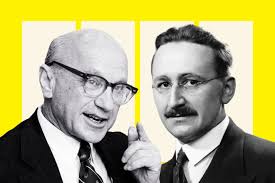
Milton Friedman Friedrich Hayek
Neoliberalism, the dominant economic system in the West over the past forty years, is increasingly viewed as an economic failure because it brought slower growth and more inequality than in earlier decades…It increased societal polarization; created selfish, materialistic, and often dishonest citizens, and contributed to a growing lack of trust.
It is intuitively clear to me that a society marked by greater equality (other things being equal) is better than one marked by huge disparities; that cooperation and tolerance is fundamentally better than greed, selfishness, and intolerance. The extreme versions of the latter that have appeared on the American scene in recent decades are truly loathsome.
Similarly, we now recognize the dangers of climate change, but if governments take action to restrict fossil fuels, under existing investment agreements, they might have to pay out as much as $340 billion to compensate the companies for not destroying the planet.
Our economic system has to be decentralized, with a multiplicity of economic units–many enterprises and other entities (of different kinds) making decisions about what to do and how to do it. The world is too complex to be centrally planned…Any well functioning economy or society requires a mix of types of institutions, not only public and private for profit, but also cooperatives, private not for profit, and so on. And the governmental institutions need to operate at multiple levels, including local, state or provincial, national and global. These institutions need to exert checks and balances on each other and the overall governance structure must limit power and its abuse. I want to emphasize that there must be large parts of the economy that are not and cannot be driven by profits. These include much of the health, education, and care sectors, in which the the narrow pursuit of profits often leads to perverse results. The private prison system has failed its core mission of rehabilitating prisoners.
…we are not born fully formed; we are shaped by our parents, our schools, and the environment surrounding us–including the economic, political, and social system in which we are embedded…cooperative institutions may spur more cooperative behavior. The neoliberal system that we’ve had for the past half century has failed on its own terms by not producing the shared prosperity it promised, but more disturbingly, it also bred more selfish and materialistic people who are less honest and trustworthy. What kind of a world is it in which individuals routinely make money by taking advantage of others and don’t even feel guilty?
Progressive capitalism’s deep aspiration is to construct a society in which there is more empathy, more caring, more creativity, and healthy striving, with individuals who are less selfish and more honest–and these attributes will lead to a better-functioning economy and society.
I believe a large part of the answer is related to two problems of neoliberalism that I’ve called attention to: the growing income and wealth divide that marks twentieth and twenty-first century neoliberal capitalism and the polarization caused by the media. Making matters worse is that current rules allow the rich and elites to have a disproportionate voice in shaping both the policies and societal narratives. All of which leads to an enhanced sense by those who are not wealthy that the system is rigged and unfair, which makes it all the more difficult to heal divisions.
As income inequalities grow, people wind up living in different worlds and don’t interact. There is a large body of evidence showing that economic segregation is growing and has consequences, for instance, on how each side thinks and feels about the other. The poorest members of society see the world as stacked against them and give up on their aspirations; the wealthiest develop a sense of entitlement, and their wealth helps to ensure that the system is rigged. But these individual opinions about the economic divide only increase the societal divide.
Not only are neoliberal economies inefficient, but neoliberalism as an economic system is not sustainable. There are many reasons to believe that a neoliberal market economy is prone to devour itself. A market economy runs on trust. Adam Smith emphasized the importance of trust, recognizing that society couldn’t survive if people brazenly followed their own self interest rather than good codes of conduct.
The regard to those general rules of conduct, is what is properly called a sense of duty, a principle of the greatest consequence to human life, and the only principle by which the bulk of mankind are capable of directing their actions… Upon the tolerable observance of these duties, depends the very existence of human society, which would crumble into nothing if mankind were not generally impressed with a reverence for those important rules of conduct.
A “businessman” like Donald Trump can flourish for years, even decades, taking advantage of others. If Trump were the norm rather than the exception, commerce and industry would grind to a halt.