
The Big Con: How the Consulting Industry Weakens Our Businesses, Infantilizes our Governments, and Warps Our Economies; Mariana Mazzucato and Rosie Collington, 2023

This book exposes the Big Three consultancies; McKinsey, Boston Consulting Group, and Bain and Company; together with the Big Four accountancys PwC, Deloite, KPMC and EY together with others as “confidence” or con operations who endanger our governments and businesses and threaten the entire economies of the world.
And the big consultancies that are intimately involved in important political and corporate decision-making often have egregious conflicts of interest themselves. Clients rarely have access to information about a consultancy’s other clients, even when they are serving “both sides of the street.” In climate consulting, for example, big consulting firms work simultaneously for governments populations would like to see lower emissions and for the fossil fuel companies that contribute most to the climate crisis.
The scale of contracts with the consulting industry–via roles as advisers, legitimaters of controversial decisions and outsourcers–weakens our businesses, infantilizes our governments and warps our economics. The cumulative use of big consultancies that operate with extractive business models stunts innovation and capacity development and learning, and undermines democratic accountability and obviscates the consequences of political and corporate actions…The Big Con imperils us all…Battling any addiction begins with admitting the gravity of the problem.
The launch of its (French January 2021) vaccine program had been a disaster; just 5,000 people had been vaccinated by the beginning of January, compared to 316,000 in Germany and 139,000 in Spain…It didn’t take long for media outlets to uncover that McKinsey had been at the helm of the vaccine rollout.
Obamacare was a bold mission to bring healthcare to more people who needed it in the United States…Dozens of contractors were brought in to manage the delivery of core parts of Obamacare. This included HealthCare.gov, the website through which individuals could purchase subsidized private health insurance via an exchange market platform and sign up for Medicaid. By 7 a.m. (launch date Oct 1, 2013), millions of people had tried and failed to access HealthCare.gov. The website had crashed…Two and a half weeks later, the White House even considered shutting the website down indefinitely.
Technology contractors and vendors were brought in to do almost everything related to the development of the website, software and integration systems. These included the military technology giant Lockheed Martin, as well as companies that specialized in providing digital technology for the federal government such Aquilent–which has since been acquired by Lockheed Martin–and a host other smaller IT and software engineering firms. In total, over fifty-five companies were hired to work directly on the project.
A government review in 2014 revealed that the costs for delivering HealthCare.gov had soared to $1.7 billion–multiples of the original budget…On the day that HealthCare.gov was supposed to launch, CGI Group (Canada) had a market capitalization of $8.9 billion, with annual revenues of around $4.8 billion…In total over $200 million was set aside for the Canadian firm. In the end, the cost overrun for its five HealthCare.gov contracts reached $28 million…An independent review determined in February 2013 that there were “a high number of coding defects” in CGI Group’s work. Internal staff in CMS (Centers for Medicare and Medicaid Services) discovered that the company’s developers “did not follow some best practices for making last-stage coding changes, resulting in code conflicts between some systems. In the end, these all proved critical to HealthCare.gov’s botched launch.
To assume that HealthCare.gov would have been successful if only CMS senior managers had “declared a clear business owner” or improved communication among its own staff ignores the systemic problems with an approach to government that relies on outsourcing core functions and parts of their management to consultants. Even with the best public managers in the world, and with an organization culture that “promoted acceptance of bad news” and “continuous learning”–as also recommended,,,the size and complexity of the contracts exacerbated the risk to the whole healthcare initiative–and to the government. To believe that these organizational tweaks would even be possible after decades of outsourcing across government departments was wishful thinking.
“Often, c-suiters–the people making the decisions at the top of organizations–have already made up their mind, but they really need an external independent arbiter to validate their position or make the case on their behalf. They can then go to the board and say, “Oh, Deloitte or McKinsey or EY said we should do this.” It’s the consultancy credibility stamp of approval. And for me, I saw that on so many of my projects.”
A loss of knowledge can also undermine the state’s capacity to govern relationships with the private sector, whether through regulation, procurement or other forms of partnership. Throughout the history of capitalism, governments have needed to maintain a deep knowledge about developments in markers and specific companies. A skilled government workforce needs to be able to analyze changes both to ensure corporate laws are abided by to amend or improve those laws where necessary. Engaging with markets has always been important in their regulation for the simple reason that businesses are a key source of information about sector and economy wide trends. But with the growth of consulting since the 1980s, many critical areas of regulation have become characterized not as a learning relationship–in which public sector analysts turn to markets for insights that will help them to make appropriate regulatory decisions–but instead by the outsourcing of the development of those rules to the market actors who will be affected by them.
That incremental loss of up-to-date knowledge also affects public bodies’ ability to negotiate suitable terms for new contracts with the consultancies and other providers. Again, this is particularly the case in highly technical areas of public services, such as environmental monitoring, finance and digital technologies.
This was illustrated when Denmark contracted with IBM to integrate “Watson” into the Copenhagen region’s hospital system. After 18 months in 2018 the relationship collapsed when it became clear the technology would never work. A former Danish official describing how “it was very oversold what Watson could do. There was something of the ’emperors new clothes’ about it.” Millions of kroner were pocketed by IBM and wasted.
- Low Agreement: During a 2017 pilot project at Rigshospitalet (Denmark’s leading hospital), oncologists found that local tumor board decisions agreed with Watson’s recommended treatments in only about one-third of the cases.
- Guideline Mismatches: The low concordance rate highlighted fundamental problems with adapting a single global AI tool (Watson) —trained heavily on protocols from New York’s Memorial Sloan Kettering Cancer Center—to regional European healthcare guidelines, localized drug availability, and distinct clinical practices.
- Abandonment: Due to these misalignments and low utility in actual clinical workflows, Danish clinicians ultimately dropped implementation of the platform.
The coup of “cronyism” during the (Covid 19) pandemic in the U.K. could not have happened without the hollowing out of internal contracting capacity. In better days, a minister who sought to provide favors for an old business partner or close friend would be met by administrators whose job it was to ensure procurement was a transparent and fair process…The scale of “corrupt” contracts in the UK and elsewhere during the pandemic suggests this is not the case today.
In business organizations–as in the public sector–the collective and cumulative development of knowledge and resources are at the heart of a firm’s capacity to innovate products and respond to new customer and social demands…The cycle of adopting and then abandoning the consulting industry’s various solutions “may reinforce a persistent lack of knowledge accumulation within the system of knowledge supply.” Some researchers even view “forgetfulness” as being at the heart of management consulting, whereby “the persistent introduction ideas…permits the repeating of previous mistakes and inhibits organizations from learning.”
In few areas have the consequences of MSV (maximize shareholder value)–and the influence of the consulting industry in its entrenchment–been more apparent than in the pharmaceutical industry. The development of new drugs is a highly complex and highly uncertain process, which requires strategic investment in a skilled workforce and technical equipment. Studies have demonstrated that in recent decades, many pharmaceutical companies have reduced investments in R&D as they increase distributions to shareholders, securing greater profits not through creating value from drug innovation, but through cutting operational spending and inflating the prices of existing drugs, often acquired through mergers.
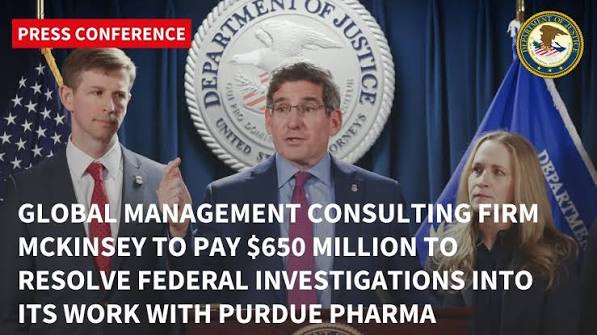 The primary resolution came through a historic $650 million deferred prosecution agreement with the U.S. Department of Justice (DOJ), making McKinsey the first management consulting firm to be held criminally responsible for advice that led to a client’s criminal conduct. Most recently, McKinsey added $125 million to Purdue Pharma’s (manufacturer of OxyConti) broader $7.4 billion bankruptcy restructuring plan to entirely resolve remaining civil liabilities.
A clear example was the collapse of Valeant Pharmaceuticals in 2016 for which the Financial Times ran the headline “McKinsey’s fingerprints are all over Valeant.”
McKinsey and other consultancies involved in the Valeant case were not solely responsible for the direction the company took. Valeant and its business model existed within g political and legal infrastructure and facilitated egregious value extraction, part of what the law professor Katharina Pistor calls the “code of capital”. The company’s strategy of maximizing shareholder value by price gouging was only possible because the United States does not regulate drug prices. KcKinsey’s calls to slash R&D spending did not fall on deaf ears and were embraced wholeheartedly by its client-because shareholders are allowed to have short-term interests and suck companies dry without ever creating value through new treatments. But KcKinsey nonetheless profited from the extractive direction the company took, and it did not face sanctions or repercussions beyond unfavorable headlines that ultimately have not affected the company’s overall growth.
In 2008, Sweden’s Stockholm County Assembly (chose) to completely reimagine the region’s largest hospital, setting the mission of creating a hospital explicitly “to meet future challenges for health delivery.” politicians across the party spectrum agreed to rebuild most of the Karolinska University Hospital, which had been established at the dawn of the country’s modern welfare state in 1940. The new hospital, Nya Karolinska Solna (NKS), would develop and implement ground breaking medical technologies, all in a building designed to minimize the risks of infection, harness the benefits of natural light and materials, and foster interdisciplinary research across departments. Public art, understood as key to patients’ holistic well-being and recovery, would adorn the hospital’s walls. Acutely aware of the environmental costs of hospital care, Stockholm Country Assembly also aimed for NKS to become one of the most sustainable hospitals in the world, with most of its energy coming from renewable sources…They commissioned reports from Ohrlings Pricewaterhouse Coopers (the Swedish branch of PwC) and Ernst & Young to explore the potential challenges of such an approach (public-private partnership). Unsurprisingly, both consultancies concluded that private firms would not only offers the “highest possibility of value creation since it gives incentives to innovation and optimized investments and operating costs over the life cycle.” but also “decreased risk for running costs, since the risk mainly is transferred to the private partner.”..Before long NKS had earned a reputation as the “most expensive hospital in the world.”..In 2019, the BMJ reported that around 250 doctors and 350 nurses at the hospital had been warned they could lose their jobs because of an unanticipated deficit.
The Kyoto Protocol of 1997 was an international treaty that sought to extend UNFCCC. In the negotiations, the Clinton administration successfully argued for the inclusion of “market based flexibility mechanisms, namely international emissions trading.” In this system, industrialized countries could emit beyond internationally agreed limits by buying “credits” from other countries that emitted less than their targeted amounts of carbon. The resulting birth of global carbon trading created a booming market in carbon credits and related financial instruments across primary and secondary markets that in 2021 were estimated to be worth $277 billion globally, and ensured industrial interests could continue to emit to their shareholders content. In 2001, the United States ultimately withdrew from the Kyoto Protocol under George W Bush…
However, governments and businesses may also hire consultancies not to reduce their climate footprint, but to convince others of the commitment to mitigating the climate crisis, even if this is not matched with action.
In response to this (deforestation), during the 2000s the UNFCCC developed the “Reducing emissions from deforestation and forest degradation” (REDD) mechanism, which aimed to create a means of offering financial incentives to developing countries to maintain, conserve, and manage forests that might otherwise be cut down for profit…In 2007, the UNFCCC contracted McKinsey to develop a metric for estimating the financial value of maintaining, conserving, and managing forests as a source of carbon capture, vis-a-vis other uses of the land, through an extension REDD known as REDD+.
The tool that McKinsey created was based on a Marginal Abatement Curve (MAC), a technique that has long been used by governments to evaluate the cost effectiveness of different climate strategies…Using its MAC tool, McKinsey advocated the reduction of deforestation to be achieved through stopping what is known as “slash and burn” agriculture by indigenous communities, because this tradition was deemed to create low financial value, and so the communities would require less compensation for the loss of habitats and ways of life. Large timber companies, in contrast, would require higher compensation because the costs of not cutting down forests for them were deemed high. The latter was, of course a far greater contributor to deforestation…McKinsey’s clients included logging companies that operated in the forests of countries involved in REDD+…The indigenous communities affected most by the mechanism…were not clients of McKinsey.
Environmental, social and governance criteria (ESG) are standards that companies can use to demonstrate that their operations do not harm the environment, that they support positive relationships with employees and other communities; and that they have effective governance structures. Advocates of ESG claim that by encouraging companies to disclose this information, good corporate behavior is incentivized because it is rewarded with higher value: The pitch that companies should focus on ‘doing good’ is sweetened with the promise that it be also be good for their bottom line and for shareholders.
Demand for corporate ESG Frameworks and financial ESG investing metrics has exploded in the past few years…The Business Roundtable, a lobbying group made up of large companies in the United States, “supercharged the ESG movement following its 2019 meetings, when it endorsed the view that businesses exist to serve stakeholders, and not just shareholders. Bloomberg reported that ESG designated assets are “on track to exceed $53 trillion by 2025,” representing more than a third of projected total assets under management. Investors with $100 trillion of assets under management have signed on to the United Nations Principle for Responsible Investment, which were “developed by investors, for investors,” and advocate greater use of ESG frameworks for investing.