
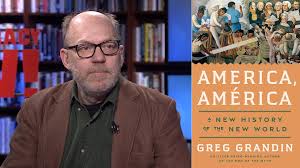
America, América: A New History of the New World, Greg Grandin, 2025
As if to intentionally mock expectations and exacerbate resentment, President Harry Truman signed the Marshall Plan into law on Apr 3, (1948), shorty after talks in Columbia (the last Pan-American Conference held in Bogota, Columbia, in March and April 1948) had gotten under way. No funds were included for Latin American reconstruction. As the plan’s formal name made clear, it was exclusively a European Recovery Program. Earlier in the year, after the government of Brazil had asked Washington to fund a modest program of industrial development, the White House send down a commission headed by the economist John Abbink, chairman of McGraw-Hill, to study the request. The commissions response, try “self-help,” and “do it yourself.” Adding to such insults, Truman, when pressed on whether Latin America would receive a recovery plan, answered: “There has been a Latin American Marshall plan for the Western Hemisphere for a century and a half and known as the Monroe Doctrine.”
Marshall had little to give because Washington had, by this point, moved on from the region. The train of global of events hurtled forward, as fighting a Cold War against Moscow became official policy.
In mid-February 1948, George Kennan’s Policy Planning Staff produced a paper meant to “trace the lines of development of our foreign policy, and to project them into the future, so that we could see where we were going.” Sending the paper on to Marshall, Kennan apologized for not including Latin America.” Kennan said, But, he confessed, “I am not familiar with the problems of the area, and the Staff has not yet studied them.”
The irony: Good-Neighbor Pan-Americanism (FDR) was such a spectacular diplomatic and strategic success that, after Allied victory, not much diplomacy or strategy was needed to administer the region. Latin America fell back to being a place to make money and rehearse new strategies of global policing. By 1948, the White House and the State Department had largely ceded responsibility for Latin America to the Pentagon and the private sector.
In Western Europe (after WWII), access to public capital and cheap credit allowed liberalism to reestablish itself, to expand social welfare. In Latin American, the need to placate foreign capital allowed no such outcome. For instance, in Germany, the founding document of the Christian Democratic Union called for the the creation of a “socialist economic order.” When Christian Democrats in El Salvador and Guatemala said they wanted the same thing, they were executed.
The Catholic Church, Israel’s secret services, and the CIA joined forces to get the SS officer Walter Rauff, who during the war killed tens of thousands with his mobile gassing vans, first to Ecuador and then Chile. There, he started building a network of refugee Nazis that he put at the service of the region’s militaries and intelligence agencies. When Pinochet overthrew Allende in 1973, Rauff began working with Chile’s secret police, the DINA, Pinochet’s notorious gestapo. Rauff also helped the government construct a concentration camp on Dawson Island in remote Patagonia and had close ties to the cultish Colonia Dignidad in the low Andes, a guarded community of German immigrants that served Pinochet as a torture center.
United States investment soared during this decade of jackboot stability, with a “great surge” of capital flowing into Latin America. The State Department, now led by John Foster Dulles, turned away appeals for intercession on behalf of the “the political prisoners rotting in the dungeons of Perez Jimenez.” “We must concede,” wrote Kennan in 1950, “that harsh government measures of repression” are necessary to establish stability.
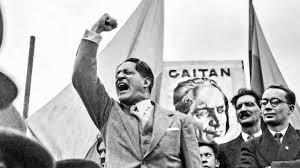
Jorge Eliécer Gaitán Ayala assasinated Apr 9, 1948 Bogota, Columbia
Kennan and Wisner went about weaponizing the kind of confusion, speculation, and conspiracy that swirled around Gaitan’s execution. The routine bewilderments of daily life, and the muddle that came with rapid social and technological change, were hypercharged whenever groups of men in the White House, at Langley, or at Foggy Bottom decided that there were things that needed doing.
Cuba didn’t become a state, as many had predicted it would. But with organized crime established on the island since at least the 1930s, Cuba was incorporated into the union in different kind of way, as a shadow state of offshore desire, for drugs, gambling, and sex…When the insurgent army led by Fidel Castro took power in Cuba on Jan. 1, 1959, the RAND Corporation calculated that the “book value” of United States investment in Cuba was greater than in any other Latin American country, apart from Venezuela…If Cuba’s (revolution) has occurred in the 1930s, say, it might have progressed at a pace of the Mexican Revolution, with cycles of reform, radicalization, reaction, and consolidation, and fights over property rights playing out over decades…”A chain reaction was occurring all over Latin America after Castro came to power. I (Jacob Esterline, CIA project director of the Bay of Pigs) saw — hell, anybody with eyes could see it– that a new and powerful force was at work in the hemisphere.” Esterline here is describing Castro the way Carcia Marquez did Gaitan, as a phenomenon whose moral energy radiated across the Americas.
In the wake of the Cuban Revolution, the United States backed a quick round of coups; El Salvador in 1961; the Dominican Republic, Guatemala (again), and Honduras in 1963; Brazil and British Guiana in 1964. All told, Washington had a hand in sixteen regime changes between 1961 and 1969.
By the end of World War II, Latin America had done the unthinkable: it had forced the great powers to recognize the sovereign equality of all nations, abrogated the doctrine of conquest, and provided a model for a world system organized around the presumption of mutual interests rather than inherit antagonisms. But a reform of diplomacy wasn’t enough to strike at the domestic sources of exploitation. Just as Eighteenth-century philosophers wrote against royal absolutism is all its stultifying effects, Latin Americans wrote and worked against all the various manifestations of dependency: economic, psychological, cultural, political, and moral.
The spread of liberation theology, dependency theory, and artistic critique went hand in hand. “Dependence and liberation are correlative terms,” Father Gutierrez wrote. “An analysis of dependence leads one to attempt to escape from it.”
The United States is now a two-tiered nation, where about 30 or so percent of the population benefits from globalization and the rest struggle to make their bills. Infant mortality is up. Life expectancy is down. And every year breaks a new record for suicides, which are significantly higher in rural areas.
Wilson imagined a world without war. FDR imagined a world without fear or want. Today’s political class imagines nothing. Its grand strategists do no better than offer perilous talk of a new cold war, of restarting nuclear testing, abrogations disarmament treaties, rearming Germany and Japan, expanding NATO, and garrisoning Africa. Wars are seen not as things to be ended but chances to leverage strategic tension to advantage, create new realms of influence.
The international institutions and rules that Latin America helped create or inspire after World War II, long enfeebled, are today nearly worthless. NATO, modeled on the Inter-American Treaty of Reciprocal Assistance, is now a blunt instrument of United States power in Europe. The world’s many wars proceed as if there never was a thing called international law. Considering the growing dependence on private mercenaries, corporate intelligence firms, and the accelerating power of out-of-control technologies, the head of Amnesty International, Agnes Callamand, says that the world stands on the brink of a “descent into hell.” Private firms like Palantir Technologies and Israel’s Elbit Systems have teamed up to turn Ukraine, the U.S. Mexico borderlands, and Gaza into their testing grounds, integrating high-tech, AI-driven intelligence gathering into what the CEO of Palantir calls “digital kill chains.”
It feels like the 1930s all over again, as Latin America teeters between the dark and the light. Only this time its reformers are on their own in their fight against reaction — there’s no equivalent of (FDR’s) (Ernest) Gruening, (Josephus) Daniels, or (Sumner) Wells to work with.
One would think that, with all the region has suffered, from the tortures of the Spanish Inquisition to the death squads and disappearances of the Cold War, Latin Americans would have given up on the idea that history is redeemable. Yet centuries of violence seemed to have seared into activists an irrepressible ability both to recognize the dialectic lurking behind the brutality and to answer every bloody body with ever more adamant affirmations of humanity.
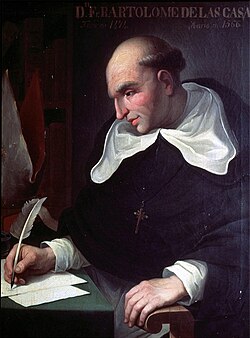
Bartolomé de las Casas Bishop of Chiapas
Las Casas spent 50 years of his life actively fighting slavery and the colonial abuse of Indigenous peoples, especially by trying to convince the Spanish court to adopt a more humane policy of colonization.
One reason for the persistence of a humanist, social-democratic left, one absorbent enough to take in demands related to gender, race, and sexuality, has to do with, I think, the fact that Spanish colonialism’s moral crisis came early with the Conquest. The critique launched by dissenters was frontal and all encompassing, and when independence from Spain finally came, many of those who led that movement understood “emancipation” (even if they didn’t always act on that understanding) in its fullest sense, to include, potentially at least, all forms of oppression. This, I think, helps explain Latin America’s commitment to a panoramic conception of citizenship, on that includes social rights.
The Anglo experience was different. Evasion and denial were English settlement’s hallmarks. And remained so for centuries. No ethical dilemma accompanied the destruction of the continent’s indigenous people. When a moral crisis over chattel slavery did finally come, in the 1800’s, it abstracted Black-skin bondage as a singular, exceptional sin. This, as historian David Brion Davis wrote fifty years ago, had the “great virtue” of providing an “ideal” and “clear-cut” model of evil, which was useful for abolitionists when it came to fighting it but a hindrance to later historians and activists when they tried to relate it to the persistence of “other species of barbarity and oppression.” This, I think, helps explain why the United States’ inability to overcome a narrow conception of individual rights.
Latin American nations do not always agree on the best way forward to calm international problems, including, for example, Valenzuela’s 2024 electoral crisis. Yet despite their differences, most of their leaders all start with the founding premises of American International Law, persistent diplomacy, arbitration, de-escalation, respect of sovereignty, and as Sumner Wells put it when Vargas made his power grab, “patience.” Washington, be it led by Republicans or Democrats, has forgotten Well’s call for forbearance — for letting countries work out their own internal class struggles — and rampages through Valenzuela like that bulls in that china shop, making matters considerably worse.
Still, Latin America remains among the the most peaceful continents in the world, in terms of state-to-state relations. For many, nationalism is still a gateway not toward rivalry but universalism. Native Americans have entered into politics in countries like Bolivia, Ecuador, Peru,, Guatemala, and Mexico not under the banner of ethnonationalism or separation. Rather, indigenous-led social movements and political parties are often the primary carriers of the region’s social-democratic heritage.
…”Democracy has,” FDR said over the radio in 1938, “disappeared in several other great nations, not because people of those nations disliked democracy, but because they had grown tired of unemployment and insecurity, of seeing their children hungry while they sat helpless in the face of government confusion and government weakness through lack of leadership,” Latin Americans know that the way to beat fascism now is the same as it was then: by welding liberalism to a forceful agenda of social rights, by promising to better the material conditions of people’s lives. Nearly every Latin American nation has the “right to health care” enshrined in their constitutions — a simple clear popular objective liberals and leftists in the United States should consider fighting for.

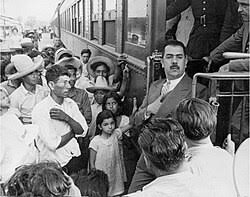

Getúlio Vargas Lázaro Cárdenas Popular Front Salvador Allende
Its difficult to imagine any politician or coalition in the United States, from any party, rising above the country’s cresting anger or its vertiginous politics of fear to become a stable ally, the way the politicians of the New Deal were, to Cardenas’s Mexico, Vargas’s Brazil, or Popular Front Chile. One can hope.