Crack-Up Capitalism; Market Radicals and the Dream of a World Without Democracy, Quinn Slobodian, 2023
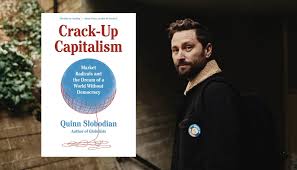
Slobodian starts with a brief history of Hong Kong and of Singapore post independence from Britain. These have been the model for special economic zones (SEZ) and greatly influenced Chinese Chairman Deng Xiaoping’s establishment of Shenzhen, Zhuhai, Shantou and Xiamen in the 1980s. (see Deng and the Transformation of China)
He later spends time on the development of SEZs in Dubai. “If there is any place in the world that has contributed to global zone fever as much as the Asian juggernauts of Hong Kong and Singapore, it is Dubai…In the first decade of the 2000s, Dubai’s economic growth grew by 13 percent a year on average, outpacing even China. Skyscrapers were built (by low cost foreign labor) at the rate of a floor every three days. In six years, the city’s population doubled and its footprint quadrupled.” All three also created additional land from massive land reclamation projects.
How could such historical accidents be made to happen again? The shortcut to Hong Kong that (Paul) Romer offered was called the charter city. The formula: persuade poor nations to surrender patches of uninhabited territory to be managed by richer ones. Pollinate the empty land with rules known to make capitalism work and watch it grow. This would be colonialism by consent, occupation by invitation…Why not go all the way and give over your country to external management.
While earlier settlers once sought wealth in gold, crops, or railroads, the treasure of (special economic) zones like Prospera in the twenty-first-century was their status as a jurisdiction — their potential as a new place to pick and choose among regulations and licensing requirements. Such zones offered vivid examples of what had become standard practice in the conduct of global capitalism. When people form a business contract anywhere in the world, they already had the choice of which law they elect to use; most commercial contracts are written either in New York State or English law. For what one scholar calls “roving capital”, laws were selected and combined a la carte…These jurisdictions (SEZs) were portals to what Oliver Bullough calls Moneyland, where people can select whichever laws “are most suited to those wealthy enough to afford them at any moment in time.”
The result, they said, would be the emergence of a hypermobile superclass of high-IQ individuals, who could remotely coordinate placid low-IQ workforces while stashing their wealth far from the grasping hands of governments.
Davidson and Rees-Mogg called this tiny, rarefied fraction of the world’s population “sovereign individuals” and estimated their combined number at a hundred million worldwide. The nation-state form was dysgenic. It worked against the dictates of evolutionary advance and survival. In an era of hypermobility, it served evolutionary interests to escape national constraints…The elites would cease to see national identity as anything meaningful, and the conceit that they owed anything to their so-called fellow citizens would be laughable. They would understand that one’s countrymen were actually “the main parasite and preditor”, their brains contaminated by the idea that they were owed a share of someone else’s hard-earned income. Sovereign individuals knew they had no obligations to anyone but themselves.
(Balaji) Srinivasan’s tweak to the start-up city model was to suggest that the online and offline worlds might not be alternatives to each other but complementary: you build online first, then you come down to earth. His replacement of the sovereign individual with “the sovereign collective” seemed like a break from Davidson and Rees-Mogg, but the difference was really only semantic. All three say the same things: the possibility of exit created by new technology, the creation of a new global caste of meritocratic adepts, and the abandonment of the taxing, regulatory state in favor of new affiliations and even new territories organized along the lines of private corporations.
Srinivasan preferred blue-sky (or, better blank-whiteboard) speculation to real-world examples. Yet one of the successful examples he offered was telling: the state of Israel. This was indeed a reverse diaspora, organized through newspapers and texts that produced a kind of cloud country of a Jewish homeland through the media of the time. Kicked off by the the publication of Theodor Herzl’s Jewish State in 1896, the Zionist plan translated only slowly into facts of the ground through small-scale acts of colonization, which were eventually accepted and given legitimacy by the dominant imperial powers of the the day. But consider the consequences of this example. The land in Palestine was no more bare than anywhere else in the world, and it remains rent by competing historical claims over territory. Israel’s solution to the problem of demographic and political geography has been to create a two-tier system separating primarily Jewish citizens of country from Muslim inhabitants of the regions. It fenced boundary — policed by cameras, drones, armed soldiers, and heat-sensing technology at the limit of theological frontier — puts the Berlin Wall’s death strip to shame.
Perhaps there was an honesty in this example. Srinivasan and his fellow tech investors expressed frustration with the problems of San Francisco — a place rife with visible inequality and untreated mental illness, the legacy of centuries of racialized poverty, violence, and discriminatory immigration policy stretching back to the original expropriation of the land on which the city was built. It is clear that Srinivasan, with his resources, could find somewhere better. But as he seemed to admit to himself, it would probably look like the state of Israel: militarized, paranoid, defiant — and also very invested in technology. It was not for nothing that a bestselling book on Israel praised by Srinivasan called it the “start-up-nation”. Here was a template: a cloud country with a twenty-six-foot-tall border wall.
Those seeking an exit in the metaverse would also find nothing of the sort. The platforms that we log on to are owned by private actors. Our every keystroke (and when we are strapped into a VR rig, out every twitch bend and nod) is minutely tracked, traced, sorted, calibrated, and sold onward to advertisers and other developers. It says a lot that one of Silicon Valley’s most successful companies — Uber — did not offer an empty prairie on which to roam and build. Rather, if you were a driver, it pulled you along like a dog on a leash, punishing you for any deviation while preserving the fiction that you were a free contractor. The metaverse, as one critic has astutely observed, is probably best thought of as a cubicle. The private government of corporations has little space for the alternative visions of collectives, other than those that reproduce its own dominance.
As one of the foundational texts of tech criticism notes, Silicon Valley often forgets its Hegel at its own risk. The German philosopher taught that the master is always dependent on the slave. Neither island nor cloud can exist without its underclass. Beyond the Masses of app-mediated gig workers, (see techno feudalism Yanis Varoufakis) even the vaunted artificial intelligence programs work only because of the often repetitive routines and efforts of labor both skilled and unskilled. From Honduras to Dubai, the waged service class is the easiest for the visionaries to forget and the hardest for them to live without.
Patrik Schumacher, Parametricism
In the twenty-first century, however, the situation changed again, (anarcho-capitalist Patrik) Schumacher said. As manufacturing grew more automated, and advances in artificial intelligence promised a “man-machine symbiosis” on the horizon, democracy no longer made sense. It was an antique ideology, an artifact of an earlier, superseded moment in the history of capitalism — a dumbly literal reading of the world map, as if everything were penned inside its colored containers. What made sense in the twenty-first century were dots on the map like Liberland: blank-slate enclaves that could be anchor points for virtual enterprises, getaways for the global elite, or new citadels of financial services, marketing, design, software engineering, and other lines of work that needed little more than an electrical outlet and a robust internet connection. “The revolution comes when the political system becomes a barrier to the forces of production” Schumacher said. “And that’s what we’ve reached.”
Reimagined Industrial City NEOM
(SEZ) Zones are everywhere, but contrary to the rhetoric of boosters, they do not seem to be creating islands of liberation from the state. Rather, states are using them as tools to advance their own purposes. NEOM is a telling example. Saudi Arabia, an economy owned and operated by a royal family, is contracting with the Chinese company Huawei to wire its agglomeration in the desert as a “smart city”. As one consultant conceded, zones have proceeded through government-enabled confiscation, running roughshod over basic libertarian principles of property rights. Creating a land market in rural China, was projected to leave 110 million villagers without land land by 2030. Zones are not turning the world into a patchwork of a thousand private polities in dynamic competition. They are strengthening the position of a handful of state-capitalist superpowers.
Good capitalists know the real game is capturing the existing state, not going through the hassle of creating a new one.
Besides, the United States itself looks more like a (SEZ) zone all the time. In 2022, it edged out Switzerland, Singapore, and the Cayman Islands to take top spot in an index of financial secrecy, crowned as the best place in the world to illegally hide or launder assets. Its own status as a democracy has been called into question. It was briefly downgraded by a well-respected index to a so-called anocracy, a system mixing features of democratic and autocratic rule. Soon, Americans may no longer need to go elsewhere to realize the perfect zone.
No matter the rhetoric, zones are tools of the state, not liberation from it. No matter the exit fantasies, zones cannot escape the earth. The third truth about them is perhaps the most banal but most consequential; zones have inhabitants. There is no such thing as a blank slate.
We can see this clearly back in the ur-zone of Hong Kong. I began this book with Milton Friedman gazing out affectionately at the city’s skyline, which he imagined as a perfect container for the conduct of capitalism, with decision-making insulated from disruptions by the absence of democratic elections. In 2017, when I presented and early version of that chapter at the University of Hong Kong, a professor from the law school laughed. Milton’s description of a quiescent city-state was borderline ridiculous in the middle of one the most convulsive periods in Hong Kong history, with the population taking to the streets time and time again to demand political self-determination.