
The Blind Spot; How Oligarchs Dominate Our Democracy, Jeffrey Winters, 2026
For oligarchs, voting is meaningless compared to how their wealth influences politics and society literally all the time…They fund candidates that protect the rich, fund think tanks to produce ideas justifying oligarchic agendas, and buy up the media that pump those ideas into society…And, as we will see, there is no area where this power is more impactful than in the epic fight over progressive taxation–the primary tool that democracies around the world use as they try to stem rising inequality. Heavy taxes on the ultra-rich, both individually and on the corporations they own, are the last chance we get to keep extreme inequality in check…Forbes reports that the US was home to about 900 billionaires in 2025, with $6.8 trillion in combined net worth. Most of that had never been taxed.
A small cushion of wealth provides an elevating safety net to fall back on; it allows for choices, buys precious time in difficult moments, and is fortifying psychologically. It must be viewed as absolutely necessary for all human beings. The problem is that most people in the world have no access to this most basic form of security; while a few are mindlessly hoarding everything they can and gearing up for an oligarchic transfer of tens of trillions of dollars tax-free to their immediate heirs.
The Gini index is reported on a scale between 0 and 100, where 0 means prefect economic equality across the population and 100 means perfect inequality — that is, everything has somehow been grabbed by a single person. (The wealth Gini for the world is 88; Sweden is 87, the USA is 83, Europe is 81.)
For the years 2014 to 2018, the 25 wealthiest American families paid a mere 3.4 percent. Warren Buffet paid 0.1 percent, Jeff Bezos paid 0.98, and Michael Bloomberg paid 1.3. Across half a century, these relentless oligarchic victories over taxation have fueled an epidemic of inequality in America and the related descent into open political warfare.

Alexander Hamilton James Madison
The converging crisis of the mid 1870s taught the (Constitutional) convention (1787) delegates two kinds of lessons reflecting two kinds of fear. One was that too much democracy and empowerment of the people could produce policies unacceptable to oligarchs. The other was that too little democracy could result in mass protests that could become volatile. What was especially worrying about all the debt relief and paper money legislation was that so many state senates had failed the test of protecting the rich…Randolph argued that, at the state level, senates were too close to the masses and too easily intimidated by unrest. Control had to shifted upward within a steep pyramid of power.
The result of 1787 was the Constitution (less all the amendments) we have today with a national senate, a president with veto power, and a high court that can override federal laws.
In 2006 Congress passed a whistleblower law for revealing tax fraud that offered a reward of up to 30 percent of the funds the IRS collects. In 2007, Bradley Birkenfeld, a UBS (Union Bank of Switzerland) employee, came forward with incrimination information. “Without Mr. Birkenfeld walking in the door of the Department of Justice in the summer of 2007, I (Kevin Downing) doubt as of today this massive fraud scheme would have been discovered by the US government.”
Birkenfeld received $104 million but spent thirty months in prison for his efforts.
Charles P. Rettig, who was the IRS commissioner in 2023, said that the actual number was “about $1 trillion in unpaid taxes every year.”..For perspective, the tax gap in 1974 was only $40 billion…With Rettig’s estimated $1 trillion in taxes going unpaid every year, it means the very rich are constantly adding hundreds of billions to their wealth through non-compliance and defeating the tax system.
We’ve arrived at a paradox where oligarchs are more visible than they’ve been in 150 years while their wealth is more invisible than ever…As we’ve seen, three of the most important weapons in the oligarchic arsenal are complexity, secrecy, and infiltration. Complexity, created deliberately be the Wealth Defense Industry, is deployed as a squid deploys ink. The secrecy that hides wealth and financial dealing is a core concession to oligarchs by governments–most evident in their reluctance to demand an answer to the most basic political-economic question: who owns an asset? And infiltration is the placement of oligarchic foot soldiers in strategic government offices to ensure key regulations tilt strongly in favor of the rich.
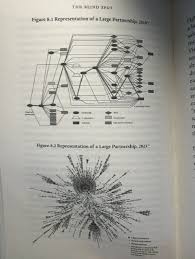
With multi tiered (20 or more) partnerships with half a million partners or more and pass throughs replacing corporations, driven entirely by tax advantages for oligarchs, tax collection is virtually impossible. Two Congressional efforts to reign in this chaos The Enablers Act and the Corporate Transparency Act (CTA) both failed.
The CTA had a very simple goal — to document “beneficial ownership.” By now, it is apparent that, in the hall of mirrors that is the world of assets, income, and ownership, there are scores of entities that range from actual people to creations on paper that can, at least financially, do everything an actual person can do except have a heartbeat. All of these constructed substitutes for persons–companies, shell corporations, shelf corporations, trusts, foundations, and so on — ultimately represent, somewhere, buried under multiple layers and tiers of concealment, real breathing persons who are the owners, the beneficiaries, the controllers and deciders, beyond whom there is nothing else. Sometimes there are so many hidden intermediaries that there is a need to refer to the “true” beneficial owners.
The CTA was the US government’s attempt to find out who owned what, their names, and where they were. Having that information makes it far easier to confront threatening groups or actors, discover how trillions of dollars in illicit funds are hidden, moved, and laundered, and sometimes intercept dangerous peoples before they can do great harm. On this occasion (the 2021 Defense Authorization Act), oligarchs were late to the game, in part because wealth defense specialist hadn’t been paying attention…It was a costly oversight… The CTA became law on 1 Jan 2021 with strong bipartisan support.
It was in March 2025 that the bombshell hit…the executive branch was now under the control of a new administration with no interest in corporate transparency…”All entities created in the United States — including those previously known as ‘domestic reporting companies’–and their beneficial owners are now exempt from the requirement to report beneficial ownership information.“..By executive fiat, over 99 percent of all companies that had been required to register no longer had to do so….The law was still there, but it had been completely gutted.
The politics of preparation
The second level of our challenge to oligarchy (after progressive taxation) is deeper, focusing on changes that become possible only during the politics of crisis, when oligarchs are at their weakest. During ruptures, the decision-makers oligarchs rely on face pressure to focus their priorities on stabilizing the society. That certainly can included default responses that shore up oligarchy itself, but that is not necessarily the case. It is in the nature of crises that those in charge become far more willing to consider policies and solutions that would be unthinkable during the politics of the ordinary. They can do this because emergencies often require extreme actions and because they are less afraid of the ways oligarchs can punish. After all, oligarchs themselves are in disarray during these ruptures and also want restabilization, even if that means significant concessions they would ordinarily oppose bitterly…When a rupture happens. two things matter most; how well organized citizens are to pursue their interests, and what major changes are prepared to be implemented. A high state of readiness in such moments enables change that is transformative and lasting.
Wealth inequality arises at two sites. The first is the labor market, where inequality unfolds at our places of employment. Many impactful things can be done there to constrain oligarchs–enacting laws that facilitate rather than block unionization, raising minimum wages, having employees own significant shares of their workplaces, and indexing compensation of employees to compensation for the highest levels of management and ownership, just to start.
The other site is after the dust has settled on these income, compensation, and wealth gains. This is where we address inequality through redistribution. Confronting political structures that uphold oligarchy– like unrepresentative lower houses, senates, supreme courts, and presidential vetoes–is unusually hard. Enacting policies for the redistribution via the tax system has not only been a realm of great success but one where the victories has been so substantial that oligarchs were forced to retreat into tax evasion as they fought to reduce the tax rates. There are two large lessons to draw from this; the progressive tax victories of the past must be won again and stronger, and the maneuvers of the Wealth Defense Industry has devised to subvert redistribution must be answered. That means dismantling the mazes of complexity the industry has built, forcing an end to ownership secrecy, and closing the industry’s revolving door with government.
There is no greater threat to oligarchy than transparency…This extreme secrecy can be defeated. In the US, enacting policies like the Enablers Act and Corporate Transparency Act will deal a major blow. We must also turn the Wealth Defense Industry against its creators by forcing its many branches to monitor and report suspicious financial activity–with stiff penalties including imprisonment for failing to do so.
Although it’s a tough sell, democratic populations around the world must support dramatically stronger tax agencies. Larger budgets, more auditors, and more technology will only hurt oligarchs.
In 1922, American oligarchs faced fifty-six brackets. After the Second World War, the highest bracket was over 90 percent. By 2026, there were just seven brackets with the highest rate being 37 percent. Having two or three dozen tax brackets, with the highest being over 80 percent is an important goal.
The immediate goal must be to impose two kinds of taxes on oligarchs–a true income tax on annual gains in the value of oligarchic fortunes, and wealth tax on the total current value of those riches.
Oligarchs enjoy substantial annual increases on their assets, but this income is rarely taxed unless it is “realized” by selling the assets. This is a pure concession to the rich that fuels inequality and serves no positive social purpose.
As I’ve mentioned, this agenda is only a start–there are many more reforms that could be attempted. Still, while achieving them would be great progress, they are not enough to end participatory inequality. That requires deeper and harder changes of a constitutional or semi-structural kind. This moves us into the realm of the politics of preparation. These proposals are grand in scale and significantly more impactful in making political power more equally shared. They are conceivable only under conditions of severe crisis.
Three of these ideas are a direct reversal of oligarchic safeguards created by the Philadelphia (1787) delegates. Such antidemocratic features have been replicated in many countries since, especially in presidential systems. The first one requires little elaboration. The veto powers of the executive branch should not exist. A single person should not be able to cancel the will of the people expressed through the legislature’s deliberations and votes. The purpose of an executive branch is the execution of laws and policies from the legislature not the making or blocking of policies from that powerful office. If there is a need to check or slow certain sensitive decisions, it would be fine to grant limited powers to the executive branch to delay implementation to allow for further national debate or to send a law back to the legislature for a confirming simple majority vote.
The second proposal concerns constitutional courts, which are everywhere made up of just a few judges whose primary function is to constrain democracies composed of millions of voting citizens, represented by many hundreds of legislators (or thousands if state or provincial legislatures are included). In the US, it takes just five judges to block the will of the people, even a super majority. Supreme courts and the constitutions they interpret have served to sustain oligarchy in the face of democracy. The only compelling justification for concentrating so much power in so few hands is to protect the the weak from the powerful. It certainly is good to prevent a “tyranny of the majority” when this means mostly actions taken democratically against the vulnerable, especially when those actions trample important principles of fairness and justice.
The problem is that in democracies dominated by oligarchs high courts have spent most of their time doing the opposite–defending the powerful few against the vulnerable many. The justification for constitutional courts collapses once it is recognized that their main obsession has been to support oligarchy against democracy.
One solution is to have our constitutional courts be much larger and more representative of average citizens.
Beyond the size of the court, it is important to change how justices are chosen. The current American system of presidential nomination and Senate confirmation was created in Philadelphia (1787) to preserve oligarchy. We can democratize that process using sortition. Half of the justices on the enlarged bench should be appointed by lottery from a pool of citizens who have a law degree, having served as a judge for at least three years at any level, and have a clean criminal record. Congress should vote on the remaining judges, but neither the legislature nor the executive should be involved in those appointed through random selection. Sortition will ensure that the overall panel of judges on the Supreme Court has a broader diversity of views and is more representative of the wider public. If this remedy fails, ending judicial review completely remains an option.
The third structural proposal to roll back oligarchic protections is the elimination of all upper legislative chambers. The primary purpose of senates and houses of lords is to dampen the power of more democratic bodies below them. Several countries have transitioned from a bicameral to unicameral system by elimination their upper chambers. New Zealand erased the Legislative Council in 1950. Denmark removed the Landsting in 1953. Several provinces in Canada abolished their upper houses. As senates are removed, societies should design alternative checks that ensure fairness, defend freedom, and protect truly vulnerable minorities.
Additional steps along these lines would include dramatically increasing the number of seats in the people’s legislature so that districts are smaller…Smaller districts bring representatives closer to their constituents, complicate legislative lobbying by special interests, and make it harder for oligarchs to dominate campaign financing across so many races.
sortition replaces voting
None of these major reforms goes far enough in addressing the ability of oligarchs to dominate electoral democracy with money. A bold proposal to neutralize the power of oligarchs in elections is to choose representative by lottery rather than voting.
In the US, over 150 million voters get to choose, but they do not get to choose their choices. The slate of candidates, and the narrow agenda they pursue, is overwhelmingly influenced by oligarchs. Camila Vergara calls this distortion of democracy “systemic corruption”, and she joins a growing chorus of others — most notably (John) McCormick himself, Helene Landemore, Gordon Alrlen — who argue this will never be fixed by tinkering at the margins.
Their startling conclusion is that in the face of centuries of resilient oligarchy, the only way to strengthen democracy so that it functions horizontally and vertically is by ending voting for representatives. In its place they propose sortition — selection of leaders by random lottery…We are represented not because we voted but because those making decisions are like us.
The closest example today is how juries are selected for trials from a random group of fellow citizens.

Amy Kapczynski’s Proposed Constitutional Amendment
Congress shall have the plenary power and duty to legislate a democratic political economy, in order to provide genuine political equality for all natural persons. This shall include the power and duty to remedy structural discrimination, to empower workers, to provide for the care and health of the people, and to ensure a sustainable environment. The judiciary shall defer to Congress with respect to legislation that pursues these ends, notwithstanding any other provision in the Constitution.
These words display a subtle appreciation of the problems at the heart of participatory inequality. Unlike the vague expressions in constitutions around the globe of popular values and goals societies should strive for, this proposal requires that they be pursued. A democratic political economy leaves no room for oligarchy. “Genuine political equality” refers to power shared equally in all its forms and only by natural persons, not corporations. And the courts are explicitly stripped of their power to impede this progressive agenda.