Human Rights Watch – a reflection

Righting Wrongs; Three Decades on the Front Lines Battling Abusive Governments, Kenneth Roth, Former Executive Director of Human Rights Watch, 2025

At 325 dense pages, this book is not easily summarized or digested. Human Rights Watch early on developed a strategy that focused on Shaming the governments perpetuating human rights violations. This required extensive and meticulous research and documentation of the abuse, gaining a reputation for the accuracy and reliability of the reports generated, and perfecting the process of publicizing, circulating, and gaining widespread governmental and popular attention to these reports.

The table of contents gives a quick look at the focus of the book: China, Russia and Syria, Saudi Arabia, War Crimes, Israel, The United Nations, Rwanda and the Democratic Republic of Congo, Hungary and Poland, The United States. For each focus, the book highlights the process of research and data collection, preparing reports, meeting key influential government and non government players, pressuring for changes, shaming through publication and pressure.

Karim Khan ICC Chief Prosecutor Putin, Netanyahu, Gallant

For this reader, the most interesting chapter was International Criminal Justice. Here is a detailed discussion of the development of international law and institutions to define global standards for the conducting of war, genocide, suppression of minorities and apartheid. Starting with post WWII Nuremberg and Tokyo tribunal trials conducted by the victors of the war, to the Universal Declaration of Human Rights, to the development of a consent of universal jurisdiction (jurisdiction that can involve a single nation or a coalition of nations or an international body) to bring legal cases against violators of human rights anywhere in the world. Included are the histories of the development of the ICC (International Criminal Court) and the ICJ (International Court of Justice), the International Covenant on Civil and Political Rights, the International Covenant on Economic, Social and Political Rights.

Interested readers are encouraged to read in its entirely this thoughtful, humane, optimistic work.


From the Enlightenment to the Present AGE OF ANGER

Age of Anger; A History of the Present, Pankaj Mishra, 2016

Friedrich Nietzsche and Marx

Voltaire

Jean-Jacques Rousseau

Nietzsche Appeared to be building on this contrast when he claimed to identify in the battle between Voltaire and Rousseau the ‘unfinished problem of civilization’. On one side stood the ‘representative of the victorious, ruling classes and their valuations’; on the other, a vulgar plebeian, overcome by his primordial resentment of a superior civilization.

One doesn’t have to subscribe to Nietzsche’s dichotomies to see that the disagreements between Voltaire and Rousseau illuminate some of the perennial questions: how human beings define themselves, what holds societies together, and divides them, why the underprivileged majority erupts in revolt against the privileged few, and what roles intellectuals play in these conflicts.

Alexis de Tocqueville

But as Tocqueville shrewdly pointed out, determined to ‘rebuilt society according to a entirely new plan, which each of them elaborated by the light of reason alone’, these men of letters (Voltaire and Rousseau) developed

“a taste for abstract, general theories of government, theories in which they trusted blindly. Living as they did almost totally removed from practical life, they had no experience that might have tempered their natural passions. Nothing warned them of the obstacles that existing realities might pose to even the most desirable reforms. They had no idea of the perils that invariably accompany even the most necessary revolutions.  Indeed, they had no premonition of them because the complete absence of political liberty ensured that they not only failed to grasp the world of affairs, but actually failed to see it. They had nothing to do with that world and were incapable of recognizing what others did within it.”

V.S. Naipaul                          Salman Rushdie

Many of them also became members, like Naipaul and Rushdie, of what  the philosopher Kwame Anthony Appiah calls a ‘comprador intelligentsia’: ‘a relatively small, Western-style, Western-trained group of writers and thinkers who mediate the trade in cultural commodities of world capitalism at the periphery’. Some other began to think, after close observation of European and American politics and history, that Voltaire and Kant, after all, might not hold the key to redemption, which may lie closer to home, in indigenous religious and cultural traditions.

John Maynard Keynes

The triumphs of capitalist imperialism in the nineteenth century had fulfilled on a grand scale Voltaire’s dream of a worldwide materialist civilization knit together by rational self-interest…A typical later example was the inhabitant of London, who in 1914, as John Maynard Keynes wrote, could ‘order by telephone, sipping his morning tea in bed, the various products of the whole earth…he could at the same moment and by the same means adventure his wealth in the natural resources and new enterprises of any quarter of the world’. This blessed citizen of an empire, who was best positioned to make money in globalized markets, regarded this state of affairs as normal, certain, and permanent, except in the direction of further improvement’. To him, ‘the projects and politics of militarism and imperialism, of racial and cultural rivalries’ seemed to have no influence on social and economic life. The extensive conflagrations of the early twentieth century, during which racial and national identity was repeatedly valued more than economic rationality, shattered this illusion. As Keynes wrote, with devastating understatement, “The age of economic internationalism was not particularly successful in avoiding war”.

But Nietzsche seemed to answer most thrillingly, as the (nineteenth) century ended, a general feeling of malaise: he seemed best able to discern, as Lu Xun, China’s iconic modern writer, claimed, ‘the falsity and the imbalances’ of nineteenth-century civilization. He confirmed the sense that old practices and institutions were failing to respond to the imperatives of development and progress, but he also seemed to amplify a widely felt need for a New Man and New Order.

To his youthful followers across the world he (Nietzsche) provided the intellectual framework for several quintessentially modern and pressing projects: the radical trans-valuation of inherited values, the revolt against authority and its shibboleths, the creation of new forms of superabundant life, and politics in the grand mode.

However, men like (Timothy) McVeigh, (Ramzi Ahmed) Yousef and (Omar) Mateen challenge the assumption that a freely willing human subject is motivated by certain desires, beliefs and perceived benefits, and has an omelette in mind — a New Man or a New Middle East — when he breaks eggs. For them the act of violence is all; they have no vision of an alternative political reality on a global or even local scale, like the one of a classless society or an Islamic nation state offered by communist and Iranian revolutionaries in the past and cultural supremacists and enthno-nationalists in the present. Pierre-Joseph Proudhon once defined this particular kind of revolutionary:

“Neither monarchy, nor aristocracy, nor even democracy itself, insofar as it may imply any government at all, even though acting in the name of the people, and calling itself the people. No authority, no government, not even popular, that is the Revolution.”

And now with the victory of Donald Trump (2016) it has become impossible to deny or obscure the great chasm, first explored by Rousseau, between an elite that seizes modernity’s choicest fruits while disdaining older truths and uprooted masses, who, on findings themselves cheated of the same fruits, recoil into cultural supremacism, populism and rancorous brutality. The contradictions and costs of a minority’s progress, long suppressed by historical revisionism, blustery denial and aggressive equivocation, have become visible on a planetary scale

They encourage the suspicion — potentially lethal among the hundreds of millions of people condemned to superfluousness — that the present order, democratic or authoritarian, is built upon force and fraud; they incite a broader and more apocalyptic mood than we have witnessed before. They also underscore the need for some truly transformative thinking, about both the self and the world.

Anarchism, Libertarianism, Neoliberalism, the origins of market Radicals

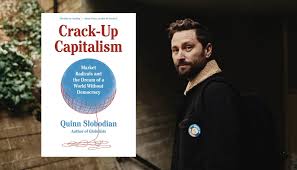
Crack-Up Capitalism; Market Radicals and the Dream of a World Without Democracy, Quinn Slobodian, 2023

Slobodian starts with a brief history of Hong Kong and of Singapore post independence from Britain. These have been the model for special economic zones (SEZ) and greatly influenced Chinese Chairman Deng Xiaoping’s  establishment of Shenzhen, Zhuhai, Shantou and Xiamen in the 1980s.  (see Deng and the Transformation of China)

He later spends time on the development of SEZs in Dubai. “If there is any place in the world that has contributed to global zone fever as much as the Asian juggernauts of Hong Kong and Singapore, it is Dubai…In the first decade of the 2000s, Dubai’s economic growth grew by 13 percent a year on average, outpacing even China. Skyscrapers were built (by low cost foreign labor) at the rate of a floor every three days. In six years, the city’s population doubled and its footprint quadrupled.” All three also created additional land from massive land reclamation projects.

How could such historical accidents be made to happen again? The shortcut to Hong Kong that (Paul) Romer offered was called the charter city. The formula: persuade poor nations to surrender patches of uninhabited territory to be managed by richer ones. Pollinate the empty land with rules known to make capitalism work and watch it grow. This would be colonialism by consent, occupation by invitation…Why not go all the way and give over your country to external management.

While earlier settlers once sought wealth in gold, crops, or railroads, the treasure of (special economic) zones like Prospera in the twenty-first-century was their status as a jurisdiction — their potential as a new place to pick and choose among regulations and licensing requirements. Such zones offered vivid examples of what had become standard practice in the conduct of global capitalism. When people form a business contract anywhere in the world, they already had the choice of which law they elect to use;  most commercial contracts are written either in New York State or English law. For what one scholar calls “roving capital”, laws were selected and combined a la carte…These jurisdictions (SEZs) were portals to what Oliver Bullough calls Moneyland, where people can select whichever laws “are most suited to those wealthy enough to afford them at any moment in time.”

The result, they said, would be the emergence of a hypermobile superclass of high-IQ individuals, who could remotely coordinate placid low-IQ workforces while stashing their wealth far from the grasping hands of governments.

Davidson and Rees-Mogg called this tiny, rarefied fraction of the world’s population “sovereign individuals” and estimated their combined number at a hundred million worldwide. The nation-state form was dysgenic. It worked against the dictates of evolutionary advance and survival. In an era of hypermobility, it served evolutionary interests to escape national constraints…The elites would cease to see national identity as anything meaningful, and the conceit that they owed anything to their so-called fellow citizens would be laughable. They would understand that one’s countrymen were actually “the main parasite and preditor”, their brains contaminated by the idea that they were owed a share of someone else’s hard-earned income. Sovereign individuals knew they had no obligations to anyone but themselves.

(Balaji) Srinivasan’s tweak to the start-up city model was to suggest that the online and offline worlds might not be alternatives to each other but complementary: you build online first, then you come down to earth. His replacement of the sovereign individual with “the sovereign collective” seemed like a break from Davidson and Rees-Mogg, but the difference was really only semantic. All three say the same things: the possibility of exit created by new technology, the creation of a new global caste of meritocratic adepts, and the abandonment of the taxing, regulatory state in favor of new affiliations and even new territories organized along the lines of private corporations.

Srinivasan preferred blue-sky (or, better blank-whiteboard) speculation to real-world examples. Yet one of the successful examples he offered was telling: the state of Israel. This was indeed a reverse diaspora, organized through newspapers and texts that produced a kind of cloud country of a Jewish homeland through the media of the time. Kicked off by the the publication of Theodor Herzl’s Jewish State in 1896, the Zionist plan translated only slowly into facts of the ground through small-scale acts of colonization, which were eventually accepted and given legitimacy by the dominant imperial powers of the the day. But consider the consequences of this example. The land in Palestine was no more bare than anywhere else in the world, and it remains rent by competing historical claims over territory. Israel’s solution to the problem of demographic and political geography has been to create a two-tier system separating primarily Jewish citizens of country from Muslim inhabitants of the regions. It fenced boundary — policed by cameras, drones, armed soldiers, and heat-sensing technology at the limit of theological frontier — puts the Berlin Wall’s death strip to shame.

Perhaps there was an honesty in this example. Srinivasan and his fellow tech investors expressed frustration with the problems of San Francisco —  a place rife with visible inequality and untreated mental illness, the legacy of centuries of racialized poverty, violence, and discriminatory immigration policy stretching back to the original expropriation of the land on which the city was built. It is clear that Srinivasan, with his resources, could find somewhere better. But as he seemed to admit to himself, it would probably look like the state of Israel: militarized, paranoid, defiant — and also very invested in technology. It was not for nothing that a bestselling book on Israel praised by Srinivasan called it the “start-up-nation”. Here was a template: a cloud country with a twenty-six-foot-tall border wall.

Those seeking an exit in the metaverse would also find nothing of the sort. The platforms that we log on to are owned by private actors. Our every keystroke (and when we are strapped into a VR rig, out every twitch bend and nod) is minutely tracked, traced, sorted, calibrated, and sold onward to advertisers and other developers. It says a lot that one of Silicon Valley’s most successful companies — Uber — did not offer an empty prairie on which to roam and build. Rather, if you were a driver, it pulled you along like a dog on a leash, punishing you for any deviation while preserving the fiction that you were a free contractor. The metaverse, as one critic has astutely observed, is probably best thought of as a cubicle.  The private government of corporations has little space for the alternative visions of collectives, other than those that reproduce its own dominance.

As one of the foundational texts of tech criticism notes, Silicon Valley often forgets its Hegel at its own risk. The German philosopher taught that the master is always dependent on the slave. Neither island nor cloud can exist without its underclass. Beyond the Masses of app-mediated gig workers, (see techno feudalism Yanis Varoufakis) even the vaunted artificial intelligence programs work only because of the often repetitive routines and efforts of labor both skilled and unskilled. From Honduras to Dubai, the waged service class is the easiest for the visionaries to forget and the hardest for them to live without.

Patrik Schumacher, Parametricism

In the twenty-first century, however, the situation changed again, (anarcho-capitalist Patrik) Schumacher said. As manufacturing grew more automated, and advances in artificial intelligence promised a “man-machine symbiosis” on the horizon, democracy no longer made sense. It was an antique ideology, an artifact of an earlier, superseded moment in the history of capitalism — a dumbly literal reading of the world map, as if everything were penned inside its colored containers. What made sense in the twenty-first century were dots on the map like Liberland: blank-slate enclaves that could be anchor points for virtual enterprises, getaways for the global elite, or new citadels of financial services, marketing, design, software engineering, and other lines of work that needed little more than an electrical outlet and a robust internet connection. “The revolution comes when the political system becomes a barrier to the forces of production” Schumacher said. “And that’s what we’ve reached.”

Reimagined Industrial City NEOM

(SEZ) Zones are everywhere, but contrary to the rhetoric of boosters, they do not seem to be creating islands of liberation from the state. Rather, states are using them as tools to advance their own purposes. NEOM is a telling example. Saudi Arabia, an economy owned and operated by a royal family, is contracting with the Chinese company Huawei to wire its agglomeration in the desert as a “smart city”. As one consultant conceded, zones have proceeded through government-enabled confiscation, running roughshod over basic libertarian principles of property rights. Creating a land market in rural China, was projected to leave 110 million villagers without land land by 2030. Zones are not turning the world into a patchwork of a thousand private polities in dynamic competition. They are strengthening the position of a handful of state-capitalist superpowers.

Good capitalists know the real game is capturing the existing state, not going through the hassle of creating a new one.

Besides, the United States itself looks more like a (SEZ) zone all the time.  In 2022, it edged out Switzerland, Singapore, and the Cayman Islands to take top spot in an index of financial secrecy, crowned as the best place in the world to illegally hide or launder assets. Its own status as a democracy has been called into question. It was briefly downgraded by a well-respected index to a so-called anocracy, a system mixing features of democratic and autocratic rule. Soon, Americans may no longer need to go elsewhere to realize the perfect zone.

No matter the rhetoric, zones are tools of the state, not liberation from it. No matter the exit fantasies, zones cannot escape the earth. The third truth about them is perhaps the most banal but most consequential; zones have inhabitants. There is no such thing as a blank slate.

We can see this clearly back in the ur-zone of Hong Kong. I began this book with Milton Friedman gazing out affectionately at the city’s skyline, which he imagined as a perfect container for the conduct of capitalism, with decision-making insulated from disruptions by the absence of democratic elections. In 2017, when I presented and early version of that chapter at the University of Hong Kong, a professor from the law school laughed. Milton’s description of a quiescent city-state was borderline ridiculous in the middle of one the most convulsive periods in Hong Kong history, with the population taking to the streets time and time again to demand political self-determination.

Why does US authoritarian right mythologize history and attack education?

Erasing History; How Fascists Rewrite the Past to Control the Future, Jason Stanley, 2024

What does history do that is so disruptive of authoritarian goals? Perhaps most importantly, it provide multiple perspectives on the past. Authoritarianism’s great rival, democracy, requires the recognition of a shared reality that consists of multiple perspectives. Through exposure to multiple perspectives, citizens learn to regard one another as equal contributors to a national narrative. And they learn, we learn, to accept that this narrative is open to continued collective reflection and re-imagination, constantly taking into account new ideas, new evidence, new perspectives and theoretical framings. History in a democracy is not static, not mythic, but dynamic and critical.

…fascist education works by strategically erasing accounts of history and current events that include a diversity of perspectives, narrowing the scope of what can be taught until students are presented with a single viewpoint, which is formulated specifically to justify and perpetrate a hierarchy of values between groups. This narrowing is inconsistent with multi-racial democracy, antithetical to egalitarianism, and carries the possibility to conjuring mass violence.

They also sometimes employ an even more scorched earth strategy, destroying any common reality that could serve as the basis for a broad alliance between citizens against power. They seek to accomplish this by destroying the institution of public education itself.

The institution of slavery is a relatively ubiquitous feature of human societies. But perhaps there is a distinctive type of dehumanization emerging from the Enlightenment that results in particularly brutal forms of slavery and genocide. Mills, in this reading, is suggesting that we can understand the brutality of the version of slavery that emerged during the Enlightenment by reflecting on the very notion of Enlightenment personhood. In this form of slavery, the enslaved are regarded as non-persons, even in a very expansive notion of personhood. If so, the Enlightenment ideals of personhood have a central role to play in explaining the brutality of radicalized colonialism, and the underlying systems of white supremacy.

An organization like the Zinn Education Project (Howard Zinn) is on the front lines of the war to defend progressive education, seeking to preserve the history of resistance against hierarchies of class, race, and gender against those who aim to erase it. It also seeks to call attention to these attacks, and the larger anti-democratic movement of which they are a part. Even in these grim times for democracy, there remains ample room for hope.

No one thinks that Russia’s election of 2024 was free. The people of Russia have been lied to. Their acceptance of these lies is not accidental to their unfreedom. Their acceptance of these lies constitutes their unfreedom. Ignorance too hinders free, informed action. Without knowledge we cannot act. Battles over education are battles over freedom.

Living in a democracy means considering replacing traditions with new ones. Education in a democracy is an exercise for agency, for self-rule. And part of an ethic of self-rule is a refusal to be ruled by the dead…When traditions are inflated and exaggerated, and critical inquiry into them threatens to expose myths that justify power, it gives the authoritarian an excuse to crack down on democracy, via its institutions, the schools.

When we understand the mechanisms by which democracy is attacked, the way myths and lies are used to justify actions such as wars, and the scapegoating of groups, can we defend against these attacks, and even reverse the tide. This struggle is part of the action of democracy itself. If we weren’t having this struggle, we wouldn’t be living in a democracy.

Authoritarianism thrives off inequality and myths that support it. Monarchy survived by a myth of divine selection. Dictatorships survive on the myth that one single leader defines and embodies the nation. Fascism survives off myths that create an outgroup, who are relegated to second-class citizenship, at best. Schools and universities allow for critical inquiry into these myths, and so attacks on them are always the canaries in the coal mine of authoritarianism. There is a reason there are no American-style liberal arts colleges in authoritarian countries.

Need to Reform Corporate Democratic Party

It‘s OK to be Angry about Capitalism, Bernie Sanders with John Nichols, 2023

2020 Campaign Task Forces of Sanders and Biden

Should we raise the federal minimum wage to $15 an hour? Agreement

Should we have Medicare negotiate prescription drug costs? Agreement

Should we be aggressive in combating climate change and create a Civilian Climate Corps?Agreement

Should we lower the age of Medicare eligibility to sixty? Agreement

Should we end private prisons and detention centers? Agreement

Should we move toward a Medicare for all single-payer program? Disagreement

Should we legalize marijuana? Disagreement

Should we forgive all student debt? Disagreement

Should we make public colleges and universities tuition-free? Disagreement

Should we impose a wealth tax on billionaires? Disagreement

Oligarchs and those bought by oligarchs are not good

Greed is not good.

Massive income and wealth inequality is not good.

Buying elections is not good.

Profiting from human illness is not good.

Charging people the highest prices in the world for prescription drugs is not good.

Exploiting workers is not good.

Monopolization of the economy by a handful of corporations is not good.

Ignoring the needs of the most vulnerable among us – children, the elderly, and people with disabilities — is not good.

Racism, sexism, homophobia, and xenophobia are not good.

For profit prisons that make money by locking up poor people are not good.

Wars and excessive military budgets are not good.

Carbon emissions that destroy our planet are not god.

Bernie’s Events contrast with State Democaratic Party Events

Our (Bernie’s) events usually brought out diverse, raucous crowds of thousands of people. There were a lot of young people. The people who showed up were mostly working-class. Some were in college, some had degrees, but most did not. What united them was a dissatisfaction with the status quo and a fervent desire for change. They wanted the government to work for them, not just for the people on top.

The state Democratic Party events were pretty much the opposite. The turnouts were small and the people who attended were older, whiter, and wealthier. A significant number of them – lawyers, professionals, and business people were “major donors.” Compared to our campaign rallies, the energy level was almost nonexistent.

The key question facing the Democratic Party is not complicated. Does the party want to open its doors and welcome into its ranks working class Americans, people of color, and young voters who could shake things up? Is it the party willing to listen to people who want to fight for fundamental change? Is it ready to be the party that demands that the promise of economic and social and racial justice be made real? Or does it want to maintain a tired status quo that poses no real threat to politics as usual? In other words, does it want to be a working-class party fighting for change, or a corporately dominated party protecting the well-off?

FDR in 1937:

In this nation I see tens of millions of its citizens—a substantial part of its whole population—who at this very moment are denied the greater part of what the very lowest standards of today call the necessities of life.

I see millions of families trying to live on incomes so meager that the pall of family disaster hangs over them day by day.

I see millions whose daily lives in city and on farm continue under conditions labeled indecent by a so-called polite society half a century ago.

I see millions denied education, recreation, and the opportunity to better their lot and the lot of their children.

I see millions lacking the means to buy the products of farm and factory and by their poverty denying work and productiveness to many other millions.

I see one-third of a nation ill-housed, ill clad, ill nourished.

Democrats should be making it absolutely clear that the people the Republicans take their money from, and the people whom the Republican policy serve—the very rich and the very powerful individuals who seek an America where uber-capitalism defines every aspect of our economy and of our society—are the problem…Democrats should be making it clear that they are prepared to challenge the rich and powerful on behalf of the working class. This will resonate with the American people in ways that the GOP lies never could.

Unfortunately, this economic justice message is rarely if ever delivered by the Democrats. And that has a lot to do with our broken campaign finance system and the Democrats’ dependence on campaign contributions from the wealthy and powerful.

There is no hiding from reality. Despite and lot of rhetoric, which fewer and fewer people believe, Democrats have not fought hard enough, or consistently enough for working people. And this failure has cost Democrats at election time. The simple truth is that, as Democrats have turned their backs on working families, millions of working-class voters have turned their backs on a Democratic Party that their parents and grandparents strongly supported.

Bernie’s bullet prescription

  • Transform the Democratic National Committee from a corporate-dominated fundraising apparatus into a source of support for grassroots activism and working-class struggles.
  • Make certain that primaries are open, fair, and well run.
  • Democratize the nominating processes.
  • Restructure debates between contenders for the presidential nomination so that they are serious examinations of the issues.
  • Make conventions genuine convenings of the party membership, as opposed to choreographed media spectacles.

Abolish the Prison Industrial Complex

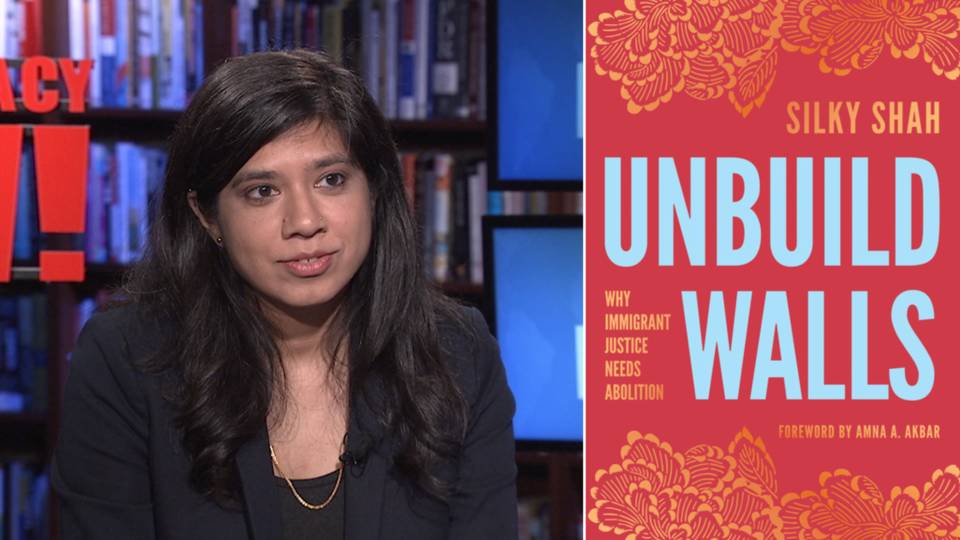
Unbuild Walls; Why Immigrant Justice Needs Abolition, Silky Shaw 2024

The title of this book, Unbuild Walls, references a quote from Ursula K. Le Guin’s 1874 sci-fi classic The Dispossessed. In the story, the “walls” are both the physical wall that exists between the two societies and the invisible walls we put up that constrain us and prevent human connection. This book is about breaking down the literal prison, jail, and detention center walls as well as the border walls, whether tangible, imaginary, or digital. But it is also about unbuilding the walls between our movements for social change. These walls are often intentional; we are fighting for a specific cause and must make that special case. Inadvertently, the divisions and lack of shared analysis because of these walls have resulted in harm to other causes and movements. Abolition helps us better understand that the struggle for immigrant justice is also a fight for racial, gender, and economic justice. By embracing abolition, maybe we can finally begin to bring the walls down.

The “nation of immigrants” incarcerated more immigrants than anywhere else in the world. Major milestones dot the history of the contemporary immigrant detention system in the United States. In 1980, when detaining immigrants was a rare practice, the arrival of Cuban and Haitian refugees by boat in the Cold War led to the birth of the modern system with the opening of the Krome Detention Center in South Florida. Later, during the height of the war on drugs, mandatory detention became law, stripping certain immigrants of due process rights. In 1996, the passage of two draconian immigration bills under president Bill Clinton expanded the grounds for deportation and doubled the existing detention capacity. But it was 9/11 that made immigrants an unequivocal target of the government in the name of protecting the “homeland”, after which billions of dollars were funneled into the deportation machinery. In recent memory, Trump’s wholesale attack on immigration led to a considerable expansion of the system, reaching a peak of half a million people detained in 2019.

But beneath these common points of departure lies another aspect of immigrant detention’s history; the rise in mass incarceration. In 1970, the United States incarcerated less than two hundred thousand people; three decades later, that number had risen to over two million. The prison boom that took place over the last half century is central to the story of immigrant detention in the United States. Critical Resistance defines the prison industrial complex (PIC) as “the overlapping interests of government and industry that use surveillance, policing, and imprisonment as solutions to economic, social, and political problems”. As the PIC was fortified through various developments, including increased funding for law enforcement, harsher sentencing laws at the state and federal levels, and the promise of jobs and revenue derived from a growing prison economy, the response to unnaturalized immigrants living in the United States, and those arriving at our borders increasingly took on a carceral logic. Since the 1980s, a combination of economic restructuring and increasingly tough-on-crime policies have produce devastating results; the highest rates of incarceration in the world and the greatest number of deportations in US history.

The restrictions on the number of visas due to Hart-Celler (1965) coupled with the end of the Bracero Program in 1964 resulted in an unprecedented rise of unauthorized migrations. At the time, some 200,000 Mexicans were coming to the United States for work annually. Now the first 20,000 immigrants from Mexico could be issued visas, but the 20,001 immigrant would not be; if they had to cross for work , they would be considered illegal. Immigration related apprehensions increased rapidly each year after the law passed, from 44,000 arrests in 1964 to over a million in 1977.

Contrary to popular thinking on the issue, the expansion of immigrant detention was not merely a xenophobic response to increasing undocumented immigration. It was a direct outgrowth of the rise of mass incarceration in the United States…Immigrant detention is part of the broader carceral landscape in the United States, and thus abolition of immigrant detention must be seen as concurrent with the demand to abolish the prison industrial complex.

Advocates and the Obama administration affirmed the idea that immigration was a “public safety” issue, reinforcing the narrative of immigrants as criminals. Our experience during the Obama years underlined for me the way that reformist reforms
setting out to “improve” prison and detention actually serve to expand it. This is a critical lesson to carry forward that explains why we must redirect our movement energy to abolitionist and decarceral reforms that dismantle and defund the system rather than try to make it “more human”…Ultimately, the intention to improve conditions only served to expand detention, consolidate the system, and benefit private prison corporations. The implementation of a risk classification assessment tool did little to release people from detention and reinforced existing racist frameworks. Along with ATDs (alternatives to detention), such reforms have repeatedly failed at reducing the number of people incarcerated or improving the lives of those subject to incarceration…Obama accepted nativist arguments that immigrants were threats to national security and public safety and enabled racial profiling through strengthening the ties between immigration enforcement and the criminal legal system, just as Clinton had done before him. In doing so, he not only oversaw more formal deportations than any other president, but likewise gave credence to Republican attacks on immigrants.

As outrage over family separations escalated that summer (2018), the call to abolish ICE gained steam among activists and even some politicians, who introduced legislation to do away with the agency. Family separation had become a flashpoint that exposed the harms of the system, leading many to focus on the agency that carries out mass deportations. What the demand to abolish ICE failed to acknowledge, however, was that the zero-tolerance policy went far beyond ICE’s purview.
Family separation under Trump emerged directly from a long-standing strategy aimed at deterring immigration through use of the criminal legal system to punish people for the act of immigration itself…In the process, and unbeknownst to most Americans, immigration became to most commonly prosecuted crimes in US federal courts. As a result, a parallel system of prisons and jails arose to to incarcerate immigrants serving criminal sentences…While the family separation policy under Trump rightly provoked significant outrage, what it revealed most was the complete moral bankruptcy of the institutions that implements it. Often the liberal critique of Trump’s immigration policy sees him and his administration as an aberration, a departure from the basic norms of governing. This perspective ignores the fact that many of his policies were continuations and expansions of what previous administrations, especially since Clinton, had been seeding; the use of the criminal legal system to punish immigrants as a tool for deterring future migration.

Closing Private Prisons

In the short time between AB32’s (California act to force closing of private prisons used by ICE) passage in October and when it became law, ICE accelerated the process and entered into fifteen-year contracts at the remaining private detention centers in California…Biden phased out private prisons for DOJ while simultaneously defending their use by another branch (ICE) of the federal government…Learning from the efforts in California, organizers and advocates in several states (Colorado, Illinois, Maryland, New Jersey, Oregon, and Washington State) have been successful at passing legislation ending detention contracts or preventing new expansion, and others are considering similar legislation…By December 2022, the Biden administration had ended contracts at five detention centers, siting concerns about conditions. Three of the five detention centers had been included on DWM’s (Department of Migrant Workers) First Ten to Committees Not Cages list…The belief that detention was necessary had started to lose its hold on advocates and politicians alike…But the reduction in the system during these years and the end of contracts at numerous facilities were important movement victories that would not have been possible without the demand for abolition.

“Many remedies proposed for the all-purpose use of prisons to solve social, political, and economic problems got caught in the logic of the system itself, such that reform strengthens, rather than lessons, prison’s hold. In a sense, the professionalizaton of activism has made many committed people so specialized and entrapped by funding streams that they have become effectively deskilled when it comes to thinking and doing what matters most.”
Ruth Wilson Gilmore, Golden Gulag

On the Rightward ideological trend of the Supreme Court

Howard Zinn made this point many years ago; “It would be naive to depend on the Supreme Court to defend the rights of poor people, women, people of color, dissenters of all kind.”

On Abolition movement building

It’s about doing the work, not just making a demand. Yes, the demand is important – it helps clarify where we’re going and opens up space for us to make our case to reduce the harm caused by the prison industrial complex. But our ability to create change is dependent on the power that we have. It requires building a base, identifying targets, developing strategies, waging campaigns, deploying various tactics, and harnessing our power when there are openings. That is the work. That is abolition.

The moral panic around the border now drives most policy decisions on immigration. In our work for migrant justice, it is critical that we challenge the right-wing fearmongering about the border in order to create safer conditions for people wanting the migrate. The immigrant rights struggle is inherently an intersectional struggle. People migrate for a variety of reasons. Global inequality as a result of capitalism and US empire has created unstable, impoverished, and often violent conditions across the world. Climate catastrophe has only exacerbated these conditions. As more migrants seek safety, the tools the federal government uses to deter migration, including prisons, police, and the military, will continue to be lifted up as necessary for preventing the “surge” or “flood” or whatever the disaster metaphor of the day is.

The intersectional nature of the immigrant rights struggle should not be seen as a challenge, but as an opportunity to bridge issues and connect the dots to imagine another world in which everyone can thrive.

In 2019, the Poor People’s Campaign, which is rooted in civil rights—era demands, released a moral budget, arguing that “the abundance of our society will grow even greater when we stop investing in maintaining injustice to benefit the few, and turn instead to policies based on the needs of the many.”

For example, NPP (National Priorities Project) points out that in 2023 “the average taxpayer paid $298 to the top five military contractors, and paid just $19 for mental health and substance abuse programs.” On immigration “T,he average taxpayer paid $70 for deportations and border control, versus just $19 for refugee assistance.”

A Native History of Oklahoma

By the Fire We Carry; The Generations-Long Fight For Justice on Native Land, Rebecca Nagle,2024


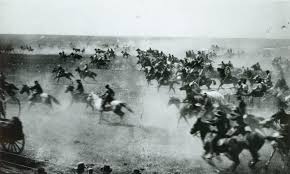
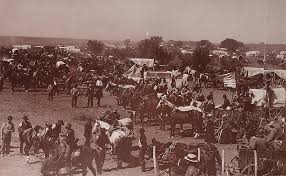
Oklahoma Land Runs 1883 – 1889

We know we belong to the land
And the land we belong to is grand!
And when we say, yeeow-a-yip-i-o-ee ay!
We’re only sayin’ You’re doin’ fine, Oklahoma! Oklahoma, okay
Songwriters: Oscar Hammerstein Ii / Richard Rodgers


Neil Gorsuch

The McGirt (McGirt v Oklahoma 07/09/2020) decision was historic, but it was not groundbreaking. In his opinion, Justice Gorsuch did not create new rules for lower courts to determine whether or not a reservation still exists. He merely followed the existing rules set by earlier decisions. Yet that outcome was still radical. Throughout US history, when laws protecting Indigenous nations are inconvenient for states or a broad base of non-Native constituents, the US government does not follow the law. But this time it did.

The McGirt Supreme Court decision resulted in the largest restoration of Indigenous land in US history. After it was denied for over a century, the court ruled Muscogee Nation still had a reservation. Subsequently, eight other reservations, covering nearly half the land in Oklahoma, were upheld. Including my own (Cherokee).

The historic status of the McGirt decision is ironic when you understand what happened legally. The Supreme Court didn’t overturn anything, strike down anything, or change their own precedent. All the court did was follow the law. Yet still, that was radical.

When it comes to tribal sovereignty, the US government is spineless. Most often when states or non-Native people want something that belongs to a tribe – whether it’s gold, oil, land, or power – they get it. Even when the law clearly protects the tribe. Sometimes our government simply looked the other way. Other times settlers wanted so much that our government remade the law to fit their demands. Greed –not justice – has governed more of our history than we are willing to admit. Oklahoma’s greed in McGirt was refusing to give up an ounce of power – even when exercising that power was illegal.

To avoid calling it greed, lies are told. The land belonged to Georgia. Illegal squatters in Indian Territory deserved property rights. There were never reservations in Oklahoma. McGirt caused chaos and crime. Often, the lies are about indigenous peoples ourselves; we are backward, corrupt, lawless, unworthy. The most persistent lie by far is that policies which obviously harm us are somehow for our benefit.

Indigenous nations have been governing ourselves since before the country was founded – since before it was even an idea. As the United States was built around us, we shaped it. Since the founding, tribal leaders, Indigenous intellectuals, Native diplomats, warriors, lawyers, and advocates carved out a space in American law through which our inherent sovereignty was recognized. Over the generations, we continue to leverage the legal foothold our ancestors created.

Federal Indian law today is not all good or all bad – rather it is the totality of our history. Embedded in American law are the victories and defeats of our ancestors, and the unimaginable compromises they were forced to make The legal terrain with which we are left is tricky: the protections Indigenous nations have under US law are not enough; yet we have to constantly fight for those protections to remain and be followed.

We demand the US government fulfill its legal obligations to us, knowing it often will not. Native nations don’t have a constitutional amendment or Supreme Court decision that ended our legal subordination. What we are left with is a government that still contains both impulses: The impulse to uphold the inherent and legally recognized sovereignty of Indigenous nations. And the impulse to railroad tribes because it can.

The lesson of McGirt is not that when the law is on our side and we fight hard, justice prevails. The lesson is that although justice for Indigenous nations is rare, in our democracy, it is possible.

The Founding Fathers wanted a democracy that, unlike the king of England, would derive its power from “the consent of the governed”. But they also wanted an empire. And so they built both: a democracy that at its center gave every citizen a voice and a vote, and an empire that, as it constantly expanded, controlled the lives and the lands of people who had no say. While over the centuries who was included in that center of democracy changed, the edge of empire never went away. From Indigenous nations, to Guam and Puerto Rico, to migrants detained at our border, there have always been people who lived under the raw power of our government but without the liberties and privileges of our Constitution. Our inheritance as American citizens is a democracy that is often wildly antidemocratic – a government that rules by both consent and by conquest.

TechnoFeudalism Killed Capitalism

Techno Feudalism; What Killed Capitalism, Yanis Varoufakis, 2023
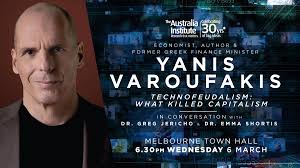

Self proclaimed libertarian Marxist.

The Rise of Big Finance and Big Business

To produce the rivers of credit necessary to fund the Edisons, the Westinghouses, and the Fords of early twentieth-century capitalism, small banks merged to form large ones and lent either to the industrialists directly or to speculators eager to buy shares in the new corporations…And it led to emergence of Big Finance, which grew up alongside Big Business in order to lend it monies borrowed effectively from the future: from profits not yet realized but which Business promised to delivery.

The Creation of the American technostructure in WWII (Eisenhower’s military industrial complex)

(after Pearl Harbor brought the US Into WWII) the US government began to emulate…the Soviet one.
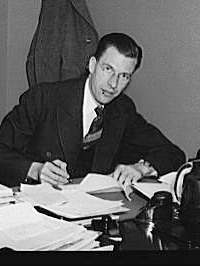

Galbraith at work in 1940
It told factory owners how much to produce and to what specifications, from aircraft carriers to processed food. It even employed a price czar – the economist John Kenneth Galbraith – whose job, literally, was to decide the price of everything, to fend off inflation, and to ensure a smooth economic transition from wartime to peacetime is no exaggeration to say that American capitalism was run according to Soviet planning principles, with the exception that the networked factories remained under private ownership of Big Business.

Under President Roosevelt, the US government’s deal with Big Business was simple: they would produce what was necessary to win the war and, in exchange, the state would reward them with four incredible gifts. First, state guaranteed sales translated into state guaranteed profits. Second, freedom from competition, since prices were fixed by government. Third, huge government funded scientific research (e.g. the Manhattan Project, jet propulsion) that provide Big Business with wonderful new innovations and a pool of highly skilled scientific personnel to recruit from during and after the war. And forth, a patriotic aura to help rinse off the stench of corporate greed that clung to them after the crash of 1929 and make them over as heroic enterprises that helped America win the war.

Galbraith called this nexus (at the end of the war) the technostructure.

With the war behind them, one thing kept the good folks of the technostructure up at night: if the government would no longer guarantee sales and prices, where would they find the customers ready and willing to pay for all the chocolate bars, cars, and washing machines that they were planning to manufacture…(hence the rise of Madison Avenue and consumer behavior modification)

In the 1960s, a decade marked by an ideological and nuclear clash between America and the Soviet Union that almost blew up the world, Soviet planning principle were implemented with remarkable success in …the United States. Irony has seldom taken a more effective revenge over earnest ideology.

The American Golden Age of Bretton Woods 1944-1971

This dazzling design, America’s Global Plan to remake Europe and Japan in the image of its technostructure, led to capitalism’s Golden Age. From the wars end until 1971, America, Europe and Japan enjoyed low unemployment, low inflation, high growth and massively diminished inequality.

As long as America was the major surplus nation, Bretton Woods was safe as houses. And that’s why, by the late 1960s, the Bretton Woods system was dead in the water. The reasons? Three developments which caused America to lose its surplus and become a chronically deficit economy. The first was the escalating Vietnam War which forced the US government to spend billions in South East Asia on supplies and services for its military. The second was President Lyndon Johnson’s attempt to make amends for the ill effects of conscription on working-class America, its black communities in particular. His valiant but expensive Great Society program substantially reduced poverty but, at once, sucked lots of imported goods from Japan and Europe into the United States. Lastly, Japan’s and Germany’s factories surpassed America’s in terms of quality and efficiency, partly due to the support successive US governments had extended to Japan’s and Germany’s manufacturing sectors – the car industry being an obvious example.

Nixon Shock the death of Bretton Woods 1971

..on 15 August 1971 President Nixon announced the eviction of Europe and Japan from the dollar zone. Bretton Woods was dead. The door had been opened on a new and truly dismal phase in capitalism’s evolution.

Fed Dismal Chairmen Volcker, Greenspan, Bernanke

In 2002, thirty years after the Nixon Shock, humanity’s total income approximated $50 trillion. In the same year, financiers around the world had wagered $70 trillion on a variety of bets…. By 2007 humanity’s total income had risen from $50 to $75 trillion – a decent 33 percent increase over five years. But the sum of bets in the global money market had gone up from $70 to $750 trillion – a rise in excess of 1000 percent…Bretton Woods was designed to prevent such greed-fueled recklessness from bringing humanity to the brink of another Great Depression, indeed another world war, ever again.

Once they lost their fixed exchange with the dollar, the dollar value of European and Japanese money began fluctuating wildly…The dollar became the only safe harbor, courtesy of its exorbitant privilege, namely, that if any French, Japanese, or Indonesian company, indeed anyone wanted to import oil, copper, steel, or even just space on a freight ship, they had to pay in dollars…The Nixon Shock produced a magic trick for the ages; the country going deeper and deeper into the red was the country whose currency was becoming more and more hegemonic…But there was another reason why the dollar’s hegemony grew: the intentional impoverishment of America’s working class.,,It is also no coincidence that union busting became a thing in the 1970s.

Crash of 2008

With investment first knocked out by the crash of 2008 and finished off soon after by austerity, throwing new money at the financiers was never going to resurrect it. Put yourself in the position of a capitalist at a time when austerity is eliminating your customer’s income. Suppose I give you a billion dollars to play with for free, i.e. at a zero interest rate. Naturally you will take the free billion but as we’ve established you would be mad to invest it in new production lines. So what are you going to do with the free cash? You could buy real estate or art or better still, shares in your own company. That way, the shares in your company appreciate in value, and if you are the CEO running it, your stature and share-linked bonuses rise too. No new investment, in other words, but a lot more power in the hands of the powerful.

For while the American deficit returned with a vengeance a year after the crash of 2008 and the subsequent bankers bailouts, it never restored the beast’s capacity to recycle the world’s profits. True, the rest of the world continued to send most of its profits to Wall Street. But the recycling mechanism was broken: only a small fraction of the monies rushing to Wall Street returned in the form of tangible investments in factories, technologies, agriculture. Most of the world’s money rushed to Wall Street to stay in Wall Street. There, it sloshed around doing nothing useful. As it piled up, it bid up share prices, thus giving the Jills and the Jacks of of finance yet another opportunity to do stupid things at a mammoth scale.

When an activist states makes fabulously wealthier, the same banks whose quasi-criminal activities brought misery to the majority, while they are punished with self-defeating austerity, two new calamities beckon: poisoned politics and permanent stagnation. The poisoned politics we need not elaborate on – from Greece’s neo-Nazis to America’s Donald Trump we have all lived through the nightmare. But permanent stagnation? Why would more wealth for the ultra-rich stagnate capitalism? And how did it lead to the funding of cloud capital?

Cloud proles and cloud serfs

…capital has hitherto been reproduced within some labor market – within the factory, the office, the warehouse. Aided by machines, it was waged workers who produced the stuff that was sold to generate profits, which in turn financed their wages and the production of more machines– that’s how capital accumulated and reproduced. Cloud capital, in contrast, can reproduce itself in ways that involve no waged labor. How? By commanding almost the whole of humanity to chip in to its reproduction – for free…By doing so, we shall see that while workers have become ‘cloud proles’ we all have become ‘cloud serfs’…Cloud proles – my term for waged workers driven to their physical limits by cloud based algorithms—suffer at work in ways that would be instantly recognized by whole generations of earlier proletarians. (As in Chaplin’s 1936 movie Modern Times)
Workers employed by General Electric, Exxon-Mobil, General Motors or any other major conglomerate pay in salaries and wages approximately 80 percent of the company’s income. This proportion grows larger in smaller firms. Big Tech’s workers, in contrast, collect less than 1 percent of their firm’s revenues. The reason is that paid labor performs only a fraction of the work that Big Tech relies on. Most of the work is performed by billions of people for free…The fact that we do so voluntarily, happily even, does not detract from the fact that we are unpaid manufacturers – cloud serfs whose daily self-directed toil enriches a tiny band of multibillionaires residing mostly in California and Shanghai.

Amazon and Jeff Bezos the end of capitalism
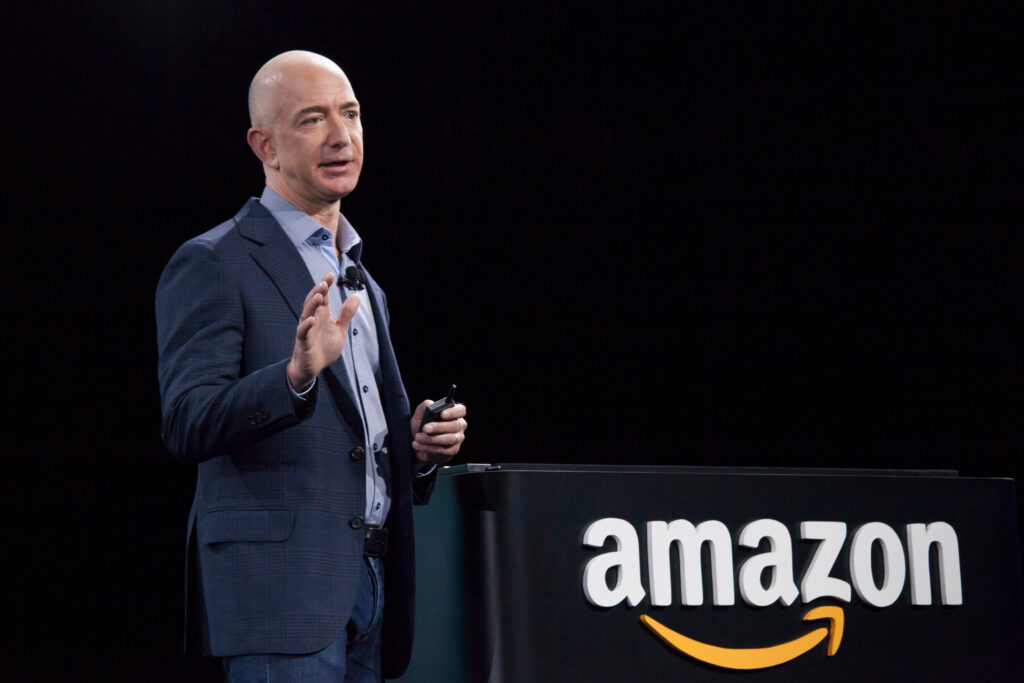
Enter Amazon.com and you have exited capitalism. Despite all the buying and selling that goes on there, you have entered a realm which can’t be thought of as a market, not even a digital one…Even the ugliest of markets are meeting places where people can interact and exchange information reasonably freely. In fact, it’s even worse than a totally monopolized market – there at least, the buyer can talk to each other, form associations, perhaps organize a consumer boycott to force the monopolist to reduce a price or to improve a quality. Not so in Jeff’s realm, where everything and everyone is intermediated not by the disinterested invisible hand of the market but by an algorithm that works for Jeff’s bottom line and dances exclusively to his tune.
(Amazon is) a type of digital fief…A post-capitalist one, whose historical roots remain in feudal Europe but whose integrity is maintained today by a futuristic, dystopian type of cloud-based capital.

Tesla and Elon Musk Amazon copycat


Copycat ecommerce platforms, offering variations on the Amazon theme, are springing up everywhere, in the Global South as well as the Global North. More significantly,other industrial sectors are turning into cloud fiefs too. Take for example Tesla,,, Elon Musk’s successful electric car company. One reason financiers value it so much higher then Ford or Toyota is that its cars’ every circuit is wired into cloud capital. Besides giving Tesla the power to switch off its cars remotely, if not, for instance, the driver fails to service it as the company wishes, merely driving around Tesla owners are uploading in real time information (including what music they are listening to!) that enriches the company’s cloud capital.

A.I. Algorithms produce Cloud Proles and Cloud Serfs

It took mind-bending scientific breakthroughs, fantastical sounding neural networks and imagination-defying A.I. Programs to accomplish what? To turn workers tolling in warehouses, driving cabs and delivering food into cloud proles. To create a world where markets are increasingly replaced by cloud fiefs. To force businesses into the role of vassals. And to turn all of us into cloud serfs, blued to our smartphones and tablets, eagerly producing the cloud capital that keeps our new overlords on cloud nine.

Privatization of the Internet Commons

Capitalism surfaced when owners of capital goods (steam engines, machine tools, spinning jennies, telegraph poles, etc.) acquired the power to command people and nations– powers that far exceeded, for the first time, those of landowners. It was a Great Transformation made possible by the prior privatization of common lands. Same with cloud capital. To acquire its eve greater powers to command, it too required the prior privatization of another crucial commons: Internet One.
Previously, to exercise capital’s power to command and make other humans work faster and consume more, capitalists required two types of professionals; managers and marketeers. Especially under the auspices of the post-war technostructure, these two service professions achieved greater prominence even than bankers and insurance brokers…Then cloud capital arrived. At one fell swoop it automated both roles. The exercise of capital’s power to command workers and consumers alike was handed over to the algorithms. This was a far more revolutionary step than replacing autoworkers with industrial robots. After all, industrial robots simply do what automation has been doing since before the Luddites: making proletarians redundant, or more miserable or both. No, the truly historic disruption was to automate capital’s power to command people outside the factory, the shop or office – to turn all of us, cloud proles (blue collar working-class) and everyone else, into cloud serfs in the direct (unrenumerated) service of cloud capital, unmediated by any market.
Meanwhile, conventional capitalist manufacturers increasingly have no option but to sell their goods at the discretion of the cloudalists, paying them a fee for the privilege, developing a relationship with them no different to that of vassals vis-a-vis their feudal overlords.

The Apple iPhone and the Apple Store


The stroke of genius that unlocked cloud rent for Steve Jobs was his radical idea to invite ‘third party developers’ to use free Apple software with which to produce applications for sale via the Apple Store. In one fell swoop Apple had created an array of unwaged laborers and vassal capitalists whose hard work yielded a host of capabilities available exclusively of iPhone owners in forms of thousands of desirable apps that Apple engineers could never have produce themselves in such variety or volume.

Google’s Android Operating System and Google Play

Only one other conglomerate managed to persuade a significant proportion of those developers to create apps for its own store: Google. Long before the iPhone arrived, Google’s search engine had become the centerpiece of a cloud empire which included Gmail and YouTube, and which would later include Google Drive, Google Maps and a host of other online services…Google followed a different strategy to Apple’s. Instead of manufacturing a handset in competition with the iPhone, it developed Android, an operating system that could be installed for free on the smartphones of any manufacturer, including Sony, Blackberry and Nokia, who chose to use it. The idea was that if enough of Apple’s competitors installed it (Android) on their phones, the pool of smartphones operating on the Android software would be large enough to lure third-party developers to produce apps not only only for the Apple Store but for a new store running on Android software. That’s how Google created Google Play, the only serious alternative to the Apple Store.

Creation of Vassal Capitalists and the Precariat

But large or small, powerful or otherwise, all vassal capitalists are by definition dependent to a greater or lesser extent on selling their wares via an ecommerce site, whether Amazon or Ebay or Alibaba, with a sizable portion of their net earnings being skimmed off by the cloudalists they depend on.
Meanwhile, as Amazon was snaring makers of physical products within its cloud fief, other cloudalists were focusing their attention on the precariat (people whose employment and income are insecure). Companies like Uber, Lyft, Grubhub, DoorDash and Instacart in the Global North, along with their imitators in Asia and Africa, wired into their cloud fiefs a vast array if drivers, delivery people, cleaners, restauraneurs – even dog walkers – collecting from these unwaged, piece-rate workers a fixed cut of their earnings too. A cloud rent.
The Great Transformation from feudalism to capitalism, was predicated on the usurpation of rent by profits as the driving force of our socio-economic system. That was why the word capitalism proved so much more useful and insightful than a term like market feudalism. It is this fundamental fact – that we have entered a socio-economic system powered not by profit but by rent – that demands we use a new term to describe it. To think of it as hyper capitalism or rentier capitalism would be to miss this essential defining principle. And to reflect the return of rent to its central role, I can think of no better name than technofeudalism.

Technofeudalism Underlies the Great Inflation

…the Great Inflation and cost-of-living crisis that have followed the recent pandemic cannot be properly understood outside the context of Technofeudalism…I recounted how for twelve long years after the crash of 2008, central banks printed trillions to replace the bankers’ losses. We saw how socialism for bankers and austerity for the rest of us dampened investment, blunted Western capitalism’s dynamic and pushed it into a state of gilded stagnation. The only serious investment of the central banks’ poisoned money during this time went into the accumulation of cloud capital. By 2020, cloud rents accruing to cloud capital accounted for much of the developed world’s aggregate new income.
…rents stunning comeback could only mean deeper and more toxic stagnation. Wages get spent by the many struggling to make ends meet. Profits get invested in capital goods to maintain the capitalists’ capacity to profit. But rent is stashed away in property (mansions, yachts, art, cryptocurrencies, etc.) and stubbornly refuses to enter circulation, stimulate investment into useful things, and revive flaccid capitalist societies. And so the vicious cycle begins: deeper stagnation.
The pandemic (2020) exacerbated the same trend. The only significant difference from the pre-pandemic period was that, this time, and for the first time since 2008, some of the fresh trillions printed by the central banks were spent by governments on the population, to keep their citizens alive while locked down. Nevertheless, most of the new monies ended up bolstering the share price of Big Tech corporations. This explains the report of the Swiss Bank UBS, published in October 2020, which found that billionaires had increased their wealth by more than a quarter (27.5 per cent) between April and July of that year, just as millions of people around the world lost their jobs or were struggling to get by on government schemes. What happens when supply suddenly dies? Especially during times when the locked-down masses get some income support from the central banks’ money tree. The price of groceries, exercise bikes, bread makers, natural gas, petrol, housing and host other goods goes through the roof and, following a dozen years of subdued prices, a Great Inflation sets in.
When, for whatever reason, prices surge across the board, a social power game is afoot in which everyone attempts to suss out their bargaining power. Business managers try to work out how far they can raise prices – if not to profit then, at least, to recoup their own rising costs. Rentiers, both traditional and cloudalists, test the water with rent hikes. Workers assess the extent to which they can push for a pay rise – at least to compensate for the higher bills they must meet. Governments play the game too: do they intervene by using the greater income and VAT tax receipts flowing from the rising prices to assist weaker citizens being crushed by inflation? Or do they subsidize Big Business as it is squeezed by high energy prices? Or do they do nothing much? Until these questions get answered inflation continues to roll.

Delayed Green Energy Adoption

The need to switch from fossil fuels to green energy could not be more urgent. The rise in energy costs that is an integral part of the Great Inflation would seem to have taken us away from that goal, offering a windfall to the fossil fuel industry. But this will not last long. Advances in green energy are pushing down fast the costs of green electricity generation. Even though the life cycle of fossil fuels has been extended, ruinously for the planet, cloud based green energy is growing – and, with it, so is the relative power of cloudalists.

China’s Dark Deal Post 1971 Global Capitalism

From the 1970s onward, global capitalism was founded on this fascinating recycling of, mainly, Asian manufacturing profits into American rents, which in turn sustained the American imports that provided Asian factories with sufficient demand.
Why call it a Dark Deal? Because in the small print of this pact between America’s and East Asia’s ruling classes was written misery for workers on both sides of the Pacific. American workers faced the exploitation and immiseration that resulted from under investment and its industrial heartland being hollowed out by manufacturing in Asia and the underdeveloped Global South. Meanwhile, in China’s fast-industrializing coastal cities, workers suffered the frenzied exploitation associated with over investment…
The came the crash of 2008. This had two main effects that, together, underpin today’s New Cold War: it strengthened China’s position in the global recycling mechanism, ant it turbocharged the build-up of cloud capital both in the United States and China.
…when the bottom fell out of Wall Street, China stabilized global capitalism by cranking up domestic investment to more than half of China’s national income. It worked in that Chinese investment took up much of the global slack caused by Western commitment to austerity. China’s international stature rose, and its accumulating dollar surpluses allowed Beijing, in addition to feeding Wall Street, to become a major investor in Africa, Asia, even in Europe through its famed Belt and Road Initiative.

Chinese cloudalist agglomeration

…to grasp the enormity and nature of China’s big five cloudalist conglomerates – Alibaba, Tencent, Baidu, Ping An and JD.com – consider the following thought experiment. Imagine if, in the West, we were to roll into one Google, Facebook, Twitter, Instagram and the version of Chinese owned Tik Tok still available to American users. Then include the applications that play the role that telephone companies used to: Skype, WhatsApp, Viber, Snapchat. Add to the mix ecommerce cloudalists like Amazon, Spotify, Netflix, Disney Plus, Airbnd, Uber and Orbitz. Lastly, throw in PalPal, Charles Schwab and every other Wall Street bank’s own app.
Unlike Silicon Valley’s Big Tech, China’s is directly bound into government agencies that make all-pervading use of this cloudalist agglomeration: to regulate urban life, to promote financial services to unbanked citizens, to link its people with state health care facilities, to conduct surveillance of them using facial recognition, to guide autonomous vehicles through the streets – and, outside its borders, to connect Africans and Asians participating in China’s Belt and Road Initiative to its super cloud fief.
With this great leap into financial services, China’s cloudalists acquire a 360-degree view of their users’ social and financial life. If cloud capital is a produced means of behavior modification, Chinese cloudalists have accumulated cloud capital beyond the wildest dreams of their Silicon Valley competitors, who, by comparison, enjoy far less power per capita to accumulate cloud rent.

American Dollar Reign

It (dollar’s reign) has allowed countries with large trade surpluses, like China and Germany, to convert their excess production – their net exports – into property and rents in the United States: real estate, US government bonds, and any companies that Washington allowed them to own. Without the dollar’s global role, Chinese, Japanese, Korean, or German capitalists would never have been able to extract such colossal surplus value from their workers and then stash it away somewhere safe. Michael Pettis: “While the US dollar may create an exorbitant privilege for certain American constituencies, this status creates an exorbitant burden for US the economy overall, especially for the vast majority of Americans who must pay for the corresponding trade deficits either with higher unemployment, more household debt, or greater fiscal deficits.”

Cloud Capital Affect on the Liberal Individual

It (cloud capital) has produced individuals who are not so much possessive as possessed, or rather persons incapable of being self-possessed. It has diminished our capacity to focus by co-opting our attention. We have not become weak-willed. No, our focus has been stolen. And because technofeudalism’s algorithms are known to reinforce patriarchy, stereotypes and pre-existing oppressions, those that are most vulnerable – girls, the mentally ill, the marginalized and yes, the poor – suffer the outcomes most…Bigotry is technofeudalism’s emotional compensation for the frustrations and anxieties we experience in relation to identity and focus…it is intrinsic to cloud capital, whose algorithms optimize for cloud rents, which flow more copiously from hatred and discontent.
And therein lies the greatest contradiction: to rescue that foundational liberal idea – the liberty of self-ownership—will therefore require a comprehensive reconfiguration of property rights, over the increasingly cloud-based instruments of production, distribution, collaboration, and communication. To resuscitate the liberal individual, we need to do something that liberals detest: plan a new revolution.
To stand a chance of overthrowing technofeudalism and putting the demos back into democracy, we need to gather together not just the traditional proletariat and the cloud proles but also the cloud serfs and, indeed, at least some of the vassal capitalists. Nothing less than such a grand coalition that includes them all can undermine technofeudalism sufficiently.

Cloud mobilization

The beauty of cloud mobilization is that it stands on its head the conventional calculus of collective action. Instead of maximal personal sacrifice for minimal collective gain, we now have the opposite: minimal personal sacrifice delivering large collective and personal gains. This reversal has the potential to pave the way toward a coalition of cloud serfs and cloud proles that is large enough to disrupt cloudalists control over billions of people.
Under technofeudalism, we no longer own our minds. Every proletarian is turning into a cloud prole during working hours and into a cloud serf the rest of the time. Every self employed striver mutates into a cloud vassal, while every self employed struggler becomes a cloud serf. While privatization and private equity asset-strip all physical wealth around us, cloud capital goes about the business of asset stripping our brains. To own our minds individually, we must own cloud capital collectively. It’s the only way we can turn our cloud-based artifacts from a produced means of behavior modification to a produced means of human collaboration and emancipation.
For a more thorough discussion of the required mobilization see Yanis Varoufakis’novel, Another Now, 2021.

Reflections of our era’s zeitgeist visionary on the alternate reality world

Doppelganger: A Trip Into the Mirror World, Naomi Klein, 2023


Naomi Wolf on Steve Bannon’s War Room

It’s a reminder that just because something is currently enclosed in a certain kind of financial arrangement does not mean it must forever stay enclosed. History is filled with successful struggles against earlier forms of enclosure – colonial powers were ejected from their onetime colonies; foreign owned mines and oil fields have been nationalized and put under public control; Indigenous peoples have won legal victories reclaiming sovereign control over their ancestral territories; Unjust ownership structures have been changed before and they can be changed again.

It bears remembering that many of the technologies that form the building blocks of modern tech giants were first developed in the public sector, with public dollars, whether by government agencies or public research universities. These technologies range from the internet itself to GPS and location tracking. In essence, Big Tech has appropriated commonly held tools for private gain, while adopting the discourse of the commons to describe their gated platforms.

That is the real source of my speechlessness in this unreal period: a feeling of near violent rupture between the world of words and the world beyond them. In recent years, left social movements have won huge victories in transforming the way we talk about all kinds of issues – billionaires and oligarchic rule, climate breakdown, white supremacy, prison abolition, gender identity, Palestinian rights, sexual violence – and I have to believe that those changes represent real victories, that they matter. And yet, on almost every front, tangible ground is being lost. Changing the discourse did not prevent the world’s ten riches men from doubling their collective fortunes from $700 billion to $1.5 trillion in the first two years of the (Covid) pandemic; it did not stop police forces from increasing their budgets while teachers have to pay for basic supplies out of pocket; it did not prevent fossil fuel companies from collecting more billions in subsidies and new permits; it did not prevent the Israeli police forces from attaching the funeral of the revered Palestinian American socialist Shirleen Abu Akleh after a bullet that was almost certainly fired by an Israeli soldier took her life.


Bill Gates at Davos solving the world’s problems

On the very exclusive meetings at Davos, Aspen, etc.: “In every case they take up the mantle of solving the world’s problems – climate breakdown, infectious diseases; hunger – with no mandate and no public involvement and most notably, no shame about their own central roles in creating and sustaining these crises.”

Novelist Daisy Hildyard; “You are stuck in your body right here, but in a technical way you could be said to be in India and Iraq, you are in the sky causing storms, and your are in the sea herding whales towards the beach. You probably don’t find your body in those places; it is as if you have two distinct bodies. You have an individual body in which you exist, eat, sleep and go about your day-to-day life. You also have a second body which has an impact on foreign countries and on whales…a body which is not so solid as the other one, but much larger.”

In Hildyard’s conception, our complicity in wars fought with our tax dollars to protect the oil and gas that likely warms our houses, cooks our food, and propels our vehicles, and in turn fuels extinction, is not separate from us, it’s an extension of our physical beings. “This second body,” she writes, “is your own literal and physical biological existence—it is a version of you.”

Elite Capture and Value Capture

Elite Capture: How the Powerful Took Over Identity Politics (And Everything Else), Olufemi O Taiwo, 2022

In democracies, ostensibly, the elites (policymakers) are put in office by the non-elites (citizens), who can remove and replace them if they fail to defend public interests. Much like the mythical market, mythical liberal democracy is supposed to be self-correcting and self-justifying by definition. This way of casting the conversation about power and governance has been integral to the framing that links “freedom” and “capitalism” in the ideals and practices of liberal democracy: a country’s freedom need only be found at its ballot boxes rather than in, say its workplaces. Thus, if one believes in liberal democracy, they may believe that imbalances of power everywhere could be fixed by instituting arrangements like the “rules-based international order,”democratic elections,” and “formal political representation.” In a nutshell, if the right ideals are embodied in the right formal systems, then the outcomes of those systems are justified.

Ronald Reagan’s 1986 Anti-Drug Abuse Act, which helped supercharge mass incarceration by establishing mandatory minimum sentencing guidelines and adding $1.7 billion toward the drug war, while welfare programs were cut…The consequences led Democratic senator Daniel Patrick Moyniham to make a striking appraisal: “If we blame crime on crack, our politicians are off the hook. Forgotten are failed schools, the malign welfare programs, the desolate neighborhoods, the wasted years. Only crack is to blame. One is tempted to think that if crack did not exist, someone, somewhere would have received a federal grant to develop it.”

And then there’s capital. The 1950’s and 60’s saw important innovations in corporate management (particularly in the United States, which stood comfortably atop the post-World War II global economy):leveraged buyouts, divestitures, mergers, major sell-offs of “non-core businesses,” and other forms of reorganization of business by profit-hungry shareholders. These trends intensified in the 1980’s, producing what researchers called the “shareholder revolution”: a proliferation of management techniques that put previously complacent industry managers under strict discipline of activist shareholders. This second phase of shareholder revolution coincided with and helped produce a larger “global business revolution,” a “fast-developing process of concentration at a global level in numerous industries supplying goods and services,” to “system integrators”–the few large firms who can reorganize global production around their “core” business models and assets.

These institutions emerged as the world order was being reconstructed in the waning years of Second World War, with the United States newly emergent as a global hegemon. The architects met in Bretton Woods, New Hampshire, where they set up the International Monetary Fund (IMF) and what later became the World Bank. Whatever the “narrow” technical pretensions of their mandates, these organizations in fact have immense governing powers. They offer aid packages that are conditional on certain governance decisions by the receiving country – decisions that help determine the availability of jobs, public services, and the price of food. These basic features of non-elite life are thus placed in the hands of foreign bureaucrats over whom the country’s population have no means of democratic control, nor even the pretense of any sort of democratic relationship.

Rather than a cataclysmic putsch or violent event, for (Wolfgang) Streek, the end of democracy simply is the gradual capture of the political by the elites. “[A]s one crisis followed the next, and the fiscal crisis of the state unfolded alongside them, the arena of distributional conflict shifted, moving upward and away from the world of collective action of citizens toward ever more remote decision sites where interests appear as ‘problems’ in the abstract jargon of technocratic specialists.

Value capture is a process by which we start with rich and subtle values, encounter simplified versions of them the social wild, and revise our values in the direction of simplicity—thus rendering them inadequate…Capitalism is itself such a system: it rewards the relentless and single-minded pursuit of profit and growth—extremely narrow value systems that exclude much of what makes life worth living. But societies organized around fundamentalisms (whether religious or secular) and war have resulted in similarly warped value systems long before capitalism arrived on the scene.