
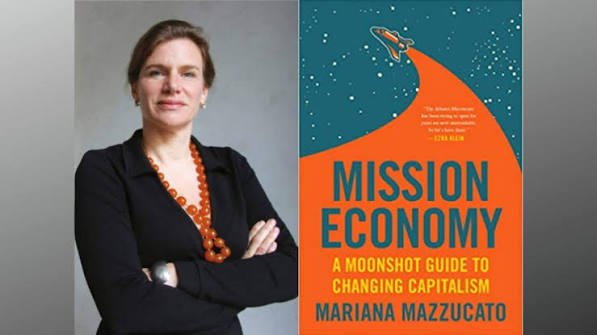
Mission Economy: A Moonshot Guide to Changing Capitalism, Mariana Mazzucato, 2021
As this book goes to press (during COVID-19), the problems being faced by both the USA and UK are the result of forty years of weakening ability to govern and manage — fueled by the ideology that government needs to take a back seat and only come in to fix problems when they arise. (like bail out the financial sector in 2008). A public management creed that belittles the ability of government to act effectively and promotes privatization has fostered much outsourcing of government capacity to the private sector and a relentless but misguided focus on static measures of efficiency, leaving governments with fewer options and even latching onto unrealistic technology panacea such as artificial intelligence or ‘smart cities’. It has also led to lower investment in public capabilities, the loss of institutional memory and an increased dependence on consulting companies, which have benefited from billions in government contracts.
In the UK, the government outsourced health contracts worth £9.2 billion in 2018 alone. Over 84 percent of care home beds are in privately owned homes, and 50,000 of those are beds in homes run by private equity (PE) companies those ultimate aim is profit, not care…The total value of the public-health grant in the UK — which enables local authorities to provide vital health care and preventative services — has been declining in real terms, from £4 billion in 2015 to £3.2 billion in 2020/2021, a decrease close to £900 million.
I call this (Apollo) different way of doing things a mission-oriented approach. It means choosing directions for the economy and then putting the problems that need solving to get there at the centre of how we design our economic system. It means designing policies that catalyze investment, innovation and collaboration across a wide variety of actors in the economy, engaging both business and citizens. It means asking what kind of markets we want, rather than what problem in the market needs to be fixed. It means using instruments such as loans, grants and procurement to drive the most innovative solutions to tackle specific problems, whether those be getting plastic out of the ocean or narrowing the digital divide. The wrong question is: how much money is there and what can we do with it? The right question is: what needs doing and how can we structure budgets to meet those goals.
Changing capitalism means changing both how government is structured and how business is run — and how public and private organizations, and relationships between organizations, through a notion of ‘purpose’ is the key to a mission-oriented approach.
By 2018, private debt to GDP reached 150 percent in the USA, 179 percent in the UK, 200 percent in France and 207 percent in China — all substantially higher than levels at the turn of the century.
And much of business has been plagued by a dangerous combination of low investment, short-term management and high rewards to shareholders and company bosses.
Today, China, the leading authoritarian economy, remains weighed down by inefficient and heavily indebted state industries, a banking system with huge ‘zombie’ loans, an ageing population, and the massive task of shifting the economy away from excessive export dependence and towards greater domestic consumption…But a central planning model is not likely to be one that will be able to take on the bold reforms to public and private collaboration that this book envisages.
To grasp the true scale of this challenge, it is important to understand that the issues described above are the consequences of deeper forces that together have led to a dysfunctional form of capitalism. There are (at least) four key sources of the problem: (1) the short-termism of the financial sector, (2) the financialization of business, (3) the climate emergency, and (4) slow or absent governments. In each, the way that organizations are structured and how they relate to each other are part of the problem. Their restructuring must, therefore, be part of the solution.
Over the same period (2008-2019), six of America’s biggest airlines spent an average of 96 percent of their free cash flow on stock buybacks — the aircraft manufacturer Boeing spent 74 percent of its free cash slow on stock buybacks — which didn’t deter these companies from asking for federal government help when the COVID-19 crisis struck.
The 2019 Intergovernmental Panel on Climate Change report argues that we have just ten years left until climate breakdown is irreversible. COVID-19 made us even more aware of the fragility of our environment and an economic system dependent on it. The climate emergency is very much a result of the four other problems in finance and business: fossil fuels still dominate our energy sources, industries are too carbon intensive, the financial sector has fed the fossil-fuel-driven economy, and government is nurturing this dysfunctionality – in 2019, extraordinarily, subsidies to fossil-fuel companies were estimated at $20 billion a year the the USA and an enormous €55 billion a year in the European Union (EU). Of the COVID-19 recovery funding allocated to energy companies by G20 governments, 56 percent has been handed to fossil-fuel projects, equivalent to $151bn (£119bn).
The problem is not ‘big government’ or ‘small government’. The problem is the type of government: what it does and how.
Mission Economy is about how government must change from within in order to deliver on ambitious outcomes, as well as how it must change its interaction with other actors. The current state of the typical instruments used by governments, such as taxation, fiscal policy and monetary policy, is rudderless. There is no systemic directionality towards de-financialization or sustainability. No attempt to change the relative cost structure through the tax system and other instruments to gear investment towards elimination of waste, reducing materials and energy use and pollution. Why are we not seriously taxing the environmental ‘bads’ and favouring ‘green’? Why are capital gains taxed less than income from work? Why is there no clear benefit for investing long-term rather than short-term? Why is nothing done to stop doubtfully legal high-frequency trading as well as the harmful practice of excessive share buybacks? Why is there no attempt to redesign the welfare state to respond to the new conditions created by the digital technologies?
But once a proper direction is systemically applied to the whole range of policies, leading to synergies in innovation and investment behaviour across the economy, government still needs to do much more. It must transform itself into an innovating organization with the capacity and capability to energize and catalyze the economy to be more purpose-driven.
