Michael Ondaatje – Coming Through Slaughter + Herodotus

Happy Birthday. Michael Ondaatjie is 62 years old today (Sept 12).

The past is still, for us, a place that is not safely settled – Michael Ondaatje

Michael Ondaatjie Michael Ondaatje
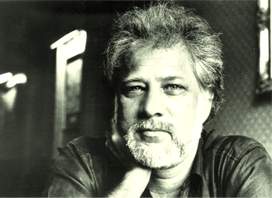
(Photo by Adam Elder via)

One of his beloved books “Coming Through Slaughter” is a fictional story of New Orleans, Louisiana about 1900, very loosely based on the lives of jazz pioneer Buddy Bolden and photographer E. J. Bellocq. Winner of the 1976 Books in Canada First Novel Award.
New Orleans and vicinity at the turn of the century is the setting for the novel. Consider the places where the action occurs: N. Joseph’s Shaving Parlor, the river, Shell Beach, the Brewitts, Webb’s cottage, the streets of Storyville, Bellocq’s studio, Bolden’s home with Nora and the children, the mental hospital.

He has given many interviews but the interview with William Dafoe

Michael became more open and revealing. He said, “I went into a tailspin after The Collected Works of Billy the Kid. I won an award for it in Canada and I went into this hole. So I wrote Coming Through Slaughter, which was a huge fury about fame. It was on a very small scale, but it was big enough. I mean, the thing is to continue to avoid being self-conscious. To write and forget that you wrote other books.”
“I have a tendency to remove more and more in the process of editing. Often I’ll write the first chapter last, because it sets up the story. The last thing I wrote in Coming Through Slaughter was “His geography,” almost like a big landscape shot, with buried clues you can pick up later. ”

On the genesis of plane crash image for English Patient:

“WD: Where did you get the central image of the plane crash, do you even remember?
MO: I just got the image and it was there. The artist, Joseph Beuys, was in a plane crash in the far north, not in the desert, but I already had this image in my head. It was one of those things where I’d heard about Beuys and his obsession with felt and that worked its way in too. That was enough. I didn’t need to know anymore. The medicine man… ”
He then continues to talk about Herodotus, Charles Olson and Robert Creeley.
“MO: I had already read some of him. Then there was a reference to him in one of the explorer’s desert journals; one guy who said, “I was responsible for our library on one of our expeditions. But our library was only one book, Herodotus” And I thought that was great, because he was an historian writing about a place where these guys are many hundreds of years later. The idea of a contemporary history and an ancient history that links up… These explorers in the 1930s were out of time. I love the idea of them checking out sand dune formations. I love historical obsessives. And I kept thinking of writers like Charles Olson and Robert Creeley in some odd way. Creeley in his toughness, brittleness and lovely guarded lyricism was a clue for me about the patient, Almasy. And this wonderful, heroic era of exploration that was then ignored, while the twentieth century became more mercenary or mercantile. Also Herodotus’ sense of history is great because it’s very much based on rumor. “

The End Judges Everything by Herodotus (with original greek text)
The world according to Herodotus
Herodotus’ Histories

Michael O. shares birthday with these two historical figures.
Lorenzo di Medici
9/12/1492 – 5/4/1519
Florentine ruler (1513-9)

Francis I
9/12/1494 – 3/31/1547
French king and patron of the arts and scholarship (1515-47 )
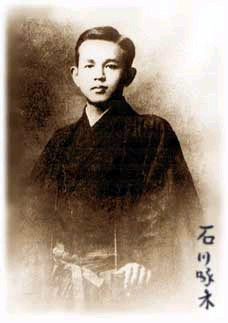
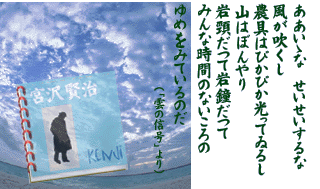
Miyazawa Kenji – Ishikawa Takuboku – Two Japanese poets from Iwate

Ishikawa Takuboku Ishikawa Takuboku
Roma-ji diary translated by Donald Keene

A Spoonful of Cocoa

I know
The sad heart of the terrorist-
A single-minded heart
Which finds it impossible to cut asunder speech and act,
A heart that wants to speak with deeds
Instead of words, which one has been deprived of,
A heart that hurls at the foe the body encasing it-
This is the sorrow serious and fervent men forever have.
Sipping cold cocoa from a spoon
After some eternal endless debate,
I know from this slightly bitter taste
The sad sad heart
Of the terrorist.

(Poem received from Hal – via email. This poem from a series of poems called The Whistle and Whistling–yobuko to kuchibue around 1911 very influenced by russian socialist, was ill at the time of poem)

Matt who lives in Japan blogged about the above poem, here.

Two renowned and beloved Japanese poets came from the same region Iwate ken.
Both born poor, excelled in school and suffered illness, one died at the age of 26, another at 37. In spite of their humble origin, both received excellent education, learned English, played music. Takuboku read Gorky and Ibsen and tried his translation of Ibsen’s work.

Takuboku according to Donald Keene was an enfant terrible who wasted his extraordinary gift. Although the western word “Terrorist” appeared in katakana in his poem, he was an apolitical poet, who was isolated, anti-social and prone to unhealthy dose of introspection and self-loathing.

Miyazawa went to the same school and followed in Takuboku’s footsteps to become a poet. But unlike self-involved Takuboku, Miyazawa cultivated a life as a thinker, a practicing buddhist, a geologist/agronomist, and idealsitic educator and reformer.

Miyazawa Kenji anime
gif

Kenji Miyazawa was born on Aug 27, 1896. Today he is known mostly for writing children’s stories.

“In the introduction to his collection of short stories, The Restaurant of Many Orders, he set himself up as an experimental medium for the chaotic processes of natural phenomena. He saw himself as a simple vehicle for reprocessing nature itself. “These stories of mine,” he wrote in 1923, “all came to me from moonlight and rainbows, at places like railroad tracks and fields and forests.”
Kenji Miyazawa, Rebel with a Cause (collection of essays)

From Who is Kenji?
Kame neko (oven cat- a sample story by Kenji Miyazawa)

All about Kenji – (more formal page from Hanamaki city)

VISIONS OF IHATOV: KENJI’s SPRING, read here.
(Kenji’s influence on the Japanese Anime culture.)

Miyazawa Kenji (image source)
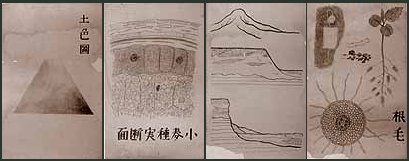
Drawings by a buddhist/poet/geologist/agronomist/socialist

Stanley Kunitz – Furious Change for 100 Years + Mark Doty

“For most of a century, Stanley Kunitz has cultivated generations of poems—and poets, The Gardner by Dana Goodyear. (New Yorker Magazine)

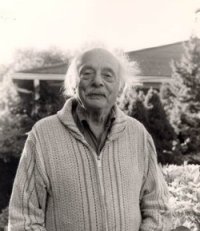
Stanley Kunitz

“In Roethke, Kunitz found someone with a similar set of psychological and poetic concerns—the lost father (just before Roethke’s fifteenth birthday, his father had died, of cancer) and the botanical world (Roethke’s family operated greenhouses). They also shared a sense of isolation: Roethke called himself “the oldest younger poet in the U.S.A.,” and Kunitz felt the same. Eliot, Pound, Williams, and Stevens had had a paralyzing effect on the generation that came afterward. “It was difficult to be a poet if you were born at the beginning of the twentieth century,” Kunitz said.

On July 29th he celebrated his 100th birthday, from here.
Video files – Watch and listen – 3 poems
The Layers, Touch Me, Passing Through.

“The Quarrel” by Stanley Kunitz & Robert Motherwell, 1983, a poem and a painting via here.

More poems by Stanley K.

Mark Dody dedicated this poem to Stanley on his birthday two years ago.

Heaven For Stanley

For his birthday, I gave Stanley a hyacinth bean,
an annual, so he wouldn’t have to wait for the flowers.

He said, Mark, I have just the place for it!
as if he’d spend ninety-eight years

anticipating the arrival of this particular vine.

I thought poetry a brace against time,
the hours held up for study in a voice’s cool saline,

but his allegiance is not to permanet forms.
His garden’s all furious change,

budding and rot and then the coming up again;

why prefer any single part of the round?
I don’t know that he’d change a word of it;

I think he could be forever pleased
to participate in motion. Something opens.

He writes it down. Heaven steadies
and concentrates near the lavender. He’s already there.

(School of the Arts Poems by Mark Doty)

In Memory of My Feelings – Frank O’Hara

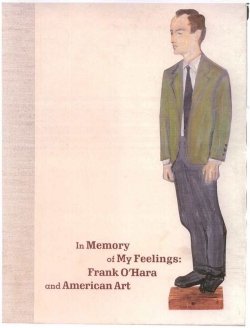
Frank O’Hara as New York Poet, Museum Modern Art Curator, Art News critic, occupied a central stage in the 50’s to 60’s art world. Larry Rivers described him as a professional hand holder and his fee was love.
Both NYTimes and wikipedia records June 27 as Frank O’Hara’s birthday. His actual birthday was March 27. He was an Aries and not a Cancer. (via “The Life and Times of Frank O’Hara by Brad Gooch). Poems he wrote about his birthday only reinforced the misinformation created by his parents to cover up the fact he was conceived before their marriage.

Frank O’hara Frank O'hara (via) By Alex Katz

In Memory of My Feelings

And now it is the serpent’s turn.
I am not quite you, but almost the opposite of visionary.
You are coiled around the central figure,
the heart
that bubbles with red ghosts, since to move is to love
and the scrutiny of all things is syllogistic,
the startled eyes of the dikdik, the bush full of white flags
fleeing a hunter,
which is our democracy
but the prey
is always fragile and like smething, as a seashell can be
a great Courbet, if it wishes. To bend the ear of the outer world.

When O’Hara wrote this poem he never worried about democracy in America, but words like ” the bush full of white flags fleeing a hunter, which is our demorcracy ….” pop out with strange effect for today’s readers.

“He was inspired and energized by New York City as other poets have been inspired and energized by nature. In Meditations he wrote, “I can’t even enjoy a blade of grass unless I know there’s a subway handy, or a record store or some other sign that people do not totally regret life.” (These words were inscribed on the railings at the Battery Park alongside Walt Whitman’s poem) He described his work as “I do this I do that” poetry because his poems often read like entries in a diary, as in this line from ” The Day Lady Died“: “it is 1959 and I go get a shoeshine.”
“He was our Apollinaire.” Philip Guston said at Frank’s funeral. Edward Gorey who was his roommate at Harvard said that he was living on the edge. Like Pasolini they both received injuries on the beach, though O’Hara’s was a freak accident and not murder.

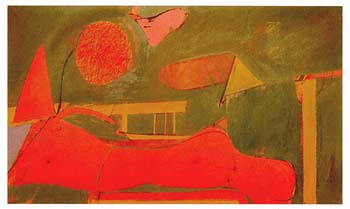
Summer Couch Willem De Kooning by De Kooning

“Well, I have my beautiful de Kooning
to aspire to. I think it has an orange
bed in it, more than the ear can hold ” (via)

O’Hara died of injuries he received when he was hit by a vehicle on the beach at Fire Island. (via)
De Kooning,who had arrived with a big checkbook offering to pay for everything, found Frank O’Hara in great pain….”De Kooning came out crying” recalls a friend. “I ‘ve never seen him like that , just weeping. When we went in we realized Frank was not going to live. He looked like a Francis Bacon.” (page 463, The Life and Times of Frank O’Hara by Brad Gooch)

A Tribute to O’Hara (via – many other great links are included from this page)

Autobiographia Literaria and many more famous poems, in here, for funny read Lines for the Fortune Cookies.

“The Last Clean Shirt” – a film by Frank O’Hara and Alfred Leslie.
Morning a blog entry of Frank’s poem last year.

“On Rachmaninoff’s Birthday” is featured at Point and Counterpoint with Frank O’Hara, Part III (Ting Alley)

Him – e.e. cummings + Fibonacci

“next to of course god america i
love you land of the pilgrims’ and so forth oh
say can you see by the dawn’s early my
country ’tis of centuries come and go
and are no more what of it we should worry
in very language even deafanddumb
thy sons acclaim your glorious name by gorry
by jingo by gee by gosh by gum
why talk of beauty what could be more beaut-
iful than these heroic happy dead
who rushed like lions to the roaring slaughter
they did not stop to think they died instead
then shell the voice of liberty be mute?”

He spoke. And drank rapidly a glass of water

e.e. cummings

” No poet deserves praise for remaining a poet. Yet in looking back on the war years I see only one American poet who kept his humanity and his poetry, and that man is Estlin Cummings.” Alan Tate (from the back of the book 100 Selected poems e. e. cummings).

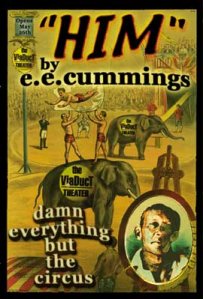
The Viaduct Theater Proudly Presents “Him” by E.E. Cummings
E. E Cummings Him by e.e.cummings
“You have to admire the Viaduct for attempting this almost impossible play – which requires some 20 actors, a live band, a re-creation of carnival oddities and a constantly changing set and frame of reference.” Chicago Sun-Times: Hedy Weisscaption
The play runs till June 25.

More on Him

e. e. cummings the painter
(“He painted all day when the light was good,” said Kostelanetz, “and wrote poetry at night.”
“He actually painted more than he actually wrote,” said Sawyer-Lucanno. )

pity this busy monster, manunkind,

not. Progress is a comfortable disease:
your victim (death and life safely beyond)

plays with the bigness of his littleness
— electrons deify one razorblade
into a mountainrange; lenses extend
unwish through curving wherewhen till unwish
returns on its unself.
A world of made
is not a world of born — pity poor flesh

and trees, poor stars and stones, but never this
fine specimen of hypermagical

ultraomnipotence. We doctors know

a hopeless case if — listen: there’s a hell
of a good universe next door; let’s go

— e. e. cummings

e. e. cummings published 95 Poems in 1958 (Norton).
This was the last book of new poems published in Cummings’s lifetime.
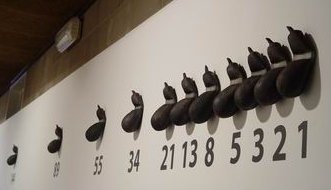
On the number 95
Fibonaci number and this from the Math site.
Leonardo Fibonacci discovered the series which converges on phi

Fibonaci Painting by David

I know what I like (Fibonaci flash wonderful from textism)

Minimal Aubergine Fibonaci from Belgium, not mutating rather stiff
eggplants.

Fibonaci aubergine fibonaci aubergine

Jean Vigo + Satyajit Ray+ Mixed Alphabet Soup

Love on the Water
“It’s a modest, everyday story without any big themes or grand spectacle. So what makes Jean Vigo’s film L’Atalante unforgettable?
“To this day, there is a Prix Jean Vigo in France for exceptional talent and resolve in the very young, and it derives from an urge in Vigo to make his films quickly, before he might be dead. ”

Jean Vigo shared a birthday with Shakespeare and Wittgenstein.
Happy 100 years from a blogger on Vigo
A clip from L’atalante animated.

Bark
Digital photo – Bark & Bark Form W.

Satyajit Ray‘s birthday today. The Apu Trilogy beautiful, moving masterpieces and must see if you have not.
“Like Renoir and DeSica, Ray sees that life itself is good no matter how bad it is. It is difficult to discuss art which is an affirmation of life, without fear of becoming maudlin. But is there any other kind of art, on screen or elsewhere? “In cinema,” Ray says, “we must select everything for the camera according to the richness of its power to reveal. (Pauline Kael).

Located a poem by Howard Nemerov that I was looking for.
(see Diane Arbus)

To D–––, Dead by Her own Hand

My dear, I wonder if before the end
You ever though about a children’s game –
I’m sure you must have played it too – in which
You run along a narrow garden wall
Pretending it to be a mountain ledge
So steep a snowy darkness fell away
On either side to deeps invisible;
And when you felt your balance being lost
You jumped because you feared to fall, and thought
For only an instant: That was when I died.

That was a life ago. And now you’ve gone,
Who would no longer play the grown-ups’ game
Where, balanced on the ledge above the dark,
You go on running and you don’t look down,
Nor ever jump because you fear to fall.

–Howard Nemerov-
(from Modern Kicks)

A Lesson in Breathing We Loved , We Still Love

Robert Creeley
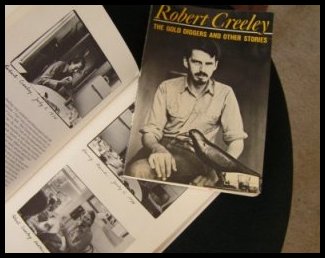
The above image shows two books by Robert Creeley, the one pictured is Elsa’s Housebook which I bought on my first trip to Boston. Read and see two terrific photos from Elsa Dorfman.

Found this poem “Creeley Led” by Crag Hill, here.

(Bresson’s Movies is a poem many love and are now going around the blogosphere. Bresson sounds like a lesson in Breathing, who is Bresson? )

Bresson’s Movies

A movie of Robert
Bresson’s showed a yacht,
at evening on the Seine,
all its lights on, watched

by two young, seemingly
poor people, on a bridge adjacent,
the classic boy and girl
of the story, any one

one cares to tell. So
years pass, of course, but
I identified with the young,
embittered Frenchman,

knew his almost complacent
anguish and the distance
he felt from his girl.
Yet another film

of Bresson’s has the
aging Lancelot with his
awkward armor standing
in a woods, of small trees,

dazed, bleeding, both he
and his horse are,
trying to get back to
the castle, itself of

no great size. It
moved me, that
life was after all
like that. You are

in love. You stand
in the woods, with
a horse, bleeding.
The story is true.

“To Bresson, add Creeley (a Robert to a Robert, as shown by the witty enjambment of lines one and two). The poem puts the poet in the picture, and a binary lyric system prepares to close. But not yet, not quite.” (read from here)

“We see, for instance, that collaboration has not been a sideline for the poet, but rather, that Creeley has consistently built many of his strongest poems out of relationships with visual artists.” (Read more here.)

Collage
Still Life with Donald Saltan
Collaborating with Gary Indiana and with Francesco Clemente , more here.

“For any young readers out there start with his early book FOR LOVE and keep going. The work expands over a rich & full life.” (from Patti Smith site, a tribute by Ann Waldman).

From Alan Sondheim, “He taught the value of the word and the spaces that fell through so that the poem disappeared.” (read more here. )

Darren Hughes just posted on his blog the release of Bresson’s
donkey film au hazard Balthazar from the Criterion Dvd Collection.

Goodbye – Robert Creeley RIP+Vincent & Nina

(This sad news came from Ron Silliman’s blog. More here, and here.)

Black Mountain poet fired by an elemental energy (from the Guardian)

Goodbye by Robert Creeley

Now I recognize
it was always me
like a camera
set to expose

itself to a picture
or a pipe
through which the water

might run

or a chicken
dead for dinner
or a plan
inside the head

of a dead man.
Nothing so wrong
when one considered
how it all began.

It was Zukofsky’s
“Born very young into a world
already very old…”
The century was well along

when I came in
and now that it’s ending,
I realize it won’t
be long.

But couldn’t it all have been
a little nicer,
as my mother’d say. Did it
have to kill everything in sight,

did right always have to be so wrong?
I know this body is impatient.
I know I constitute only a meager voice and mind.
Yet I loved, I love.

I want no sentimentality.
I want no more than home.
(Poem is from here).

Van Gogh
Vincent van Gogh was born in Groot Zundert, The Netherlands on 30 March 1853, (from here.)
Read his Letters on his birthday.

Read this article today. Olivier Assayas said, “Maggie is a mystery,” he says, finally. “I don’t know if I ever fully understood her. I thought I did, but she’s even more of a mystery to herself.”
A parting gift for Maggie (from here.)

Another (the) Long Goobye took place in Arizona.
Funny Long Face says goodbye to Nina this morning.

Lost Frog in the Thick of Blog Fog – Basho & Fernando Pessoa

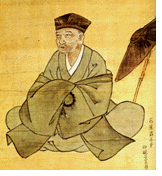
Basho Basho
Basho is said to have become enlightened after hearing a frog jump into a garden pond (from googlism).
Ponder this, the pond may not be the best place to find a competent translation of the Basho’s haiku.
Check out these great minds struggling with the translation here.

Alan Watts liked Plop and Ginsberg liked Kerplunk. Or notice how Edward Seidensticker and Donald Keene compete in their free association with the word “old”, as Seidensticker chose “quiet” and Keene chose “ancient”.

Pessoa 1pessoa

Or take a look at 16 ways to translate Fernando Pessoa’s poem Autopsychography here.
At least it is not about a lost frog. (It is about a poet who fakes, lies, invents and pretends).
<> <> <> Multiple Pessoa here

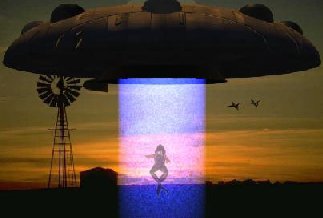
Frog abducted Frog abducated by Aliens by Aliens

Here is a website seriously looking for a frog, him name is Hopkins.

More fun links are added on the sidebar menu under frog .

Knots – R.D. Laing + Drawing by Louise Bourgeois

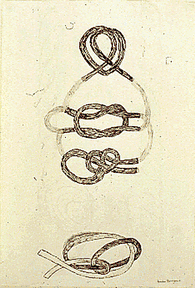
Drawing by Drawing by Louise Bourgois Louise Bourgeois.

Positive and Negative Binds

Negative: Can’t win. Everything I do is wrong.
Positive: Can’t lose. Everything I do is right.
I do it, beacuse it is right.
It is right, because I do it.

They are playing a game. They are playing at not playing a
game. If I show them I see they are, I
shall breake the rules and they will punish me.
I must play their game, of not seeing I see the game.

Knots by R.D. Laing

“The specifically human feature of human groupings can be exploited to turn them into the semblance of non-human systems. ….All those people who seek to control the behaviour of large numbers of other people work on the experiences of those other people. Once people can be induced to experience a situation in a similar way, they can be expected to behave in similar ways. Induce people all to want the same thing, hate the same things, feel the same threat, then their behaviour is already captive – you have acquired your consumers or your cannon-fodder.”
From Politics of Experience, ch.4 1967
More links here