His work is based on the ethics of the Other or, in Levinas’ terms, on “ethics as first philosophy”. For Levinas, the Other is not knowable and cannot be made into an object of the self, as is done by traditional metaphysics
Here are some photos of eleven good men whose lives were cut short with Aids. R.I.P
Klaus Nomi Derek Jarman and Tony Perkins in the middle.
Klaus Nomi died on August 6, 1983 – he was 39.
Perkins died on September 12, 1992.. Berry Berenson (Perkins’ wife), was killed on American Airlines Flight 11 during the September 11 terrorist attacks in 2001.
Derek Jarman died In 1994 London, aged 52.
Arthur Russell died on April 4, 1992, at the age of 40
Foucault died in Paris on 25 June 1984, he was 58.
Tseng Kwo-Chiand Herman Costa having a blast at photobooth (Thanks Herman for this photo). Martin Wong with lunchboxes
Tseng and Martin – pride of Chinese Americans!
In 1990, TSENG died at age 39 in NY.
Martin Wong died on 12 August 1999 in San Francisco.. He was 53.
“All these years, I’ve felt Manhattan was just another island-jail. A bigger jail with more distractions but a jail nonetheless. It just goes to show that there are more than two hells. I left one kind of hell behind and fell into another kind. I never thought I would live to see us plunge again into the dark ages. This plague — AIDS — is but a symptom of the sickness of our age.” Reinaldo Arenas
The book opens with an extended discussion of Diego Velázquez’s painting Las Meninas and its complex arrangement of sightlines, hiddenness, and appearance. Then it develops its central claim: that all periods of history have possessed certain underlying conditions of truth that constituted what was acceptable as, for example, scientific discourse. Foucault argues that these conditions of discourse have changed over time, from one period’s episteme to another. Jean Piaget, in Structuralism,[1] compared Foucault’s episteme to Thomas Kuhn’s notion of a paradigm. Foucault demonstrates the parallelisms in the development of three fields: linguistics, biology, and economics.
These were culled from a variety of French philosopher Michel Foucault’s works – from the early “Madness and Civilization” (1965) through the last two published volumes of “The History of Sexuality” (1985-1986) – and some key essays …
In order:
1. Michel Foucault, cover illustration for Alan Sheridan’s ‘The Will To Truth’;
2. The Ship of Fools (‘Madness and Civilization’)
3. Marquis de Sade, by Man Ray (‘The Order of Things’)
4. ‘Las Meninas’, by Velazquez (‘The Order of Things’)
5. Friedrich Nietzsche, by Munch (‘Nietzsche, Genealogy, History’)
6. Don Quixote, by Picasso (‘The Order of Things’)
7. Jeremy Bentham’s Panopticon (‘Discipline and Punish’)
8. Jeremy Bentham (‘Discipline and Punish’)
9. Philippe Pinel (‘Madness and Civilization’)
10. Friedrich Hoelderlin (‘The Father’s “No” ‘)
11. David Ricardo (‘The Order of Things’)
12. Georges Bataille {‘Preface to Transgression’)
13. Jorge Luis Borges (‘The Order of Things’) (continue below)
(see more from youtube comment)
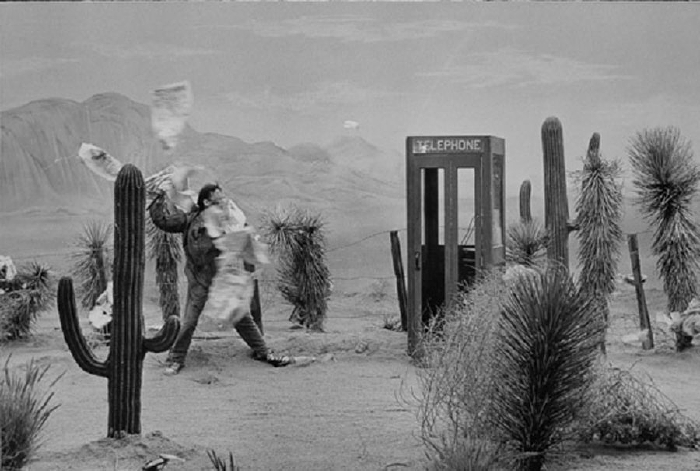
Michel Foucault sings his philosophy through a surreal collage landscape. The film is from a series of mini-musicals based on the works of the great philosophers.
A Conversation With Sophie Fiennes (OVER YOUR CITIES GRASS WILL GROW)
The film came about because I had met him on a few occasions through shows; his gallery knew that I liked his work. The gallery and he called me, somewhat spontaneously, saying “Come down to Barjac.” The gallery then called me back and said “He’s leaving Barjac… it’s an amazing moment and it is an extraordinary place. Why don’t you just come and see it?” So, it was a very loose invitation and when I got there I saw this extraordinary place. The filmmaker in me was completely challenged and there were so many possibilities somehow. I had to make a film there.
<>
Anselm Kiefer and Sophie Fiennes
Her mother’s death galvanised Sophie Fiennes, and now she has produced a brilliant documentary about the artist Anselm Kiefer .. (Times on Line UK)
Sophie is the sister of the movie star Ralph Fiennes.
Herman Hesse Statue at Calw
On Monday 2nd July 1877 at 18:30 Hermann Hesse was born in a flat on the second floor of Marktplatz 6, Calw, opposite the town hall, and lived there for the greater part of his youth.
“Gluck” means… luck, fortune, happiness. ‘The very sound of it’, Hesse says, ‘brings forth that feeling of lightness, life and joy.’
To study history means submitting to chaos and nevertheless retaining faith in order and meaning. It is a very serious task, young man, and possibly a tragic one. HERMANN HESSE, The Glass Bead Game
The deity is within you, not in ideas and books. Truth is lived, not taught – HERMANN HESSE, The Glass Bead Game
Ninon Hesse – an art historian who married Hesse and became very important in his life (photos here)
“God has two families of children on this earth, the once born and the twice born (today born again).” The former are born happy and view God as the animating spirit of a beautiful harmonious world. Examples for James were Ralph Waldo Emerson and Walt Whitman. The twice born James views as sick souls. These sick souls may find community, solace, and comfort in religion but they remain sick and should never be entrusted with power.
In Memoriam: a toast to some of those who left us in 2010.
Kazuo Ohno, Dennis Hopper, Claude Chabrol, Howard Zinn, Louise Bourgeois
David Markson, Sigma Polke, Henryk Gorecki, Jill Johnston, Arakawa Shusaku,
Arthur Penn, Jose Saramago, Benoit Mandelbrot, Nathan Oliveira, Takamine Hideko
and Denis Dutton
Denis Dutton, the author, academic and philosopher who saw the Web as a place where intelligent ideas could flourish, has died in New Zealand at the age of 66, according to New Zealand news sources. Dutton was raised in Los Angeles and was the brother of booksellers Doug and Dave Dutton of the legendary Dutton’s Bookstores in Los Angeles.
Denis Dutton is a philosophy professor and the editor of Arts & Letters Daily. In his book The Art Instinct, he suggests that humans are hard-wired to seek beauty. (Ted)
He has defended a universal definition of art—something that many theorists assumed was simply impossible. And he has advanced a theory that aesthetics have a universal basis in human psychology, ultimately to be illuminated by the processes of evolution. His ideas in this area are not meant to be the last word, but they lay out testable hypotheses, and point to many fields that can be brought to bear on our understanding of art.
”He saw that pompous and empty prose in the humanities had become an impediment to thinking, and initiated the Bad Academic Writing contest to expose it. ”
Steven Pinker from Edge.
Denis was a very sly, very funny, supereducated, and widely allusive lunch companion. He struck me as a natural bon viveur, someone who delighted in talking smack about those not present. His eye gleamed differently from other humanities professors I’d known, his shoulders lacked the obligatory apologetic slump.
What I love—Heidegger, organic food, government overreach—Denis clearly detested. I don’t care. What I learned from Denis, and at exactly the most precarious moment, is the lesson that’s on display every day at ALDaily.com: that one can be precise and brisk, and nuanced and weird, at no cost to either camp; and that the distinction, between the ivory tower and the real world is not only a false, but a callow one. To a new technology, Denis Dutton brought an ancient and enduring grace—the belief in a free and contentious marketplace in ideas. He is sorely missed.
Johannes Kepler was born on December 27, 1571, he was the first strong supporter of the heliocentric theory of Copernicus and the discoverer of the three laws of planetary motion. Kepler Nasa homepage
The chart drawn by Kepler.
(Recently discovered horoscope calculated by Kepler for an Austrian nobleman named Hans Hannibal Hütter von Hütterhofen, who was born in 1586.)
The Structuralist
A biography explores Claude Lévi-Strauss’ fascination with what makes cultures tick
In Claude Lévi-Strauss: The Poet in the Laboratory (Penguin Press, $29.95), Patrick Wilcken has written the biography not just of a man, but of an intoxicating intellectual moment.
Peter Singer’s thoughts on the ethics of consumption are amplified against the backdrop of Fifth Avenue’s posh boutiques. Slavoj Zizek questions current beliefs about the environment while sifting through a garbage dump. Michael Hardt ponders the nature of revolution while surrounded by symbols of wealth and leisure. Judith Butler and a friend stroll through San Francisco’s Mission District questioning our culture’s fixation on individualism. And while driving through Manhattan, Cornel West—perhaps America’s best-known public intellectual—compares philosophy to jazz and blues, reminding us how intense and invigorating a life of the mind can be.
Featuring Cornel West, Avital Ronell, Peter Singer, Kwame Anthony Appiah, Martha Nussbaum, Michael Hardt, Slavoj Zizek, Judith Butler and Sunaura Taylor. (via)
Sunaura Taylor (Astra’s sister) and Judith Butler on the street of San Francisco.
Going against the norm of “serious” documentaries tending to be depressing, Taylor here creates a film of substance that is nevertheless light on its feet. Neither the walking philosophers nor their conversations stop for a moment during Examined Life, so the result is physically and mentally energetic piece of filmmaking. And as the ideas in Taylor’s film are engaging and thought-provoking without being overly complex, we are left invigorated rather than bamboozled.
One of Taylor’s inspirations comes from Rousseau’s Reveries of a Solitary Walker – Scott McLemee
Professor Aoki introduced me to the writings of Paul Tillich, Soren Kierkegaard, Simone Weil, Camus, Martin Buber, Dietrich Bonhoeffer and others in his class at the University of Hawaii. He used to step on top of the podium and do the Zorba the Greek dance. His lectures were so moving that many of his students in class were often in tears. He was a Buddhist and a Christian and a cosmic dancer.
The Rev. Mitsuo Aoki helped countless people, particularly cancer patients and their families, with his compassionate outlook on dying.
“He was sought out a lot for his wisdom,” said the Rev. Clarence Liu, chaplain of Hospice Hawaii. “He lived his dying in the very same way that he shared about it and talked about it. There was great integrity and great truthfulness in the way he lived his life.”
Aoki, a theologian, minister and college professor who founded the religion department of the University of Hawaii at Manoa and served as an influential figure in the establishment of Hospice Hawaii, died Thursday at his Pohai Nani home in Kaneohe. He was 95.
Born in the plantation town of Hawi on Hawaii island, Aoki, known as “Mits,” attended the Chicago Theological Seminary and Union Theological Seminary.
According to longtime friend Rick Bernstein, who knew Aoki for 40 years, he was raised in the Jodo-shu Buddhist tradition and converted to Christianity in the 1920s. He was a recipient of Honpa Hongwanji Mission’s Living Treasure award and the Jefferson Award for outstanding community service.
Dying people are my people
In 1957 Reverend Aoki experienced an out of body experience when he had a car accident.
Ubuweb indexed Gradiva (26 min.) Raymonde Carasco’s film is finally available to the world at large.
Step by step, delusions escape us like a snake between two stones. The solemn, ritualized repetition of a maiden’s foot stepping on ancient stones has been described as a synecdoche, a trope by which the part represents the whole. The whole in this case is W. Jensen’s novel Gradiva, immortalized by Freud, Bréton and many later French intellectuals like Jean Rouch or Derrida. It is a story about a archeologist who is entranced by the of figure an ancient bas-relief depicting the walk of a young woman from Pompei. Shot with the assistance of Bruno Nuytten (known for his work with Duras), Carasco’s Gradiva is a poetic construction about the fetishization of desire, one that seems to go against Freud’s reading: the gracious movement of the maiden’s foot is seen to be the object itself, not a mere referent, of male desire. ..-Eye of Sound (Read more Ubuweb)
How can cinema reach the poetic truth of phenomena, how should the sensual description of appearances and particularities be converted into such a ‘magnetic song’?
We must thus go back to the very origin of Carasco’s quest. She did not set out for Mexico in the late 1970s in order to rape and pillage the imaginary of the Tarahumaras, but rather to follow the traces of Antonin Artaud, to empirically verify the encounter between a sacred text of modernity and its reality. With the result that her research does not comprise a classical type of investigation (to hide, discover, expose), but an alliance of the senses: to enjoy the privilege of being there, to accept that that she will never see everything, to acquiesce in the gradual revelation of only a few traces, to grasp some movements, some signs that testify to the beauty of friendship, before pretending to understand anything – to share not the secret but the cult of the secret, the cult of mystery and trance.
The words of the last of the Tarahumara shamans alternate with Artaud’s texts about Ciguri, the higher plane of consciousness they access through peyote rituals.