+

Mahjong: Contemporary Chinese Art

October 7th, 2008

Li Shun <> (Click to enlarge)
Rouge Flower - Silkscreen and Oil

141 works by 96 artists are represented in Mahjong:Contemporary Chinese Art from Sigg Collection now at Berkeley Museum.

Ai Wei Wei Han Dynasty Urn with Coca-Cola Logo (Click to enlarge)

Shi Xhinning Duchamp Exhibition in China (Click to enlarge)

Here more click through below,

Obssessive Memories - Liu Jiang Hua (In the mood for lost arms and body parts? Wong Kar Wai in porcelain).

Great Walls 2000 Years ago and Restaurant by Miao Xiao Chun

It looks like a landscape Liu Wei, Born 1989 in Beijing - Liu Wei

Wave by Li Song Song
(Mme Mao Tse Tung or Lady Maobeth and scarier than Sarah Palin, Chiang Ch’ing was another no talent actress when she met Mao. )

Opening Ceremony by Li Zhang Yan

Chen Zai Yan - Three Famous Xingshu Documents

Hai bo - They Recorded for the Future

Hon Hao Beijing No5

Mostly Mao here for this post, extremely narrow and biased selection, neverthless we must acknowledge that Mao was good for artists.

Yu Youhan (Click to enlarge)

Insiders View of China’s Art - Kenneth Baker

The collector explained that the Berkeley Museum’s architecture muddled the plan to have 12 thematic sections, which gave rise to the title “Mahjong.”
Uli Sigg: The exhibition concept doesn’t derive from mahjong, but it plays with it. It’s a game with 144 stones and you will have 12 groups of 12 stones. … Mahjong has been played since the Ming Dynasty and today it is played on the Internet, so it has a very large audience. It looks back into the past and also into the future. And the third element is that each time you play, the stones are combined differently, and as the exhibition travels, works will be combined in different ways.

A review from C-Monster

But here at Mahjong was a consumer vocabulary I could understand. There were fun clothes and bright constructivist posters and plastic tchotchkes, all sensationally over-obvious in their message. I wanted to buy, buy, buy!

Happy Rat Year

February 6th, 2008

Banksy dead rat (via)
Google Banksy Rat
Rat Dude is on sale.

Before Banksy there was Blek Le Rat

I am Blek le Rat. I am a French graffiti artist. I was one of the first artists to use stencils for an artistic purpose in Paris in the beginning of the 1980s—in ‘81 exactly. At first, I put rats and I made them run along the wall. I wanted to do a rat invasion. I put thousands all over Paris.

Between me and my heart there is nobody - Blek Le Rat on youtube

It is worth noting that the Rat Brigade did not discriminate on the basis of species.

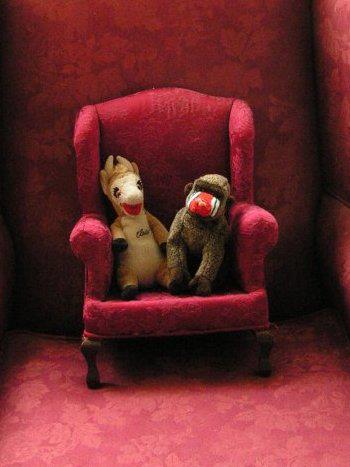
Monkey on high bike monkey on high bike
The above image from A Speculative History of Rat patrol

Chinese New Year Rat Happy Rat Year 2008

Chinese New Year 4706, which begins Thursday, is the Year of the Rat, which holds a place of honor as the first creature in the 12-year cycle of the Chinese lunar calendar.

Porcile and Earthly Delight - last Chinese New Year post

Update:Not everyone is celebrating New Year in China
<> <> <> <> <>Lunar new year 08 google gif

Nixon in China + Zhou En Lai

January 8th, 2008

Zhou En Lai greets Nixon. (Act I)

This funny opera was composed by John Adams, produced by Peter Sellers, and choreographed by Mark Morris.
Judging from these clips on youtube, Pat Nixon is the only non political person in the mix of power hungry world leaders, providing the audience with maternal warmth and humanity.

The Bad Boy provides us with more clips (one clip is missing).

As a big fan of the opera Nixon In China, I was so excited to find the following clips from it on YouTube. As the title implies, NIC is about the historic meeting between Richard Nixon and Mao Tse-tung. The composer, John Adams, once described it (jokingly) as an opera for “Republicans and Communists.” Well, I’m neither and I still love the hell out of it.

This third clip is one of my favorites. Kissinger (as Lao-Szu) whips a peasant woman half to death in a stage play. Pat Nixon comes to the woman’s aid and then the music gets better.

Nixon and Zhou En Lai (image source)

Today January 8 was the day China lost their beloved leader Zhou En Lai. in 1976.
How do you assess Zhou’s achievements in China’s tumultuous history?
Some accuse Zhou of going along with Mao and not protecting the Chinese people; others show gratitude to Zhou for saving China from Mao’s tyranny.
Zhou was first and foremost a survivor. Most of Zhou’s contemporaries died directly under the hand of Mao or died in mysterious accidents. Zhou alone, of his stature, survived. Mao was determined to outlive Zhou and did so by a few months.

Perhaps my favorite image of Zhou is from footage of Richard Nixon’s visit to China in 1972. As the US President blathered on about ‘friendship and mutual respect,’ the jaded premier shifted in his chair unable to contain a mighty yawn at the dog and pony show onstage. Zhou’s work with Kissinger was done and in the books. That had been the important part.
Perhaps, he was simply tired. (This date in history: The Death of Zhou Enlai)

Was he a tragic hero?

A sentimental eulogy to Zhou En Lai on youtube.

National Day in China

October 1st, 2007

Photography by Wang Ningde
Photograph by Wang Ning De

Today is the 58th Anniversary of People’s Republic of China.
A Chinese film depicting Mao Zedong founding the People’s Republic of China. Title unknown (From youtube)

The heroism of Burmese, the shame of China by Rosemary Righter (London Times)

When China joined Russia last January to veto a fairly mild United Nations Security Council resolution calling on Burma to free political prisoners and improve its abominable human rights record, Beijing’s Ambassador at the UN helpfully explained that “no country is perfect” and that “similar problems exist in other countries”. Including, as he of course did not say, China.

Looking for great photos of contemporary China?
Meeting Place Photo Beijin

Dance in a Small Town - Wang Nin De (Federico WangNinde Fellini)

Yoshiko Yamaguchi - The Manchurian Candidate

September 25th, 2007

Yoshiko Yoshiko Yamaguchi and Isamu Noguchi and Isamu Noguchi

She met Isamu Noguchi in New York in the fall of 1950. They were married in Japan in May 1952 (From Noguchi org.)

Yoshiko (Shirley) Yamaguchi (born 1920), is a noted Japanese film star, television reporter and politician. Yamaguchi’s parents were Japanese, but she was born and raised in Manchuria. After the Japanese invasion of Manchuria she adopted a Chinese name, Li Xianglan (in Japanese, Ri Ko Ran), and appeared in propaganda films and other movies produced by the Japanese for Chinese audiences. At the end of World War II she avoided execution for treason in China by revealing her Japanese identity, and then established a career as Shirley Yamaguchi in Hollywood and on Broadway.

She went through radical changes as she assumed new names, new locations and new professions.
As Lixiang Lang (fragrant orchid) she sung like Judy Garland. Persian bird(Перская птица) (ペルシャの鳥) sang by 李香蘭 (Interesting find from youtube - she appears in a Russian film)

How exciting! I just found out that my favorite filmmaker Kore eda is working on a bio-pic of Li Xianglan. (via Jason Gray)

Born in turbulent times, Li Xianglan lived a complex, controversial life in which everyone seemed to have experienced multiple identities.

“What was that war all about?” remains the fundamental question. For me, “Li Xianglan” often reminds me of my father and my mother, living in their memories that are an
integral part of their personal history. Telling the story of Li Xianglan is my personal tribute to the memory of my late parents (Kore eda from Night Fragrant Flower)

Fluent in Mandarin Chinese, she avoided being recognized as Japanese in Manchuria and when in Japan she hated to see the Japanese feelings of superiority to Chinese.
More here from an interview - Looking back on my days as Ri-kolan

As Yoshiko Yamaguchi she left the land where she grew up to start afresh in Japan.

Scandal Mifune Toshiro and Yoshiko Yamaguchi in Scandal - Kurosawa film Yoshiko with Toshiro Mifune in a Akira Kurosawa film.

As Shirley Yamaguchi she appeared in Hollywood films, one of them A House of Bamboo is a film noir directed by Samuel Fuller.

As Yoshiko Otaka, she ran for office and visited the Middle East and became an advocate for the Palestinian cause.

I went to Vietnam to report on the war. I saw the front lines in Vietnam, and next I became interested in learning what the Middle East War was all about. (Looking back on my days as Ri-kolan)

Here is her early years slide show on youtube interspersed with a story of Mao and Chang Ching.

Here is another film clip - A woman of Shanghai..

I (this blogger) was in this film as a film extra with other Chinese classmates when I was around 7 years old. Every morning a bus from film studio came and pick us up from our school in Tokyo. We did lots of running around in Chinese orphan costumes. We even had a song to sing.

This was my mother’s favorite song which is banned by the Chinese government today.
Suzhou is the theme song of a sequel of the popular 1940 movie “Xina no Yoru” (China’s Night). The song’s lyrics depict the separation of two lovers — a Japanese sailor and a Chinese female guerrilla fighting against Japanese invaders.

Of her life with Isamu Noguchi, she was in awe and overwhelmed by his severity and steadfast dedication to his craft, to his art and his vision. (This I pulled from my memory from her old interview she did in a Japanese magazine. Frieda Kahlo had an affair with Noguchi. Compared to Frieda, Yoshiko seems more conventional.)

Li Xiang Lang (Yoshiko Y.) and T.E Lawrence.

She visited the Middle East several times and in her report THE ARABS UNWRITTEN she wrote that she met a young Bedouin Sherif in Egypt whose uncle claimed that he had adopted T. E. as a son(!)

See Billy Rose Sculptural Garden designed by Noguchi in Jerusalem - one - two another side by side comparison to Yoshiko work as a politician for the Palestinians’ causes.

Ma Jun’s Television

August 17th, 2007

Mao’s Feet Ma Jun Mao's feet Porcelain

Tradition has become an obstacle of modern development. Consumers need not to care about tradition anymore. Modernization changed China greatly. Consumerism takes the place of the traditional art when the life style changes. Ma Jun described the change in his works “Porcelain Equipments” vividly. In his works, we could find both the artist’s memory of classic and his acceptance of consumerism, which are definitely the two aspects of modern urban life. (Via)

Ma Jun Television Porcelain

Here is a synopsis of imaginary tale of Chinese Porcelain “A Cup of Light” by Nicole Mones. (Scroll down)

More Ma Jun’s Television, cars, coca-cola and Chanel bottles here

Do you buy bottled water? Read this and think about the waste.
(Bicycle Mark drinks water from tap.)

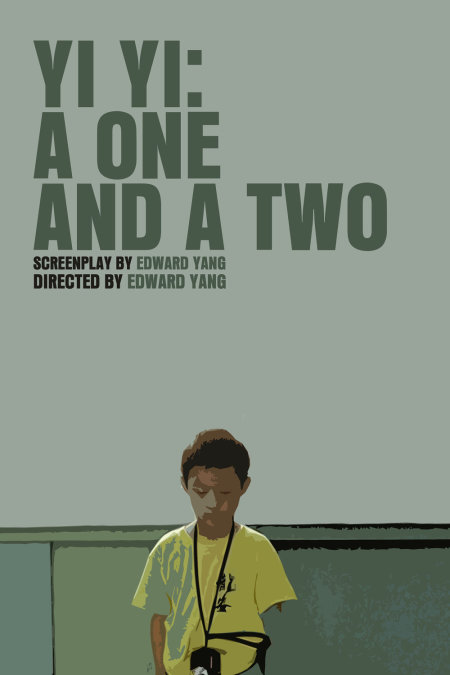
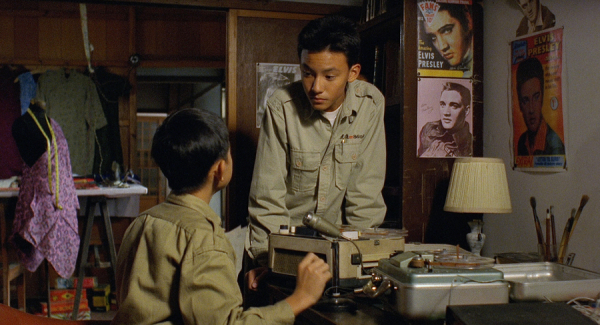
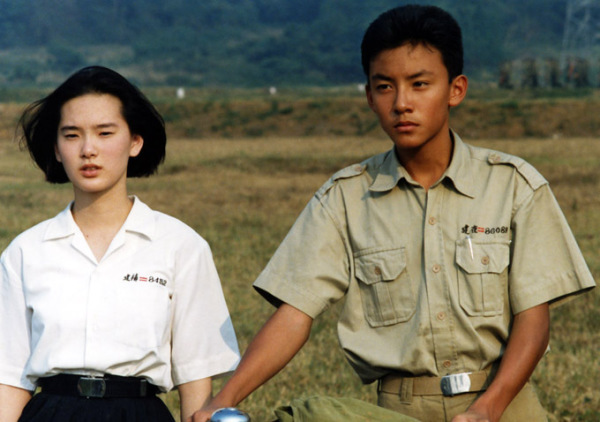
RIP Edward Yang

July 3rd, 2007

Edward Yang - 1947-2007

Yi Yi on youtube with Portugese subtitles. Here Issey Ogata plays Japanese Bill Gates type computer businessman.

The kid with a camera says farewell to grandmother here.

Obit from Steven Shaviro who has seen Edward Yang’s early films. Yi Yi is the only film released in USA.

I remember being stunned and blown away by The Terrorizer (1986) when I saw it at the Seattle Film Festival: sometime in the late 1980s. It was an elegant, beautifully meditative, and deeply unsettling exploration of urban anomie and alienation, paranoia, and random encounters; it played as if a Patricia Highsmith novel had been turned into a screenplay by Jorge Luis Borges, and then shot by Antonioni.

Edward Yang - a profile from Senses of Cinema.

Chinese Surname Shortage

June 13th, 2007

Chinese surname spark rethink

When everybody’s named the same, then who knows Hu’s Hu?’ (via)

In a country of around 1.3 billion people, about 85 percent share only 100 surnames, according to a nationwide survey conducted by the Ministry of Public Security in April and published in the China Daily newspaper on Tuesday.

Zhang Ziyi and Zhang Yimou
Chinese stars
In the middle is Tony Leung Chiu Wai and the bottom is Tony Leung Ka Fai

Fay Wong in Chungking Express directed by Wong Kar Wai or Kar Wai Wong.

Ang Lee who is now a respected American director shares his surname with Spike Lee. Spike Lee is not even Chinese. They were roommates when they studied filmmaking at NYU.

Zhang and Zhang the Chinese pair figure skaters took Silver at the 2006 Olympics (Youtube) The commentator said that they share the same surname but are not related.

The Road Home - Zhang Ziyi in her first film directed by Zhang Yimou

Actually Zhang Ziyi and Zhang Yimou have different chinese characters. In romanized they are the same.

The Soong Axis, Forgotten Dynasty

December 19th, 2006

Soong Sisters
Sisters and Actresses

Read about the Soong family featuring four famous American educated siblings, three of which were notorious for their corruption.

The Emperor, Brushes and Brice Marden

November 2nd, 2006

Today (Nov 2) is the birthday of a famous artist/poet/Taoist Emperor who lost his kingdom for his love of art, luxury and culture.

Emperor Huizong was born on November 2, 1082.

Emperor Huizong digital image by Fung Lin Hall

Zhao Ji (Emperor Huizong) was an artistic emperor ruled from 1100 to 1126 AD. The cost of his ardor for the art and fatuity in government affairs was grievous: when his capital fell into Nuchen hands in 1127, he was taken prisoner, spending the rest of his life in a remote, bleak, desolate land.
(from the History of Chinese Calligraphy)

Finches and Bamboo

Partial view of Court Ladies Preparing Newly Woven Silk from the Museum of Fine art Boston.

The Politics of Culture and the Culture of Politics, subtitle of this book from Harvard Press.

Emperor Huizong and Late Sung Northern China
Huizong was an exceptional emperor who lived through momentous times.

Here is a western painter who continued in the Chinese tradition and is going around in a media blitz today.
Joseph Duemer really wants to see Brice Marden at MoMa for his retrospective exhibition.

The exhibition shows him as an artist who has spent his career assiduously converting the rule-ridden zone of Minimalist abstraction into a capacious yet disciplined place, pushing it toward landscape and the figure while reconnecting it to its roots in Abstract Expressionism and beyond, in non-Western art. It makes perfect sense that one of the greatest influences on Mr. Marden’s recent work has been Chinese art, where originality is a much fuzzier, more nuanced concept. His inspirations include calligraphy, landscape painting, scholars’ rocks and ceramics. (Roberta Smith from NYtimes.)

Brice Marden
Brice Marden and his studio

Etchings to Rexroth.

Here is a harsh but entertaining review by Finch on Marden at MoMa.

Jackson Pollock would have headed for that tree a lot earlier if he had painted like Brice.
Brice was at the MoMA opening Thursday in a black wool hat, quietly the center of attention, apparently still wondering if his paintings were any good, looking for validation.
He should have been in the studio, trying something new. And maybe in another 20 years, he will.

(Finch does not appreciate Chinese art? Like Finches and Bamboo or baboons)

Brice and Bounty paper towel

“How I wish I had never read this article about Brice Marden’s intimate relationship with Bounty paper towels.” (via culturegirl)

Let’s hear from Brice himself.

Basically I decided to be a painter because I loved the lifestyle. Later, at Yale’s graduate school, I had Jack Tworkov as a teacher who would come in and say, “that’s a cliché on De Kooning,” “that’s a cliché on Kline,” and so on. And I said, “well, how do you get rid of it?” Then the next thing you know you’re living on the Lower East Side . It just happened overnight.

His sister in law was Joan Baez.

And when I got into New York, my scene was the folk scene. It wasn’t really at Max’s Kansas City, because at that time I didn’t really know any artists yet. And that’s when Dylan was going around Joanie. (from In Conversation Brice Marden with Jeffrey Weisse.)

Brice Marden and Emperor Huizong were brought together once before, here.
(He does have a great name: Brice Marden. With a name like that he could have been a movie star and a lot luckier than the ill fated Taoist Emperor.)

To Live in China - Yu Hua and Lu Xun

January 7th, 2006

High price to pay for China’s wealth reads this headline.
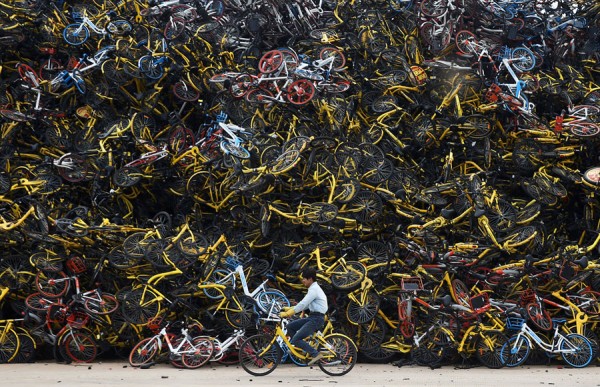
China is changing and the city people are abandoning bicycles for cars these days. Chinese automaker Geely plans to move aggressively to U.S. market by 2008.

Bikers byZhang Hongtu Zhang Hongtu or Mr Momao

Zhang Hongtu whose portrait of Mao’s last supper was featured last year when Jung Chang’s Mao book was released.

Picked up Yu Hua’s To Live from the library. It is a slim book for an epic story that was adapted to an award winning film with the same title by Zhang Yimou. Unlike the huge book on Mao by Jung Chang, Yu Hua’s light book was easy to carry on my bike. (The spouse had just finished reading Mao Tse Tung, since then he never stopped talking about Mao’s atrocity and monstrous acts on his people. He was a Sun Emperor who scorched everyone who came close to him. )

The differences of the novel and film adaptation are discussed from this review.

Film review “To Live’ as allegory of historical discourse” and this page with more photos and reviews.

A conversation with Yu Hua

This web page on Lu Xun was bookmarked about a week ago and the fate has it his name got repeatedly mentioned in the afterword section of Yu Hua’s To Live and also from the conversation from the above link.
Lu Xun wikipedia page is here.

Update: just stumbled upon on this review of Zhang Yimou’s new film “Riding Along for Thousand Miles” by Rob Smith. Zhang wrote this film for Takakura Ken a 74 years old veteran of Japanese cinema known in the west for the movie “The Yakuza” with Robert Mitchum.

Raise the Red Lantern & Mosuo Women - A Meditation on Contrast

September 20th, 2005

“Saturated in hothouse colors, the three-act “Lantern” is an intense dance-theater version of the multi-award-winning film by Chinese auteur Zhang Yimou (”Hero,” “House of Flying Daggers”). The stage version is as lush and fluidly cinematic as Zhang’s — which, ironically, was banned in China when it was released in 1991.” (LA Times)
Raised the Red Lantern

“Raise the Red Lantern is now a “Chinese Ballet making an American premiere this month in Berkeley and will be also at the Orange County Performing Arts Center for six performances beginning Tuesday. (The company then goes to the Kennedy Center in Washington, D.C., and the Brooklyn Academy of Music in New York.)
“Having seen and admired the film of the same name, I have to report that the ballet is entirely different and only the theme of female subjugation remains” (from past review when it showcased in England)

A few days ago BBC had this curious article about Mosuo Women in China - it says ” The Chinese region with women in charge
Matriarch

The two images from BBC.

Now read Mr. Zhang Jia in a comment to the blog Peking Duck referring to this same article.
“A huge fuss is made of the supposedly “matriarchal” Mosuo who live around Lugu Lake. The Mosuo were just one of a whole patchwork of local ethnic groups who had adapted in different ways to their environment. They mingled with Tibetans who practised polyandry [several brothers, one wife] and Han Chinese who still practise polygamy with their Da Laopo and Xiao Laopo. The Mosuo were a lot more than just a matriarchal society: to label them as some unique sexual social group is to misrepresent them as freaks. Unfortunately, they have attracted the attention of prurient tour group visitors who come thinking that they will be able to partake of casual sex in the name of a “walking marriage”.
If you want to read more about the traditional mix of Mongols, Mosuo, Pumi, Naxi and Tibetans in this area, try:
In the Footsteps of Joseph Rock

Edge on Dan Sperber talking about Anthropology.
“Anthropologists started studying themselves and trying to reflect on their own situation. It was a kind of reflective anthropology, which had a number of interesting aspects. I certainly don’t think it was useless although it became a bit obsessive. Parallel to these developments, were the post-structuralist and then post-modernist movements in the humanities and the social sciences, the development of “cultural studies,” and many anthropologists felt at ease in these movements. This produced a new kind of discourse, taking the study of other cultures as much as a pretext as a subject matter to be investigated in a standard scholarly manner. Again, some of the products of this appraoch are of genuine interest, but on the whole more harm has been done than good.”